Tuesday, February 21, 2012

Athletes are not heroes, but Gary Carter was

Gary Carter - Hall of Famer and hero
It was the middle of the night in late October 1986 and I was listening to the radio as I lay in my bed, in a dark, damp, dingy bed-sit in Dublin. I was feeling despondent - yes despondent - when Gary Carter delivered a serious shot of hope for the New York Mets and, thus, for me.

Fans of the Mets and the Boston Red Sox who are old enough remember clearly how that 10th inning of the 6th game of the 1986 World Series played out. As far as I'm concerned it was Carter and not Mookie Wilson nor Ray Knight, both of whom feature in the most famous clips from that game, who delivered the biggest blow for the Mets in that inning/game/series. It was Carter who spit in the eye of despair and sprinkled the Mets and their fans with hope.

Hope. That's what was missing in that last inning of (what would have been) that last game. When Carter got his hit he changed the mood. I could feel it from 3,000 miles away. I could sense it despite the fact it was 5:00 in the morning and despite my pitch black surroundings and I had nothing but a radio for company. I could feel that tingle and it was thanks to Carter, who declared: "We're not done."
____________
Read More:

Ireland used to produce baseball players

Mets' Irish groundskeeper calls it a day after 50th season

Trinity College research team makes breakthrough with cancer vaccine
_____________

I remember as I was listening to that inning unfold I kept thinking about Carter - how I'd actually never been fair to him; how I'd never really liked him. As my hopes mounted with the Mets' rally I kept asking myself what is it about me that I never warmed to Gary Carter? I had often considered what it was about Carter that  bothered me, but in that moment when he'd demonstrated - again - that he was a winner I turned the question around so that it was me that I was wondering about.

What was it about me that I couldn't take to Carter the way I did the other players on that team? I knew, but I didn't understand why. Carter's overt wholesomeness turned me off.

Carter stood out on that Mets team because he seemed too good to be true. He was never in the papers for the wrong reason. He never seemed to have anything bad to say about anyone. He didn't seem to curse, even. He always played hard. He was always smiling. What's not to like, right? Yet I didn't.

I was cynical and when I think back on it, what on Earth did I have to be cynical about? I was young and the world was my oyster, but for some reason I liked those players who were ... a bit edgy. Carter certainly was not edgy. Most of the Mets were Rock n Roll, but Carter was Christian folk music.

Everything I knew about Carter (and everything I've read and heard about him since) told me that Carter was a model ballplayer and a model citizen. I should have idolized him, but I didn't.

A few years ago I was listening to the Mets' radio announcers talking about their profession during a rain delay. The two announcers were talking about how players will confront the announcers when they make a critical comment.

Then Howie Rose said that only once in his career had he heard from a player after making a positive remark. It was Gary Carter. He had heard something Rose had said and sought him out just to say "Thank you." When I heard that story all I could think was, "What was wrong with me when I was 21?"

You'll often hear it said that athletes are not heroes. Well most of them are not, but by all accounts Gary Carter was. His performance on the baseball diamond was heroic. His attitude to life was heroic. His devotion to his family was heroic. His courage in the face of the brain cancer that took his life was heroic.

Of all the tributes to Carter that I've heard and read since he died last Thursday the most poingnant and most telling was from his often-troubled 1986 Mets' teammate, Darryl Strawberry who simply said, "I wish I could have lived my life like Gary Carter. He was a true man."

"I wish I could have lived my life like Gary Carter." He didn't wish he had played like Carter, but lived like him. Carter's example is something that Strawberry now sees as a model to follow. That's heroic.

Of course I didn't know Carter as Strawberry did, but in that one moment in 1986 he had an impact on me. He forced me to confront something in me that I thought needed correcting. Over time, as I grew up (okay, grew older) and I learned more about Carter the man I realized there was nothing to dislike in him. It was in me. He helped make me a better person. That's what heroes do.

{Photo from the Newark Star Ledger.}

Wednesday, February 15, 2012

Why on Earth is London hosting the Olympic Games?

Counting down the days/hours/minutes/seconds until the
London Olympic Games are opened
– in front of the National Gallery
London is hosting the Olympic Games this summer, but for the life of me I can't understand why. Why is London hosting the Olympics?

Back in 2005 when London "won" the bid to host this summer's Games, the British government - funders of this extravaganza - claimed that the games would cost the British taxpayers £2.4bn ($4.2bn). Inevitably the costs have risen. Now it's estimated that the games will cost anywhere from £9bn ($14bn) up to £24bn ($37bn).

Let's stick to the lower end of that scale and estimate the British taxpayers' final bill at around $20bn. Twenty billion dollars. Just in case you're not sure, yes, $20bn is a lot of money for the UK government. They have their own economic and budgetary problems, as yesterday's Moody's announcement highlights. So, again, the question again arises: why? Why is London hosting the Olympics?

I was in London yesterday. As the plane was taking me to the UK's capital I was wondering how much Olympic hype I'd be confronted by. I figured I'd see billboards at every train station, buses featuring huge Olympic ads and Olympic merchandise everywhere. I couldn't have been more wrong.

In fact, other than the ridiculous Olympic countdown clock in Trafalgar Square {photo} and one billboard at an Underground station {photo below} I saw virtually nothing shouting Olympics at me. Okay, one or two airlines had Olympic-themed ads around the city, but really, it was as if the Olympics were five years away and not five months.
____________
Read More:

Titanic commemorations will be bigger than the Olympics, say Fodor's

London to spend $960 million on Olympics security due to IRA and Islamists threat

Irish Olympic team gymnast was told twice that he'd never walk again
_____________

The lack of Olympic hype I experienced yesterday convinced me that Londoners don't need the Olympics to  believe their city is special. They already know it is. So, again, why? Why is London hosting the Olympics?

I understand why some cities want to host the Olympics. The Olympic Games can put a city/region on the map. Acting as host of the Olympics can showcase a city as a potential tourist destination and, maybe, if the games are deemed a success (and are they ever not these days?) maybe businesses will take a closer look a locating in the area. Atlanta made perfect sense to me in that way. Rio de Janeiro makes similar sense, I suppose.

But London? London doesn't need the Olympic Games to entice tourists. In fact, I suspect the Games will deter as many from visiting this summer as will ultimately turn up to watch. London is already one of the great cities of the world. I can't imagine there is anyone, anywhere who needs to see Synchronized Swimming or the Hammer Throw or the Modern Pentathlon from a London arena to be sold on the idea of visiting London.

Same goes for business, only double. I'd love to meet the corporate executive who opts to locate his operation in London having only considered such a move after catching the Weightlifting finals. Honestly.

So if the Olympics are not going to help bring tourists or new businesses to London then why is London hosting the Olympics?

Ad for official Olympic merchandise at a London Tube station
The funny thing is, the Olympics do have the potential to be a real negative for London. Whereas many thousands of visitors to London have experienced the oppressive heat of the city's un-airconditioned underground trains and hotel rooms, their experiences are mostly individual. That could change with the anticipated, excessive coverage of this summer's Games, which could bring this issue front and center to people all around the world. Unless ... the weather is miserable and another fact known to many of London's visitors is suddenly a big talking point for a global audience.

Then there are other possible pitfalls. I read the other day that Britain's stretched mobile phone and other telecomunications networks could crash during peak demand for internet services during the Olympics. What a great ad for London that will be – a global audience being told the UK's infrastructure can't cope with modern communication demands.

When the Olympic committee announced that the 2012 Games were going to be held in London Prime Minister Tony Blair called it a "momentous day" for London and Britain. It may well turn out to be exactly that, only in a London-is-really-falling-apart type way. {And let's not forget that Mayor Bloomberg tried to get the Olympics to come to New York, which would have been equally stupid for all the same reasons.}

Great cities should not want the Olympics. The Games are too costly, too intrusive, unneeded for promotion and potentially more damaging than beneficial. So, why, oh why, is London hosting the Olympic Games?

Tuesday, February 7, 2012

Ireland's leader Enda Kenny pays no price for bad-mouthing the Irish people

Ireland's Prime Minister Enda Kenny addressing the World Economic Forum in Davos, Switzerland.
Enda Kenny speaking at the
World Economic Forum
in Davos, Switzerland.
Ireland's Prime Minister Enda Kenny will be speaking at Harvard University on February 16 and if his past form is anything to go by, he will denounce the Irish people as a bunch of over-educated elitists in the hope of eliciting praise from the Harvard audience. Or something like that.

I can hear you from here. "This guy's nuts. No elected leader would do such a thing."

You may well be right about his upcoming Harvard appearance, but ten days ago Kenny did essentially that when he 'explained' to a gathering in Davos, Switzerland that the Irish people "went mad borrowing," which led to "a spectacular crash" in our economy.

When I heard what the Taoiseach had said I was gobsmacked. I fully expected there to be political uproar in Ireland. At a minimum I was expecting him to be forced into some form of ignominious climb-down. I was sure there would be blood.
____________

Read More:

Bill Clinton to host New York round-table forum on Irish economy this week

Irish leader Enda Kenny was unfairly slammed for telling the truth

Ireland's Prime Minister Enda Kenny – the wrong man at the wrong time
_____________

I was wrong. A few people made noise arguing that the Taoiseach was wrong, but some popped up to back-up Kenny including the editor of The Irish Times.

Within a few days it was all over. Done, dead, forgotten. The firestorm I anticipated less than a lighted match. Once again I totally misread the political mood of the Irish people.

It wasn't what Kenny said that I thought would excite people. It was where he said it and to whom.

Sure there was some truth in what Kenny said. Many of us did "go mad." There was a fever here in the years running up to 2006/07. People - regular people, not millionaires or whatever - were desperate to own that second home to rent out or to own an apartment in Bulgaria or Croatia. There were ads on the radio from law firms and businesses offering their legal, translation and other services to people keen to own that little slice of the Baltic region. Others spent like there was no tomorrow, usually on their credit cards. I didn't understand it then and I understand it even less now.

However, the madness of the people was more a symptom than a cause of our troubles. And what, exactly, caused our troubles you may well ask?

The old saying holds that success has a thousand fathers and failure is an orphan. Well, in Ireland our orphan - the economic failure - has a thousand paternity suits. Nobody is claiming the baby, but a lot of people are pointing the finger at those who might be the father.

The truth is there were many factors that led to our collapse. Our bankers, our regulators, our central bank, our government, even ourselves all failed to keep in check what should have been kept in check. Too many impulses were allowed to run riot.

However, some of the factors that drove us into this dismal state were external. The people who designed the euro failed Ireland. Europe's banks - the kingpin drug dealers who fed our banks' habits - failed Ireland. The European Central Bank and other European regulators failed Ireland. EU economists and civil servants failed Ireland.

And it was this latter group who were in the audience that day when Kenny pointed the finger of blame as those at home. I still can't believe he did that.

Only a short eight weeks earlier Kenny had gone on live prime-time television to tell us we weren't to blame, but we'd have to shoulder the costs. If he believed it was the fault of the Irish people, that our "greed" got the better of us, he should have said so in that television address. He would have annoyed some people, but many would have acknowledged there was some truth in his view. He would have been seen as providing some leadership.

He didn't do that however. No, he waited until he had an audience of wealthy fat cats, many of whom were complicit in what happened here and whose bone-headed investments in our banks the Irish people were covering, to explain that it was the Irish people's fault.

Implicit in his speech was that those bone-headed European bankers were not to blame. Eurocrats - in the clear too. Same goes for all those involved in the design and management of the euro. He left Ireland to go to an exclusive gathering of the world's elite at a ski resort in Switzerland to tell them not to worry, it was all our fault. They weren't to blame.

This is why I was so sure that there would be a major political backlash against Kenny. Surely such gutlessness would require a price. Surely the press and opposition and the people generally would be all over him, possibly even calling for him to resign. How wrong I was.

Kenny read the Irish public's mood correctly - too cast down to speak up. By doing so he won some friends in Davos. Maybe someday they'll be able to return the favor.

{Photo - Michel Euler of the Associated Press.}

Saturday, February 4, 2012

I'm a disappointment to Ireland's NFL fans

Eli Manning & Tom Brady - known
to many  Irish sports fans.
There's so much hype here, in Ireland, that I'm beginning to believe I'm the only man in Ireland who doesn't care who wins the Super Bowl. Everyone seems to be talking about it. Okay, not everyone and undoubtedly the Ireland vs Wales rugby game Sunday afternoon is a bigger deal here, but I can't get over the interest in the NFL these days, especially among men under 35 or so.

There's loads of talk about the Super Bowl on the radio, in the newspapers even among men chatting in the pub. Of course I find myself included in loads of Super Bowl conversations. People only have to hear my accent and they engage me in a Super Bowl discussion. Unfortunately, I don't really know enough about football today to hold up my end of the bargain unless we take a diversion back to Super Bowls of the 70s.
____________
Read More:

Super Bowl fever is suddenly sexy all over Ireland again

St. Louis Rams to become a London NFL franchise? What this means for Ireland

More news on the Super Bowl from IrishCentral
_____________

So this Sunday when I tune in it's more out of curiosity than as a real fan. And I'll probably only watch the first half, but no more than that. I can't stay up late enough for the whole Super Bowl.

You have to remember, by the time they finally kick off in Indianapolis it will be 11:18pm here. That's a big part of what amazes me about the interest here. The game is on so late and, of course, it's endless. Yet so many people will watch it to the end. {I wonder how much bigger the audience in Europe might be - extra $$ - if the NFL moved the kick-off up by 90 minutes.}

I can't say exactly when I lost my keenness for pro football, but my interest had waned significantly before I had moved to Ireland in '91. When I was in school I watched 6 hours of football every Sunday. I rooted like crazy for my team to win and suffered when they lost. Somewhere, somehow that left me.

None of this would be an issue if it weren't for the fact that every Irish NFL fan I meet seems disappointed that I can't match their knowledge and excitement and provide them with the conversation they crave. Sure I know who Tom Brady & Eli Manning are, but after that I don't know much about any of the others playing on Sunday.

Back in 1986 when I came here as a student, there was a weekly NFL highlight show on TV. It was weirdly, wildly popular, but those who watched didn't really get to know the game. These days Irish fans can watch two or three full games a week - and many do - and they follow internet message boards and take part in fantasy football leagues and so on. They really know the game and I disappoint them when they get talking to me.

Over the years I've gotten used to the fact that there are Irish people who know more about American politics than I do - and I feel like I'm keen follower. Yet, somehow I feel like I'm letting others and myself down by not being able to discuss football with them.

If only the Irish were as interested in baseball. That I could talk about knowledgeably and enthusiastically for hours, days even. Baseball doesn't appeal, unfortunately. Football has gripped the Irish sports fan. I don't know which of the two teams is the favorite with Irish fans, but I'll be giving half a cheer for the Giants simply because they're the NY team.

+++
It's not the Super Bowl, but tonight's college basketball game from the Bronx featuring the Iona Gaels and the Manhattan Jaspers has me excited. If I'm going to stay up late for anything it will be this game - a full-throated Go Jaspers from me.

UPDATE: Jaspers lost. These things happen. Plenty of basketball still to be played this month.

Thursday, February 2, 2012

It may be a stereotype, but the Irish do great funerals

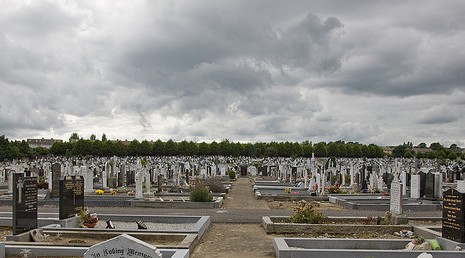
Deansgrange Cemetery, Co Dublin
Nothing stays the same, even death, in Ireland as elsewhere. The traditional rituals and ceremonies surrounding an Irish funeral are not what they were 100 or even 50 years ago. Yet, as I learned this past week, death in modern Ireland, even in suburban Dublin, still retains many of the old ways.

When I was growing up an Irish wake was the subject of a joke built around a stereotype of Irishness. "What's the difference between an Irish wedding and an Irish wake? One less drunk." Unflattering, yet my teen self often wondered what was so bad about a celebratory wake? Everything I knew about death seemed so forbidding and frightening that I kind of liked the idea of laughing in its face.
____________
Read More:

An Irish funeral brings family together

Ireland's bad debt problems now affecting funerals

Liberator Daniel O’Connell’s descendants continue tradition of following funeral route
_____________

A couple of weeks ago I heard a man on the radio say that everyone always describes the Irish as "repressed," but that this was not true when it comes to death. I thought then and I'm more convinced now that he's right. Yes Ireland is changing, becoming more ... American, but still death is discussed and handled in a more natural way here than it generally is in America.

Marking a death in Ireland is a multi-step process. The wake is in the deceased's home, not a funeral home. This first step in an Irish death is fading away, unfortunately.

I was only once at a wake in a home and it was a great experience. Took me a couple of minutes, but I soon realized that waking an old woman in the room in which she spent most of her life was the most natural thing in the world. Her family and neighbors and friends were all gathered around her praying, crying, laughing, and just talking about her. Perfect.

Next is 'the removal,' which is in the evening. I'm not certain, but I think it's only a Catholic tradition. The deceased is 'removed' from either their home, if waked, or the funeral home if not and brought to the church. Tradition calls for a procession to follow the hearse to the church on foot for at least the last few hundred yards if not more. There are a few prayers in the church and then everyone comes to offer the family their condolences.

The removal in the evening is a great idea because not everyone who'd like to go to the funeral can take the day off work to attend. The removal allows them to pay their respects outside the working hours.

The funeral isn't really much different than what you'd see at a traditional funeral in America. After the funeral most people go to the graveyard in a procession that passes by the deceased's house along the way. At the graveyard there are more prayers as casket is lowered into the grave.

The whole process finishes in a local hostelry, where funeral-goers gather to take a bite of lunch and a few libations. Often there may have been some time spent in the pub after the removal the night before. And, indeed, if there is a wake there may be "drink taken" then too. You know what? I don't care. Even if the death of a loved one does turn into something of a three day party, so what?

Do some people overdo it? Of course, but those same people overdo it at weddings, christenings, football games and Wednesday afternoons when they have nothing better to do. The majority of the people are merely enjoying themselves, usually with stories about the deceased.

It's a great time for stories to be handed down from one generation to the next. Who would prefer a morose gathering from which people can't wait to escape? Not me. I think it's far better to be recalled with laughter and with stories that keep memories alive. If death is inevitable then it's best followed by an Irish funeral.

{Photo from William Murphy on flickr.com.}

Thursday, January 26, 2012

Ireland's President Michael D Higgins says intellectual crisis is worse than economic crisis

Ireland's President
Michael D Higgins
I suspect I'm the only person in Ireland taking new President Michael D Higgins seriously. Truly. That's the only way I can explain why his comments yesterday have received so little attention.

Yesterday in a lengthy (and tedious) speech Higgins said: "There is now I believe an intellectual crisis that is far more serious than the economic one, the one which fills the papers; dominates the programmes in our media."

What utter tripe. I only wish Higgins had said this before last October's election because he would not be President now if he had. Oh no, during the campaign the media talked about Higgins as a poet, an academic, an activist, but they failed to press home the fact that he is also a pompous windbag.

Honestly, what planet is Higgins living on? Ireland is littered with the wreckage of a failed economy, of the effects of poor regulation and inept regulators, of a European Union that is anything but united, of a government that saddled us with public expenditures far in excess of what we can afford and Higgins thinks none of this is as serious as the need for academics to revisit the social theories of Max Weber.

{Read the whole thing for yourself, but have plenty of coffee at the ready. I told you it was tedious.}

I'm not disputing that Ireland has major issues and I welcome the input of intellectuals and academics on these issues. However, to imply that the anything that's going on in the halls of Irish academia is more important than the business failures, job losses, emigration and budget cuts in the real world is insulting to the rest of us plebeians, a.k.a. the citizens of Ireland.

I would bet that even some of those academics listening to Higgins yesterday were thinking to themselves, "Easy there Michael. All we do is argue among ourselves and then toss out occasional papers printed in journals. We don't really have any solutions. We're not going to create new businesses that will employ the jobless thousands."
____________

Read More:

New Irish president Michael D Higgins will visit US in May

President Michael D Higgins requests his salary cut to $336,755

Elected: Michael D Higgins - Ireland's most anti-American President
_____________

Higgins fancies himself as an intellectual. His speech is full of clues as to what he really believes should be done: people like him - thinkers - should be given a lot more authority to set down what is and what is not allowed in terms of economic policy, social policy and everywhere else that matters.

Higgins believes not only that the free market is irrational, but evil. It is sin. It must be avoided if possible, tightly controlled if not. He will tell us what we should want and when we should want it.

Higgins says the market has failed, but his model has failed too. His model was tried before and it produced a society and an economy that was great at producing chess players, but not washing machines; great at producing ballets, but not food; great at unaccountable bureaucracy, but terrible at change and freedom.

Yes, the market has wreaked havoc on Ireland, but much of that was thanks to the failure of our central planners in Dublin and Brussels. I see no reason to suppose that Higgins and his intellectual friends could do better. I'll take my chances with the market and freedom any day over Higgins' model society.

Wednesday, January 25, 2012

Michael Noonan doesn't get that emigration is a disaster for Ireland

Michael Noonan - Ireland's Minister for Finance
Ireland's Minister for Finance garnered a healthy heaping of headlines for himself last week when he decided to give his two cents on what is a very sensitive subject in Ireland: emigration. In answering a question from a reporter Noonan provided a handy soundbite for the press to hang him with when he said that there were a lot of families for whom emigration was a "free choice of lifestyle."

Frankly, I think Noonan's language was a bit clunky, but the gist of his full answer was not as insensitive as was portrayed by the media.

He cited his own family as an example of what he meant. Noonan said his three grown up children were living abroad, but this was a "free choice of lifestyle and what they wanted to do with their lives." He added that he didn't think "any of the three could be described as an emigrant."

I disagree with him on that last point. His children are emigrants even if they were not, as he admitted others have been, "driven abroad." Noonan noted the differences between his children's experiences and those thousands who have left Ireland recently after losing their jobs in a bloated construction sector. Most of those people have "absolutely no hope ... of being re-employed in the building industry again in Ireland."

Is that really all that insensitive? It's candid, but true too. Would it be better if he'd said that he hoped one day all of those people would be able to come back and find positions in construction even though he knows that cannot - and should not - happen? Of course not because that would be insulting to them and to all of us still living in Ireland.
____________
Read More:

Michael Noonan slammed after branding emigration a lifestyle choice

Ireland's Finance Minister talks economics & immigration

America's losing out to Canada, Australia on luring ambitious Irish people
_____________

Although I don't accept that Noonan was being insensitive, I wouldn't have a problem with him even if he had been insensitive. I'm sick of sensitive politicians. I don't want them to 'feel my pain.'

The problem with what Noonan said is that emigration is a huge negative for Ireland, but he doesn't seem to understand that..

If emigration is a positive for the country then by all means let's hear Michael Noonan make the case. We won't hear anything of the kind, however, because emigration is a loser for the nation whether the people emigrating are "driven abroad" or not.

Noonan's comment about it being a "lifestyle" choice is ridiculous. It's been a "lifestyle choice" for decades. Even those who left in the 1950s left not because they were facing death by starvation, but because they couldn't face a lifetime of subsistence farming or life as one of the many urban poor. They knew there was a better life out there and they went to find it. That was the choice they made. Others made the opposite choice. It was a choice, a "lifestyle" choice if you like.

Every emigrant is a loss, a loss of someone with the spunk and ambition enough to strike out for a foreign land, with the desire for change that a belief that there can be something new and they can make that happen. These people are risk-takers, the same people who might open a new business if they saw sufficient light at the end of the tunnel. In Ireland today, as in the 1980s and the 1950s, the light at the end of the tunnel is too dim and too far away to keep these people here.

Noonan concluded his remarks with, "What we have to make sure is that our young people have the best possible education right up to third level so that when they go, they’re employed as young professionals in their country of destination rather than the kind of traditional image of Irish emigrants in the 1950s."

In other words, we should tax ourselves til it hurts to provide a first class education - "right up to third level" - for people who are then going to take all that expensive book learning and head overseas and enhance the economy of some other country.

What's the sense in that? Are we better off because we paid so much to prepare these people to be productive in some other nation's economy? Those who left in the 1950s were a big loss in terms of energy and ambition, but at least they weren't taking tens of thousands of dollars worth of education with them.

Here's an analogy. What if the New York Mets General Manager proclaimed himself satisfied that at least when Jose Reyes left for the Florida Marlins that he took with him the years of training and development the Mets had provided him? Now imagine if Reyes had left the Mets not after six years in the Major Leagues, but just as he was ready to begin his big league career, to begin helping his team win games. The GM would be fired for saying something so stupid, but that's essentially what Noonan said last week.

The Minister for Finance of a bankrupt nation doesn't recognize that losing people who have just completed years of expensive education, who are on the cusp of becoming productive citizens, is a disaster for the country.

Noonan didn't need to soothe our hurt feelings and he shouldn't have tried. That's not his job. What he should have done is demonstrate that he understood what emigration really means to Ireland. He should have expressed disappointment that the government has so far failed to find the means to entice those people to stay. He needed to show a determination to stem that flow immediately.

He didn't do so because he doesn't get it. To Noonan and to the governing classes generally, emigration is a safety valve, a means of getting the most disgruntled out of their hair. For that reason, history will go on repeating itself.

Tuesday, January 17, 2012

When Steve Jobs and Apple first came to Ireland

Steve Jobs opened plant in Cork in 1980
December 23, 1980 and thousands of Irish people were facing the prospect of no electricity on Christmas Day. The basics of modern life - electricity, telephones, indoor plumbing - were still relatively new in Ireland then. Anyone describing the modern, telecommunications-dominated world of today would have sounded like a science-fiction writer, not a businessman about to open a new factory. Yet, Steve Jobs was in Ireland talking about the future.

My wife and I were going through boxes of my father-in-law's papers and pictures over the weekend. We found a treasure trove of genealogical tidbits such as dates of birth, marriage certificates, which provide lost maiden names, etc.

There were also a few old newspaper cuttings, which are always interesting. Airplane, The Blues Brothers, Brubaker and The Shining were among the movies playing that Christmas in Dublin.

There were a couple of news items that caught my eye.

Christmas, of course, was a focal point. An industrial dispute at the national electricity company threatened to leave many people in the west of Ireland with no electricity for Christmas. I don't know how that turned out. There was an article about a man spotted stealing a piece of buttered bread from the sparrows and feeding it to the ducks. They were simpler times.

There was a short item on a speech by Pope John Paul II, who was warning of the dangers that arise when political blocs "seek to assert their rights over small nations." Although he was alluding to his native Poland, Ireland in 2012 is being squeezed very hard by the political bloc that currently controls the European Union.

There was, however, one article that really stood out, that leaped off the page. An American company was opening a new factory in Cork and the the head of that company was saying some radical things. The company was Apple Computers and the man was Steven Jobs (or Stephen Jobs - the caption writer didn't agree with the journalist).
____________
Read More:

Bono brands Steve Jobs the Elvis of the computer world

In Cork Steve Jobs found the perfect match for Apple

Steve Jobs was a great American genius
_____________

You can sense journalist Dick Cross is skeptical where he writes that "Irish housewives could be throwing away cookery books and taking their recipes off the screens of mini computers" and doctors will similarly store and retrieve patient histories. Cross' skepticism is tempered when he notes that Jobs has become a "millionaire in just four years."

Cross wasn't the only non-believer in attendance at the opening or at least his report indicates he wasn't. "At the Holyhill, Cork, assembly plant there is no time clock to monitor the coming and going of the workers. Many experienced trade union people lifted their eyebrows in disbelief at the concept." Jobs trusted his employees, but that was clearly not the norm in Ireland in 1980.

Nothing earth-shattering in the report, but I couldn't help wondering what those tough union folks made of Jobs and Apple over the 30 years since the Cork plant opened. Did they regale people with stories of how they were there when it all started, how they could see it in his eyes that he and Apple were going to be wildly successful and that the people of Cork were on a winner from the start? Or did they admit that they thought he was a loon and that his way of doing business would never work in Ireland?

These days "Irish housewives" don't save recipes on their "minicomputers." They call them up from the web using their iPads. Irish doctors presumably store all sorts of patient data in computer databases, although based on what I heard from the Minister for Health this morning, our hospitals have a way to go on this yet.

I don't know if other people shared Jobs' vision back in 1980, but I bet there were very few in Ireland. Possibly none, although I bet those who were the first employees of Apple in Ireland were quick converts. I can well imagine that many who read that report simply thought to themselves that they'd be happy if they could get a reliable telephone and electricity supply. They probably didn't so much disbelieve Steve Jobs as assume he was actually from "a Galaxy Far Far Away" from Ireland.

Tuesday, January 10, 2012

America's losing out to Canada, Australia on luring ambitious Irish people

Saskatchewan's Premier Brad Wall,
who wants Irish workers to
relocate to his Province.
The government of Saskatchewan is planning a mission to Ireland to recruit workers to come work in the central Canadian province. Saskatchewan isn't the only Canadian province interested in recruiting Irish workers either. Nova Scotia and a few others are also keen. Western Australia and other Australian states are of similar minds.

Canada and Australia are both actively seeking Irish workers.Given the high unemployment and dismal projections of years of economic stagnation, Irish people are responding. They're heading to both places in their tens of thousands. Definitely, Ireland's loss is Canada and Australia's gain.

When it comes to Irish immigration to America it's always about 'the undocumented' – campaigners pleading for clemency for those who have gone to live and work in America without the papers being in order. I'm not belittling that. There's real human suffering there. I wouldn't want to undermine the efforts of those hoping to ease the plight of the people caught in that legal limbo.

I suppose it's just that if I were in Washington meeting members of Congress I'd show them the Canadian and Australian recruiting campaigns and ask, "What is it those two countries see that we don't? Why are they making such an effort to entice Irish workers while we have erected almost insurmountable barriers to the same people?"

The fact we're talking about Canada and Australia is important. Those two countries are the two nations on Earth most like America in terms of population and attitude. What is it about the Irish that has the Canadians and the Australians so focused on recruiting them? I'll tell you: the Irish emigrants of 2012 are essentially the same people who flooded into America in the years leading up to WWI.

____________
Read More:

Canada seeks thousands of Irish immigrants urgently

Irish families flooding to Australia as new restrictions will make it more difficult

Democrats move Irish immigration bill but GOP blocks it
_____________

I know that today's young Irish generation has had a different up-bringing to that of our parents, grandparents and great-grandparents. They've been raised in a different Ireland, had different experiences and have different political and religious views than those who went to America in the past. Yet, in many ways - especially those that matter to the United States of America - the young Irish of 2012 are the same decent, hard-working people who went to America seeking new opportunities in 1912.

Just as too often in the past, today's Ireland has nothing for a large proportion of the Irish people. Many of those people are not content to sit around waiting for something to happen. They want to make it happen for themselves even if it's outside Ireland. Those are the people heading to Canada and Australia.

What makes this generation of disenfranchised Irish different from those in the past is today's potential emigrants are very well educated. A large percentage have top-notch degrees. Also many have already had a brief taste of success, they've acquired the kind of skills that will benefit employers in a forward-looking economy. They're hungry and talented. And they have more confidence in themselves than those who've gone before. They're also more entrepreneurial.

These Irish people will be a real benefit to whichever country they move to. That many would love to go to the United States is beyond question, but they cannot. They are unwelcome. They won't worry about it too much, though, because if America doesn't want them someone else does.

The loss is America's more than it's these quality Irish people. Barring such people when they're in such demand elsewhere is so breathtakingly stupid it hurts.

Yes, of course, the American economy is down now and not really looking for new workers, but now is is the time to correct this so that when US companies are again looking for skilled workers the Irish are available to them.

Now is the time for America to prepare to compete with Australia and Canada. Irish emigrants have so much to offer America, but America has to want them, has to open the door to them. If not, they'll simply pass on by to the next-door neighbors who have the door opened and cake baked ready to welcome them.

{Photo from CTV.}

Tuesday, December 27, 2011

New Year's with Notre Dame football

Notre Dame plays in the
Champs Sports Bowl  on Thursday
By New Year's Day Notre Dame's season will be over. Again. Yet when I was growing up Notre Dame seasons didn't end until New Year's Day and that was at a time when New Year's Day was the last day on the college football calendar, unlike today when it seems to drag on through half of January.

Like all the best memories, mine are pretty vague. In my mind, Notre Dame played in one of the big four bowl games each year. Of course, it couldn't be the Rose Bowl, but ND played in one of the other three - the Cotton Bowl, Sugar Bowl or Orange Bowl - annually. And, again in my mind, although Notre Dame was never on top of the polls themselves, they were more often than not playing the Number 1 team in the country in the bowl game.

As I said, my happy memories are vague and I'm refusing to allow Google spoil them with facts. That's the trouble with the internet - stats and facts can ruin what you "know to be true."

My memories of New Year's Day with Notre Dame are also tied up in family memories, the kind that can't be ruined by Google, only by other family members with clearer memories. Some of my best memories from childhood are from Christmas time. In our house, not only did we look forward to a visit from Santa, but also from another old man - Father Edmund Murray or, as he was known to us, Father Ed.

Father Ed taught Irish History at Notre Dame. He loved that place and instilled that in each of us. He hoped we would go to college there and we did too, even if when we were young it was because we thought we would get to see even more of Father Ed.

On paper Father Ed would appear to be a distant relative - he was my grandmother's first cousin - but in reality he was like our grandfather and every year he would come to us to spend Christmas with us. For the four of us growing up Father Ed's arrival at Christmas was a very close second to Santa's in terms of excitement and anticipation.

Father Ed didn't lavish us with gifts, but we all had plenty of Notre Dame tee-shirts, sweatshirts and hats. He was a lively, jolly man who loved listening to us, telling us stories, playing cards with us or taking us out for ice creams or whatever. And he liked watching football, especially, of course, Notre Dame.

One game in particular stands out for me - the 1973 Sugar Bowl. The game was actually on New Year's Eve 1973 and not New Year's Day, but it was the biggest game of the year. Alabama was undefeated and Number 1 and Notre Dame was undefeated and Number 2.

My parents were out at a New Year's Eve dance and Father Ed was baby-sitting. I was the oldest in the family and Father Ed let me stay up to watch the game with him. I was only nine. I had never stayed up so late in my life. Although I have only vague memories of the game now, there are a few plays I can still see clearly - in black and white.

I remember being over the moon when Notre Dame had held on for a 24-23 victory. I can't remember anything Father Ed said the whole night, but I can still remember the loud clap of his hands each time Notre Dame scored or made a big play and especially when the game ended. In fact, I think he jumped out of his chair. I'm sure he'd have had more fun watching with a group of alumni or even my father, but he never let on and as far as I'm still concerned that's one of the best nights of my life.

A few weeks after that game a gold Notre Dame National Champions banner arrived at our house. That banner hung in my brother's and my bedroom for years afterwards.

Father Ed is a long time dead, but I still think about him a lot at this time of year. I still root for Notre Dame, although I rarely see them. I'm hoping I can watch the Champs Sports Bowl - whatever that is - this week, although it would be better if ND was playing on New Year's Day where they belong.