Showing posts with label Irish economy. Show all posts

Wednesday, June 5, 2013

Hey Senator Levin - Ireland is NOT a tax haven

Senator Carl Levin has been pointing his
finger at Ireland, claiming it is a "tax haven."
{Photo: Christian Science Monitor}
Senator Carl Levin keeps moaning about Ireland and its corporate tax rate, restating his position that Ireland is a tax haven. This is despite the fact that he is only talking about one company - Apple Computers - and the operations he is talking about are not resident in Ireland for tax purposes.

What the Irish do and have been doing is not new and is no secret: they entice companies to locate in Ireland with a low corporate tax rate. Apple computers is actually legally exploiting a crack between the tax codes of Ireland and the United States and for Senator Levin to keep pointing the finger at Ireland for this tells me he's either dishonest or dimwitted, I'm not sure which.

Senator Levin is moaning like a baby about laws over which he actually has more say than just about any other person on Earth. The laws of international commerce are written by the big boys and the United States is the biggest boy in the game.

Senator Levin is a powerful member of the United States Congress and rather than show-boating and pointing fingers at those who are playing the game by the rules he helps set, he should lay out his case to his fellow lawmakers to change the law. If Apple Computers and others are exploiting loopholes in the United States tax code then change the law.

By any objective measure Ireland is NOT one of the big boys. Ireland's control over the laws of international commerce is pretty slight. The Irish are just trying to "compete in the global marketplace."

The global marketplace is like a basketball tournament and Ireland is a team with no uncanny ability or unusual natural advantages for the game. So they do the only thing they can do: examine closely what skills they have and then parse the rule book looking for a way to get an advantage and maximize those skills. The United States is the Miami Heat of international commerce and the Irish are the Princeton Tigers: playing smart and making the most of what little they have.

Ireland has to do something special to "compete" in "the global marketplace." There are only 6.5 million people on the entire island.* Any Irish business making and selling products has only a small potential market before they have to sell "abroad." So before a business has achieved any type of scale they have to master a new legal and cultural environment and often a new currency. This is a significant competitive disadvantage for any Irish business trying to compete with a British or German or American company that can grow much larger before it is forced to export.

In addition, Ireland is not a land blessed with loads of natural advantages. Other than lush green fields ideal for the production of beef and dairy products there are no vast stores of natural resources to enrich the country (until that day when rain water becomes an expensive commodity).

Also, Ireland is an island. That makes the cost of distribution high. There's a good reason nobody makes cars or refrigerators or televisions in Ireland. The Irish market is too small and there are high costs involved in shipping such large items to where there are markets of significant scale. No company making big items would locate in Ireland when there are better locations at the center of Europe (or even in densely populated Britain).

Throw in China and all those cheap manufactured goods and you have the global marketplace in which Ireland competes. Given that the deck is stacked against them the Irish people had only two options: sulk off into unhappy and poverty-stricken economic isolationism or parse the rule book and find a way to compete. They chose the latter.

The Irish government** developed an economic strategy that revolved around being a European base for high value added services and goods with low distribution costs. They shaped their tax laws to entice companies, mostly American companies, to establish their European headquarters in Ireland. The companies the Irish targeted produce the sort of goods for which transport costs are small: computer processors, pharmaceuticals, software and banking services. They have been pursuing this strategy for decades.

Apple Computers has been in Ireland since 1981. If Apple ever got any special deal from the Irish government it was then and at no time over the years did the Irish government hide anything Apple was doing in Ireland from the United States government.

During all those years Carl Levin has been a member of the United States Senate. For 30 years he's been in a position to influence and vote on the United States tax code. For 30 years he's been in a position to vote "Yea" or "Nay" on any and all treaties. Yet he did nothing about the Irish and Apple. Until now and what he chose to do was theater without substance.

I can only imagine that Senator Levin imagines himself as being like Emilio Estevez in Mighty Ducks 2, in which Estevez coaches the American hockey team that overcomes the odds and defeats world power ... Iceland. A laughable premise for a movie, but an even more laughable cause for a member of the United States Senate. Senator Levin should stop playing to an audience and do his job - fix whatever is wrong with the United States tax laws and stop bad-mouthing Ireland.

* It doesn't matter north or south businesses on both sides of the border face pretty much the same challenges.

** This applies to the Republic of Ireland, but there are moves in Northern Ireland to follow suit.

Wednesday, February 27, 2013

Will Ireland's emigrants catch a break on property tax?

Ireland's Minister for Finance, Michael Noonan,
introduced the new property tax.
In all the time I have lived in Ireland there has never been a property tax. That is all about to change as the government is rolling out a tax on residential property this year.

Irish homeowners will start to see the bills for tax owed on their homes from next month. As you can imagine, no one's all that happy about this.

The biggest losers of course are all those struggling homeowners, the people who took out huge mortgages to  family homes during the boom, have taken substantial pay cuts or even lost their jobs and are now faced with a new tax that will cost them hundreds each year.

I know if you live in America your initial reaction will be something like, "What are they moaning about? I pay $4000 per year." And you'd have a point. However, the American system has a series of taxes - Federal, state, local, - the sum total of which can be substantial, but probably not on a par with what the average Irish person is paying. For example, does anyone in America pay a 23% sales tax? I don't think so.
____________
Read More:

Property tax unveiled for Irish homeowners as Michael Noonan reveals Budget 2013

Irish homeowners are not "revolting" - they're treating their incompetent government with contempt

Google pays just $10 million Irish tax bill by routing €9 billion profits abroad
_____________
It is always difficult comparing tax rates in different countries because there are so many different taxes and what those taxes are supposed to provide is different too. Take my word for it: Irish people pay a lot in taxes, this is a new one and they're not happy about it.

Right now many people are saying they "are not going to pay." Sure many of them are blustering, but the Household Charge that was introduced last year was seen as a precursor to this year's full property tax was ignored by a large percentage of households. Maybe the government will someday catch up with those who refused to pay the Household Charge, but the fact is at the end of December nearly 30% of householders had not paid the tax. No matter how you slice it, that's a significant level of non-compliance.

Unless the government ups its game they can expect at least the same level of non-compliance. So far all we've heard is that they're upping their threats. The head of the Revenue Commissioners recently noted that they had the power to take the money from any non-payer's salary or pension or even bank account. In other words they have you. Unless ...

When I heard those comments the other day the thought struck me that there's one group of homeowners who might slip through the Revenue Commissioners' net: emigrants. I don't know how many there are, but anecdotally there are quite a few. Families, couples and singles who have bought homes have had to leave Ireland and their homes (rented, if they're lucky). There's a good possibility I'm missing something, but from the looks of it right now emigrants might owe the property tax, but it doesn't look like the Revenue Commissioners have any way to force them to pay.

I'd like to think that emigrants will catch a break here. I'd really like to believe the government would waive the property tax for those who have had to leave Ireland due to the dire economic conditions, but if there is one group the government doesn't really care about (ignore those crocodile tears) it is emigrants because they cannot vote. Thanks to that and thanks to the fact that most of them had to leave due to circumstances not of their making I hope they can avoid the property tax. It's the least they deserve.

Friday, February 8, 2013

Ireland and the debt deal - 24 hours of farce and high drama

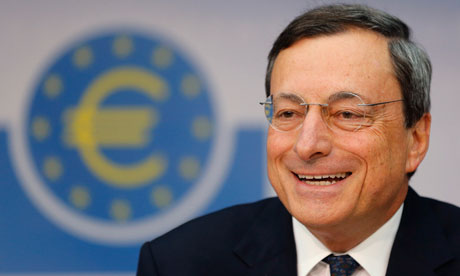
Mario Draghi, head of the European Central Bank.
The end is nigh; the sky is falling. We're all doomed, doomed I tell ya. That was Wednesday night in Ireland. It was as if the end-times had arrived.

It was a very strange 24-hours from Wednesday afternoon to yesterday afternoon. It all started with breathless reports on banking and Ireland's national debts from Irish reporters in Frankfurt. There were leaks and rumors: the Irish government had secured a deal on the bank debts that the state had absorbed. What that deal was, nobody could say exactly, but we had "a deal."

Part of the deal involved the liquidation of the Irish Bank Resolution Corporation (IBRC), which was established by the government in 2011 as something of a banking hospice for the brokist, most bankrupt bank on the planet - Anglo-Irish Bank - and its little brother, another broke institution, the Irish Nationwide Building Society (INBS). Anglo is the Bank that Broke Ireland.

So far, so good you might think. Well, maybe not for the 800 people employed by IBRC, but given how hated Anglo-Irish was there didn't seem to be a whole lot of sympathy for those people.
____________
Read More:

Enda Kenny announces deal on Anglo-Irish debt with European Central Bank

Trial date for disgraced Anglo Irish Bank boss Sean FitzPatrick set for next January

Ireland has a new Chief Secretary
_____________
As Wednesday evening turned into night that's when things started getting strange. The details of the deal were not forthcoming and then the noises from reporters with contacts "in Frankfurt" (that is, the European Central Bank - ECB) began to sound ominously like there was no deal after all.

That's when the mood of television and radio reporters went from baffled to aghast as they found there were no answers to their questions. That's also when Irish tweeters went bananas.

There was nothing on the debts, but the IBRC liquidation was going ahead. That required government involvement because everything had to be finished by 7am Thursday morning, although we weren't told why. In order to get that done the Dáil and Seanad (Ireland's lower and upper houses of parliament) would have to have a late, possibly all-night, session. We were also told that the President was cutting short his state visit to Italy so he could return to sign the bill into law on Thursday morning.

It may not sound like the makings of a high drama, but it really was. All the frantic confusion evident in the government's rushing to get 50 pages of legislation drafted and passed by 7am Thursday sent Irish tweeters over the edge. In 140 characters Irish economists and banking experts - those who weren't pronouncing on our impending doom on television and radio - were conveying their skepticism and fatalism in equal measure. The rest of Ireland's tweeters joined in, often adding humor to the fatalism.

#PromNight was soon trending in Ireland, a reference to the Anglo-Irish Bank promissory notes at the center of the whole national debt crisis. The sense that we were coming to an apocalypse was thanks to the similarity between Wednesday night and the night back in late 2008 when the parliament stayed late to approve the bank guarantee scheme that has led us to national bankruptcy and the loss of national sovereignty.

Announcements from Taoiseach (Prime Minister) Enda Kenny were pushed back a few minutes. Then another few minutes. The whole thing had the feeling of a farce or, as people here presumed, a national tragedy. Eventually, around 11pm, Kenny and his government made their way to the Dáil where they expected to have a vote on the legislation - 50 pages of it - despite the fact nobody had yet read it. A short period of shambolic parliamentary proceedings ensued as the opposition parties sought some time to consider the bill.

At this point cool economic discussion and political analysis on TV and radio was replaced with something akin to a desperate moment of national prayer. "Please God, don't let them make things any worse." The tweeting was even more desperate.

When the discussion of the legislation finally got going - around midnight - it was a welcome relief. The endless droning of politicians didn't make anyone feel better, but at least they put us to sleep. We'd have to wait til morning to find out if the verdict was death. Or worse.

Thursday morning things were calmer. Maybe it was simply that the sun had risen on a new day that provided that glimmer of hope, but the fact that we learned that the bill was passed by both houses and signed by the President after his mad dash home from Italy was at least certainty.

That calm gave way to even more hope as rumors of an ECB deal again began to circulate. The strangeness returned around lunchtime when Mario Draghi, head of the ECB was asked about the deal during his regular press conference. His response: We "took note" of the Irish actions. "Took note." And with that commentators were baffled again and twitter was aflame. A collective "I knew it! We are screwed" was the general theme. A few other journalists at the press conference asked for more clarity, but Draghi remained indecipherable.

We only had a short while to wait, however. At 2:30 the Taoiseach rose again in the Dáil to announce that we did, in fact, have a deal with the ECB. Amen.

Calm has been restored, although nobody seems too clear as to whether (a) the legislation rushed through on Wednesday night is actually constitutional or (b) the deal on the debts that we got was all that great. For many people the fact that we have removed any doubt about whether the state was going to repay Anglo's debts makes this deal a bad one. I have sympathy with that view, but that ship sailed a long time ago. There are virtually no bondholders left. The debt now is to the ECB and there was no way we were going to renege on that.

The deal may not be great, but it's better than we had. The total debt will not be paid off til 2053, which makes it more like war reparations than bank debt, but so be it. The state wrongly guaranteed those loans and now we have to pay.

The new deal makes it a bit more affordable and pushes back the pain enough so that we can at least hope that with a bit of luck and a bit of inflation and economic growth the debt will seem less significant than it was last week. We're still sick, but it's a chronic rather than terminal illness. That's progress.


Monday, January 21, 2013

New York Times paints a picture of a mythical 'green' Ireland

Electric car charging point - they're not hard to find in Ireland,
but you're more likely to see a unicorn than to see someone
using one of these.
Perhaps over Christmas you came across a NY Times article about Ireland and carbon tax. The article essentially claimed that the Irish people had swallowed Al Gore's Kool Aid en masse and have experienced an environmental and economic miracle thanks to our new found environmentalism.

If you did happen to see that article you were hopefully asking yourself one key question: is any of this true? The answer, in a word, is 'no.'

Ireland may well be "40 Shades of Green", but that sort of 'green' is not among them. Granted Irish people are wary of messing with their beautiful green land and that sometimes frustrates me, but they are far removed from the picture of a nation of environmental devotees that the Times' Elisabeth Rosenthal painted. In fact, most of Rosenthal's article is a complete nonsense. I'm not sure it even qualifies as journalism.

____________
Read More:

Ireland and global warming – electric cars, but colder winters

Archbishop Dolan right to slam NY Times for anti-Catholic articles

‘Suffering of Irish people outrageous’ says NY Times Paul Krugman
_____________

Rosenthal interviewed one politician for the piece - former Minister for the Environment Eamon Ryan. Ryan was one of six Green Party TD's (MP's) in the last Dáil (Parliament). His Green Party was the junior partner in the last government, which brought in the carbon tax. That government is also widely blamed for the bank guarantee that has bankrupted the nation, destroyed our economy and (temporarily we all hope) ended Ireland's 90 year experiment with sovereignty.

In the election that followed our economic collapse not a single Green Party TD managed to be elected. The party barely exists now, but Rosenthal tracked down Ryan to get a positive assessment of the carbon tax. If the carbon tax was the blessing Rosenthal claims how is it she couldn't find a single current government minister or even elected official to sing the carbon tax's praises? None of the remaining Fianna Fáil TD's was willing to speak in favor of the carbon tax despite representing the senior partners in the government that brought it in. Odd if the carbon tax is all Rosenthal claims it to be.

Rosenthal's economic claims were even more laughable. What little good news Ireland had in 2011 was entirely due to the Irish operations of large US technology and pharmaceutical companies. The domestic economy declined in 2011.

Rosenthal's entire article is a sham. Carbon taxes were introduced just as the economy was going into free fall. The sharp decrease in emissions is ENTIRELY due to the fall in economic activity. So many companies have gone to the wall that production has decreased sharply. Unemployment has sky-rocketed so fewer people are driving to work and emigration has taken off again so there are actually fewer people here burning oil and gas. That's the real carbon emissions story. Everything else is a green fiction.

The carbon tax is just another tax. Taxes have risen across the board. Our VAT rate (sales tax) is now 23.5%. All sorts of other new charges have been introduced, often with little or no protest because we all know the government is broke and we all know that our European masters love all these new charges. So they come in, we moan and then we pay them. That's what happened with the carbon tax.

Rosenthal ties in charging people for their garbage collection service with the carbon tax. That's a completely different issue. Ireland has limited landfill space and it's filling up fast. Garbage collection was getting too expensive for local governments so they sold off the routes and now we have to pay. I don't think this situation would be unfamiliar to many Americans.

My absolutely favorite part of Rosenthal's fairytale was the accompanying photograph of an electric car recharging its battery. The picture was taken at a car dealership. Funny that, considering there are hundreds of these electric charge points all over Dublin. You know why she didn't get a picture of someone charging their car at one of those curb-side charging points? Yup, you guessed it, NOBODY uses them because NOBODY has an electric car.

I was in California two weeks ago. In first the ten minutes I was in Pasadena I saw more electric cars charging their batteries than I have in the two years since the Irish government began rolling out the unused infrastructure for the non-existent national fleet of electric cars.

The Ireland I live in is not the one Rosenthal wrote about. The one I live in is still bankrupt, still hemorrhaging young people, still awaiting further tax hikes, still governed by people sensible enough to know that the average Irish person is still unconcerned by 'climate change.' The Ireland she described is a mythical green land experiencing an environmental-policy-led economic turn-around. You can probably find the 'Little People' running Rosenthal's Ireland.

Tuesday, December 11, 2012

Irish people, shivering in their own homes, have only themselves to blame

Irish people have been turning off the heating in their homes because of the cost of gas
Irish people have been turning off the heating in their
homes because of the cost of gas

Saturday's Irish Independent reported that many Irish people are turning off the heat and shivering in their homes thanks to the cost of natural gas in Ireland. Frozen Irish people is a result of a combination of the collapse in the Irish economy and the doubling in the residential price of natural gas over the last 7 years.


The real kicker here is that for the most part Irish people have no one to blame but ourselves. In order to ensure that natural gas is as expensive as possible we have added taxes onto the price of gas and worked tirelessly to stymie any attempt at increasing production of natural gas in Ireland.

The additional "carbon tax" was added a few years ago. The purpose of this tax was two-fold: (1) to provide subsidies for the wind energy production boondoggle err, industry and (2) to encourage Irish people to simply use less gas - that is, they want us to heat our homes less and cook less.

At the time the carbon tax was imposed on us the Irish government was a coalition of a big party - Fianna Fáil - and a small party - the Green Party. The carbon tax was a case of the Green Party tail wagging the Fianna Fáil dog. Yet, even after we threw them out of office and obliterated the Greens' political representation the new government didn't have the courage to reverse the "carbon tax."

The carbon tax is frustrating, but not as frustrating as what's going on with the production of natural gas. It's becoming increasingly clear that the seabeds around Ireland are rich in oil and natural gas, especially natural gas. Yet we have been unable to properly exploit this resource thanks to small groups of protesters holding up production.

It's the same with the gas held deep beneath the rocks in Ireland. The process to free that gas and bring it to the surface so that it can be distributed to the homes and schools and businesses of Ireland is called hydraulic fracturing, or fracking.

The introduction of fracking is the source of America's energy revolution, which has seen prices of natural gas fall sharply and will lead America to energy independence. Fracking could well work a similar miracle in Ireland, but we lack the political will to ensure that local concerns are allayed and trouble-making environmentalists* are sidelined.

We can't even import cheap natural gas from America thanks to the ridiculous regulatory situation. Hess Corporation and other partners want to import liquefied natural gas from America to a new facility in Kerry, but despite getting approval from the planners in 2007 the facility is still mired in red tape and may remain so through 2014.

So for the foreseeable future Ireland will be denied cheap natural gas, whether Irish or imported from America. The carbon tax, however, will remain as a daily kick in the head, an additional extra cost on top of our exorbitantly expensive natural gas. The Irish government's position remains "keep shivering." We vote for them, though, so we have only oursevles to blame.

* The ability of environmentalist protesters to stifle this industry actually makes me wonder if we'll ever see the oil coming ashore in Cork.

Thursday, September 6, 2012

This weekend's Notre Dame game is all 'Official Ireland' wants from Irish-America

Notre Dame fans thronged Dublin over the weekend
Notre Dame fans thronged Dublin over the weekend .

What a fantastic weekend! Tens of thousands of Notre Dame and Navy fans taking advantage of all too rare great summer weather seeing the sights, 'having the craic' in Dublin and, of course, enjoying a football game. The general consensus is that they came, they saw and they were charmed.

Oh, and they spent too - an estimated $150m this weekend alone. Of course, they didn't just stay in Dublin a couple of days for the game. They saw the rest of the country too. More spending, more great days for Ireland's hotels, restaurants and pubs.

In addition to the sight-seeing and fun times there was some serious business discussion too. The movers and shakers among the traveling thousands were wooed by the government in the hopes that they would steer some investment in Ireland's direction.

It was a dream weekend for the Irish economy, one that bears witness to what's possible when Ireland reaches out to accept the two hands always on offer from Irish-America, without which this weekend would never have happened.
____________
Read More:

City business owners tell Notre Dame fans to come back soon – and often

Former Intel chief executive volunteers to help drag Ireland out of recession

Ireland needs ITLG's American optimism
_____________

However, that's as close as official Ireland wants Irish-America to get. Tourists spending a fortune? Hurrah! Wealthy, powerful Irish-Americans steering jobs and investment to Ireland? Hurrah! Any further, deeper involvement of Irish-America in Ireland? "Whoa! Hold on there. That might be an issue. Can't have that."

Best example of this is how Craig Barrett has been treated. Barrett was the head of Intel for many years, including when Intel made its initial massive investment in Ireland back in the late 1980s.

Back in June of this year Barrett added his name to the list of those Irish-Americans who are willing to sit on boards of state companies, offering their wisdom and experience to these companies, to Ireland, for free.

The response of official Ireland to his offer? Zzzzzzzzz. Barrett joined the Irish Technology Leadershp Group's (ITLG) Diaspora 2016 movement after it had already been received in silence by the government and slapped away by Maura Quinn, head of the Institute of Directors (Ireland).

Diaspora 2016's mission is to "make a list of at least 100 business leaders from across the globe who wish to contribute their experience and time to helping Ireland's economic recovery." As Barrett pointed out, for Ireland's economy to rebound and thrive Ireland "must integrate the best of Irish innovation from around the world."

Too true. There are Irish people, whether born here or of Irish descent, who want to see Ireland succeed. They're willing to help out, to contribute.

Spurning their expertise is foolishness in the extrem. As Tom McEnery, former Mayor of San Jose wrote in response to Quinn, "One would think that all is well in Ireland." Attitudes like Quinn's can only be explained as the response of those who are comfortable and fear 'outsiders' coming in and shaking things up.

I admire McEnery, Barrett and the others' persistence. They refuse to take 'No' for an answer.

There is so  much potential in this group, so much that these men and women have to offer. All that's required is that Ireland stop resisting.

I just don't see that happening, especially not after this past weekend.

This weekend was exactly what official Ireland wants from Irish-Americans. Let's entice them to come to Ireland in big numbers, hence next year's "Gathering." Let's get the very successful among them to come to Ireland, hand them a glass of Jameson and a piece of brown soda-bread, put on a display of Irish dancing, show them our tax breaks and convince them that they should locate their EU operations here. Ask them to bring their non-Irish friends next time.

That's the extent of it. That's what Irish-America is for, tourism and investment. I don't really have a problem with either of those, but how is that any different from the strategy in 1987? How does it differ from 1962?

Next year's Gathering is actually a good idea. I support it. But how often can we gather? How often can Notre Dame play in Dublin?

Networking is the future in a world where technology has made distance almost irrelevant. In Irish-America Ireland has a ready made network; all it has to do is accept it. It's time for official Ireland to reach out with two hands and fully embrace Irish-America.

{Photo from Matt Cashore, University of Notre Dame}

Wednesday, August 15, 2012

Gold medal for Katie Taylor cost Irish taxpayer close to $400,000

Katie Taylor captured Ireland's only gold medal
at the London Olympics.
{Photo thanks to Reuters}
Did you see Monday's pictures from Bray, Co Wicklow? Tens of thousands of people gathered to celebrate Katie Taylor's Olympic gold in boxing. There were similar scenes in other Irish hometowns of the country's successful Olympians.

Ireland's national television station, RTE, provided quite a bit of coverage of these events and undoubtedly will provide even more from today's national "homecoming" event in Dublin. Tremendous stuff. These local celebrations and the big one in Dublin cost a bit, but it's only a small sum and what taxpayer would quibble when the public mood is so keen on these celebrations?

Well, maybe me.

Although the truth is I don't have a big problem with these events. The public joy over Katie Taylor's success in her hometown, where I happen to live, is universal. Taylor, or I should say Katie as us locals refer to her, is a source of real pride to the people of Bray. {I'm still not comfortable with women's boxing, but I admire the way she conducts herself as an athlete and as a person.}

____________
Read More:

Katie Taylor overcome by emotional return in her hometown of Bray

A sort of Olympic homecoming announced for Dublin on Wednesday

When Irishwoman Katie Taylor goes for Olympic gold I won't be watching
_____________

What irks me, however, is the amount of taxpayers' money that goes to pay the athletes Ireland sends to the Olympics.

The Irish government pays €40,000 ($50,000) annually to each of Ireland's elite "high performance" athletes. This year there are 27 such athletes, some of whom actually did well in London and won medals. Katie Taylor is one of the 27 and she has received almost €300,000 ($370,000) in government funding (aka our money) since 2005.

Why? What does the Irish taxpayer get for this investment? After all, our government is bankrupt. Maybe the view is 'what's another few million euros into the vast debt pit in which we find ourselves?'

Don't get me wrong, it's not just Taylor. And at least she won a medal and set up Monday's happy day in Bray. Boxer Paddy Barnes, who got €40,000 this year and has received over €200,000 ($250K) in total, won a bronze and is the toast of Belfast.

Track athletes Olive Loughnane and Derval O'Rourke have received sums similar to Taylor, but neither of them was near a podium finish in London. Clay Pigeon Shooter Derek Burnett has received €270,000 ($330,000) and finished his Olympics in 46th place (I think). David Gillick has received similar money and didn't even make it to London.

There are boxers, cyclists, sailors, canoeists, archers and others receiving government money to compete in their sports. Why? What public benefit do we get for this money?

A crowd of up to 20,000 fans greeted Katie Taylor in her
hometown of Bray, Co Wicklow on Monday.
{Photo thanks to the Irish Times.}
I fully understand what the politicians get from spending our money in this way. They will be indirectly claiming credit for Ireland's Olympic medals, trying to cash in on the feel-good vibe the medal-winners provided. I'm sure they're keen to be seen on the stage in Dublin with the athletes later today. Of course, there will be no shots of any of them with the David Gillicks on the payroll. (And I don't know his story. He could well have been injured, but that only begs further questions as to how the government chooses who to fund, etc.)

The old amateur ideal of the Olympics is long dead. The International Olympics Committee makes a ton of money on the games. Let them pay the athletes who compete. I mean, nobody asks the taxpayer to pay the salaries of those who play in the NFL, NBA or English Premier League.

Besides, Katie Taylor is worth a whole lot more than €40,000 to the IOC. She is a tremendous advertisement for the Olympics. Not only should they pay her, but they should give her a huge raise.

I love sports. I watched a lot of the Olympics and rooted for the Irish competitors. Regardless I don't understand why the public should be so keen to pay the athletes who compete. Are we that desperate to see a medal hanging over a green jersey and the Irish flag flying from a stadium roof?

I'm not. I can endure, even enjoy, an Irish-medals-free Olympics.

Tuesday, June 19, 2012

You can help create jobs in Ireland and earn a tidy sum doing so

Connect Ireland founder Terry Clune
So you're enjoying your hot dog at the annual 4th of July barbecue organized by your neighborhood when your heart sinks because your annoying neighbor Bob spots you and heads over to talk. Last year he cornered you for 15 of the longest minutes of your life and here he comes again.

Bob's a braggard. He loves to tell you how great his life is; how great his job is; how great the company he works for is. You're barely listening when Bob says something that causes your ears to prick up. You ask him to repeat himself and you hear, "Yeah things are going so well that the rumor is we're going to be looking expand overseas."

There it is. "Expand overseas." You know Bob has told you before what his company does, but you never paid attention. Now you're interested and you casually learn what they do - they produce medical devices - and you get a few other details about the company's size and management structure.

You endure a few more minutes then you make your excuses and walk away from Bob, whip out your phone and save a few notes for later. Why? Because Bob's bragging might well earn you some easy money.
____________
Read More:

Botox maker to make new $350 million investment in Ireland’s economy

When Steve Jobs and Apple first came to Ireland

Bring Them All Back Home
_____________

Connect Ireland is a new Irish government initiative designed to help drive jobs to Ireland. If you are the first to register Bob's company on the Connect Ireland web site you'll be in line to get a payment from Connect Ireland if the company locates some jobs in Ireland.

It really is that easy. Most of the work will be done by the Irish government agencies. They're really only asking you to tip them off. If you hear a rumor about a company expanding or just relocating, let them know. That's your part done. It's their job to actually sell Ireland as a base to Bob's company.

When Bob's company decides to open a small plant in Cork employing 35 people you'll get a nice reward. For your "trouble" the Irish government will pay you €750 for each of those 35 people working in the plant 12 months after opening. That's €26,250 ($33,000) for enduring Bob's bragging for 15 minutes. That's great, but it's not the best part. The best part is they'll send you another €26,250 ($33K) if those 35 jobs still exist a year later. That's a €52,500 ($66K) pay-off for 15 minutes of suffering.

So get started today. Register with Connect Ireland and then keep your ears open this summer. You don't know what you might hear from your annoying neighbor at the barbecue or your son's friend's mother at the local pool or even from that father who never stops yellling at his son at the ball field. People love to talk about their work and it might well pay for you to listen.

{Photo from SligoToday.ie}

Wednesday, May 16, 2012

Ireland and the EU Fiscal Treaty - it cannot be 'No' this time

Declan Ganley - bogeyman of Irish politics & a leading
'No' campaigner on EU Fiscal Stability Treaty. 
 
Europe is in turmoil. Greece is heading for an ugly exit from the Euro, possibly from the European Union itself. The big European powers are at loggerheads as to how to solve Europe's massive problems and in the midst of all this the Irish people will be going to the polls on May 31 to vote on the EU Fiscal Stability Treaty.

The 'Yes' side is desperate for us to approve the Treaty. They're pleading; they're threatening. The Treaty is about "jobs;" it's about "stability." A 'No' will mean Ireland will be denied all access to credit (ie money) and we'll be kicked out of the euro. Basically they're saying that if we don't agree to the terms on the table our European "partners" will leave us battered, bleeding and slumped over in the corner.

The problem for the 'Yes' folks is that we've heard all of their positive gloop about jobs before. Nobody's buying it this time. The Irish people have finally and thoroughly removed the wool from their eyes: we were sold a pig in a poke starting with the Maastricht Treaty when we voted to join a currency we had no business joining. The Europhiles led us into this mess. Nothing positive they say now has any meaning. As for the menacing, negative stuff, well ... more on that in a minute.

The 'No' folks are the usual hodgepodge group of socialists, nationalists and others who are just fed up with the never ceasing centralizing of power in Brussels, outsiders all of them. In the Dáil (parliament) they comprise no more than 20% of the elected representatives, but when it comes to the EU they represent a far greater percentage of the electorate.
____________
Read More:

Support grows for EU Fiscal Treaty as Declan Ganley joins the No camp

A punt comeback - will Ireland vote against austerity treaty?

Anti-immigrant surge likely as Irish economy deteriorates -- Resentment of foreign doctors and workers tip of the iceberg
_____________

The most "unofficial" leader of the 'No' campaign is businessman Declan Ganley. If anyone in Irish politics can be called a bogeyman, it's Ganley. He's scorned by the left - his allies in these treaty referendums - and he's scorned by the center and pro-EU right.

One reason Ganley is so distrusted and disliked by so many, is that he appeals to a large segment of the population and he never fails to turn up when it's EU referendum time. He never takes the unthinking 'Yes' for an answer.

Ganley is not among the group generally called "Euroskeptics," but rather he's a Euroidealist. Ganley believes in a federal Europe with democratic institutions. Ganley wants the Irish people to reject this treaty because it doesn't solve the serious economic problems we in Ireland and people across Europe face now and it doesn't address the democratic deficit at the heart of the European Union.

Ganley's right, of course, but he's also wrong. It's too late. The EU is doomed and voting 'No' in the hope that this is going to trigger the change Ganley hopes for is just pie-in-the-sky thinking. There is no appetite for a new EU, although it's badly needed. Those who founded the United States had the sense to revisit the Articles of Confederation and draft a new Constitution, but they didn't wait for 25 years to realize the error of their first attempt. The EU has waited too long and the Germans and other creditors have too much to lose fixing it now.

All of which brings me back to the menacing, negative stuff that is bubbling up in Brussels, Berlin and elsewhere in Europe. Ganley says voting 'Yes' is like buying a ticket on the Titanic. He's wrong about that. We're already on the Titanic. The only hope now is that sucking up to those who control the lifeboats will work in our favor when we hit the iceberg. Voting 'No' will not endear us to those people.

In the past when we voted 'No' to EU treaties we were told to go try again, like the Irish people were disobedient children being asked to leave the room and come back to the table in a mannerly fashion. That will almost certainly not be the case this time. This time we can't stop the Treaty, so if we vote 'No' it will only affect us. We may well be taught a serious lesson by those who now control the purse strings here. They may well tell us to leave the table, go to our room and not return.

I love the idea of voting 'No' and toughing it out, but we're in a very weak position right now. If we were actually cut loose by those calling the shots in the EU the hardships we currently face would seem as nothing. Civil disorder or mass emigration are possible in such a scenario.

If this were 1999 when we were riding high I'd be all in favor of telling the EU leaders where to get off. I've only once before supported a 'Yes' in an EU treaty referendum. I won't be voting 'No' this time, however. I'm definitely not in the 'Yes' camp either, but I am in the 'Not No' camp.

{Photo thanks to Independent.ie}

Wednesday, April 4, 2012

Irish homeowners are not "revolting" - they're treating their incompetent government with contempt

Ireland's Minister for the Environment Phil Hogan,
who bungled the Household Charge.
It seems just about anywhere the new Irish household charge appears in the foreign press the words "boycott" or "revolt" are used to describe the fact that so many people did not pay the fee by Saturday night's deadline. Yesterday's New York Times quoted an Irish parliamentarian who refers to the "mass boycott." The Financial Times says the Irish government is facing a "revolt" over the new tax. {You might even see such words around here.}

Words like "boycott" and "revolt" suit those political campaigners who have been leading the charge calling on the people not to pay, but what's going on is nothing like a boycott or a revolt. It's more a case that hundreds of thousands of Irish people have weighed up the pluses and minuses of paying and come to the conclusion that not-paying is not such a bad idea. Why? Because the government blew this one in a big way. The charge was designed and implemented badly. Very badly. 100% ineptly.

The charge itself – €100 ($133) for the year payable by the owner of each house and apartment in the state – is more annoying than crushing. There was even an option to pay the tax on a quarterly installment basis.

Considering the hefty sums people pay in income tax and VAT (sales tax of 23%) €100 is no where near the most onerous levy Irish people pay. Heck it's even less than €160 ($213) annual license fee for having a television in the home, a fee that most Irish people pay without grumbling.

____________
Read More:

Half of Irish homeowners join boycott on $131 tax

Anti-household charge protest attracts 5,000 demonstrators in Dublin

Ireland's leader Enda Kenny pays no price for bad-mouthing the Irish people
_____________

Before this new charge was introduced for the 2012 tax year there was no tax on homeowners at all. {No property tax, although there is a fairly steep stamp duty payable on the purchase of a home.}

So it is a new tax, but did the Irish people really revolt against the government's austerity program when they decided not to pay this new tax? Is it really the case that after four years of accepting the punishing cut backs and tax hikes that this €100 charge was the straw that broke the camels' back? No. No, what really happened is that many Irish homeowners thought they might get away without paying this one.

From the start it was clear that government was flying by the seat of its pants on the household charge. They had no database of who owned what property. Sure they knew who lived where, but they didn't know who were the renters and who were the owners.

When this point was put to members of the government they went into full tyranny mode. The Minister for the Environment Phil Hogan oversaw the planning and implementation of the Household Charge and he, in particular, became the face of this hectoring, bullying government.

The government declared that they were going to get the information they needed by strong-arming the electricity and natural gas companies into revealing what they knew. The state-owned banks too would be forced to comply.

That tactic didn't work, but it was revealing: the government was going to struggle making people pay. The government's lack of information as to who owed and who didn't meant no bill or invoice could be sent to those who had to pay. The more this question was raised the more aggressive the government became. The public didn't so much fear as smell fear.

It wasn't just the lack of invoice, however. The tax came with a list of exemption criteria, but the criteria were unclear. If the vox pops on the radio are an indication many people who aren't exempt seemed to believe they are. It was all as clear as mud.

The government carried on brow-beating long past the point when it was obvious that it wasn't working. As the clock ticked down towards the March 31 deadline the government then took to threatening homeowners with cuts to local services. That too failed, possibly because it was too late, possibly because the waste in the mostly unaccountable local government spending is obvious to all or possibly because many people just didn't want to pay the €100.

The government made such a mess that 800,000* Irish homeowners thought they'd take their chances on the possible fine for late payment. This only served to highlight another serious design flaw in the Household Charge: the penalty for not paying on time is too small.

Those who fail to pay within the first 6 months will owe €116 ($154). The penalties rise a bit after that, but if you leave it for a year you owe only €142 ($189). A €42 ($55) penalty is just too small to cause anyone worry, especially if you believe that this government is incapable of figuring out who really owes and who doesn't. (Compare that penalty to the €60-90 that's owed by those who fail to put €2 into a parking meter.)

To me this is the essence of what's going on here – hundreds of thousands of people have treated the new Household Charge as not much more than a parking meter. They figure there's a good chance they'll get away without being caught and if they are caught the price they'll pay is too small to worry about.

This isn't so much a revolt against imposed austerity as a statement by the people on the capabilities of the government to actually enforce the law. For generations Irish people have skirted the law when the opportunity has arisen and this is more of the same. They've looked the government in the eye and said, "I'll pay - when you make me." It's up to the government to prove them wrong.

* Even the figure of 800,000 who didn't pay is open to question as the government doesn't really have an accurate figure for how many households there are in the country. Simply incredible.

** Just for the record: I paid. My wife says I'm too American.

{Photo thanks to Independent.ie.}

Tuesday, March 27, 2012

Ex-Irish Premier Bertie Ahern's spectacular fall mirrors Ireland's

Former Irish Prime Minister
Bertie Ahern
Bertie Ahern's name is mud. The former Taoiseach (Irish Prime Minister) was named and shamed in a report published last week by the judge who headed the 15-year-long tribunal into corruption in the planning process here. Since then Ahern's name has been more spat out than spoken.

All of this would have seemed almost unthinkable a few years ago. Then Bertie Ahern was feted as a political genius. He was the pragmatic deal-maker who helped bring peace to Ireland. He was the efficient manager orchestrating Ireland's economic surge. He was the longest-serving Taoiseach since Éamon de Valera was running the country in the 1930s, 40s and 50s.

There were no airs about Ahern. He was comfortable in his skin and the people were comfortable with him. He loved his sports, loved being seen out supporting his teams, here and like so many Irish soccer fans, in England watching Manchester United. He drank in his local pub and was a proud Dub (person from Dublin). He had an everyman's Dublin manner of speaking. Yet he was admired across the island: north, south, east and west.

There were frailties too. Before he became Taoiseach he opened up on a TV program about the problems in his marriage. He was separated from his wife. Yet from what we could see his relationship with his two daughters was about as good as any separated father could want.

When his girlfriend began accompanying him on foreign trips it was hardly even a talking point. He was a true representative of the new Ireland, the one shorn of the rigid social strictures of the past, but confident in business and management.

Bertie – he was always Bertie to the people – was loved. Sure there were detractors, but as far as any high-ranking politician can be loved, Ahern was. Even people who didn't vote for his Fianna Fáil party liked him personally.

His smiling face more than any other was the human face of the Celtic Tiger. He was a success. We were a success.
____________
Read More:

Former Prime Minister Bertie Ahern gave false evidence says Mahon Tribunal investigation

Clueless Bertie Ahern and Brian Cowen handled Irish economy like 'drunken joyriders'

Bertie Ahern quits and leaves a divided legacy---Celtic Tiger collapse and North peace
_____________

Unfortunately for Ahern he more than anyone else in Irish politics is held responsible for the terrible turn of fortune over the past four years.

Today Ireland is a failure; it's hard-won sovereignty lost when the EU and IMF came in to oversee our elected leaders' work. Irish people are leaving in droves and those who remain are seeing massive cutbacks in public services along with punishing tax increases. Ahern's smiling face now looks to the Irish people like he's smirking, like he got away with something and we're paying for it.

None of this was in the Mahon Report, but it's the underlying context for the animosity now being directed at Ahern. I doubt anyone would be paying too much attention to the allegations against Ahern if the economy was still flying high.

The Tribunal found that Ahern had been untruthful in his testimony, was evasive about the source of payments he received. He was completely bizarre and unbelievable when he said he had no bank account.

I have no time for corruption in politics so my sympathy for Ahern is near nil. The only thing that bothers me is that unlike Ireland's other corrupt leading politicians, Ahern doesn't seem to have any of the trappings of a wealthy life. No island, no yacht, no 3 houses, no "insatiable appetite for money." The tribunal said Ahern got £165,000 (approx $275,000), which in the early to mid 90s was not a bad sum. What then did Ahern do with that money?

I guess it doesn't really matter now. His 'good name' is in tatters. Everyone is jumping on the anti-Bertie bandwagon, including many of those in his party who owe their political positions to him. Those people I hold beneath contempt because they're now pleading that they 'had no idea' when everyone in Ireland knew the Fianna Fáil way of doing things consisted of a nod and wink to the rules, the law. They should all get out of politics and see if a younger, untainted Fianna Fáil can revive the party.

You know what else is bothering me? We all knew. We didn't know the specifics, but we all knew that Fianna Fáil had this element to it – the shady operations, the 'look-the-other-way' method of enforcing the law when it came to their pals. We went along with it because despite (or maybe because of) that slick used-car-salesman approach we thought they were the best at "getting things done."

Now, thanks to the fact that what they got done was our undoing we want not so much justice as vengeance. We must have our pound of flesh and Bertie's flesh looks more tempting than all others right now.

Tuesday, February 7, 2012

Ireland's leader Enda Kenny pays no price for bad-mouthing the Irish people

Ireland's Prime Minister Enda Kenny addressing the World Economic Forum in Davos, Switzerland.
Enda Kenny speaking at the
World Economic Forum
in Davos, Switzerland.
Ireland's Prime Minister Enda Kenny will be speaking at Harvard University on February 16 and if his past form is anything to go by, he will denounce the Irish people as a bunch of over-educated elitists in the hope of eliciting praise from the Harvard audience. Or something like that.

I can hear you from here. "This guy's nuts. No elected leader would do such a thing."

You may well be right about his upcoming Harvard appearance, but ten days ago Kenny did essentially that when he 'explained' to a gathering in Davos, Switzerland that the Irish people "went mad borrowing," which led to "a spectacular crash" in our economy.

When I heard what the Taoiseach had said I was gobsmacked. I fully expected there to be political uproar in Ireland. At a minimum I was expecting him to be forced into some form of ignominious climb-down. I was sure there would be blood.
____________

Read More:

Bill Clinton to host New York round-table forum on Irish economy this week

Irish leader Enda Kenny was unfairly slammed for telling the truth

Ireland's Prime Minister Enda Kenny – the wrong man at the wrong time
_____________

I was wrong. A few people made noise arguing that the Taoiseach was wrong, but some popped up to back-up Kenny including the editor of The Irish Times.

Within a few days it was all over. Done, dead, forgotten. The firestorm I anticipated less than a lighted match. Once again I totally misread the political mood of the Irish people.

It wasn't what Kenny said that I thought would excite people. It was where he said it and to whom.

Sure there was some truth in what Kenny said. Many of us did "go mad." There was a fever here in the years running up to 2006/07. People - regular people, not millionaires or whatever - were desperate to own that second home to rent out or to own an apartment in Bulgaria or Croatia. There were ads on the radio from law firms and businesses offering their legal, translation and other services to people keen to own that little slice of the Baltic region. Others spent like there was no tomorrow, usually on their credit cards. I didn't understand it then and I understand it even less now.

However, the madness of the people was more a symptom than a cause of our troubles. And what, exactly, caused our troubles you may well ask?

The old saying holds that success has a thousand fathers and failure is an orphan. Well, in Ireland our orphan - the economic failure - has a thousand paternity suits. Nobody is claiming the baby, but a lot of people are pointing the finger at those who might be the father.

The truth is there were many factors that led to our collapse. Our bankers, our regulators, our central bank, our government, even ourselves all failed to keep in check what should have been kept in check. Too many impulses were allowed to run riot.

However, some of the factors that drove us into this dismal state were external. The people who designed the euro failed Ireland. Europe's banks - the kingpin drug dealers who fed our banks' habits - failed Ireland. The European Central Bank and other European regulators failed Ireland. EU economists and civil servants failed Ireland.

And it was this latter group who were in the audience that day when Kenny pointed the finger of blame as those at home. I still can't believe he did that.

Only a short eight weeks earlier Kenny had gone on live prime-time television to tell us we weren't to blame, but we'd have to shoulder the costs. If he believed it was the fault of the Irish people, that our "greed" got the better of us, he should have said so in that television address. He would have annoyed some people, but many would have acknowledged there was some truth in his view. He would have been seen as providing some leadership.

He didn't do that however. No, he waited until he had an audience of wealthy fat cats, many of whom were complicit in what happened here and whose bone-headed investments in our banks the Irish people were covering, to explain that it was the Irish people's fault.

Implicit in his speech was that those bone-headed European bankers were not to blame. Eurocrats - in the clear too. Same goes for all those involved in the design and management of the euro. He left Ireland to go to an exclusive gathering of the world's elite at a ski resort in Switzerland to tell them not to worry, it was all our fault. They weren't to blame.

This is why I was so sure that there would be a major political backlash against Kenny. Surely such gutlessness would require a price. Surely the press and opposition and the people generally would be all over him, possibly even calling for him to resign. How wrong I was.

Kenny read the Irish public's mood correctly - too cast down to speak up. By doing so he won some friends in Davos. Maybe someday they'll be able to return the favor.

{Photo - Michel Euler of the Associated Press.}

Thursday, January 26, 2012

Ireland's President Michael D Higgins says intellectual crisis is worse than economic crisis

Ireland's President
Michael D Higgins
I suspect I'm the only person in Ireland taking new President Michael D Higgins seriously. Truly. That's the only way I can explain why his comments yesterday have received so little attention.

Yesterday in a lengthy (and tedious) speech Higgins said: "There is now I believe an intellectual crisis that is far more serious than the economic one, the one which fills the papers; dominates the programmes in our media."

What utter tripe. I only wish Higgins had said this before last October's election because he would not be President now if he had. Oh no, during the campaign the media talked about Higgins as a poet, an academic, an activist, but they failed to press home the fact that he is also a pompous windbag.

Honestly, what planet is Higgins living on? Ireland is littered with the wreckage of a failed economy, of the effects of poor regulation and inept regulators, of a European Union that is anything but united, of a government that saddled us with public expenditures far in excess of what we can afford and Higgins thinks none of this is as serious as the need for academics to revisit the social theories of Max Weber.

{Read the whole thing for yourself, but have plenty of coffee at the ready. I told you it was tedious.}

I'm not disputing that Ireland has major issues and I welcome the input of intellectuals and academics on these issues. However, to imply that the anything that's going on in the halls of Irish academia is more important than the business failures, job losses, emigration and budget cuts in the real world is insulting to the rest of us plebeians, a.k.a. the citizens of Ireland.

I would bet that even some of those academics listening to Higgins yesterday were thinking to themselves, "Easy there Michael. All we do is argue among ourselves and then toss out occasional papers printed in journals. We don't really have any solutions. We're not going to create new businesses that will employ the jobless thousands."
____________

Read More:

New Irish president Michael D Higgins will visit US in May

President Michael D Higgins requests his salary cut to $336,755

Elected: Michael D Higgins - Ireland's most anti-American President
_____________

Higgins fancies himself as an intellectual. His speech is full of clues as to what he really believes should be done: people like him - thinkers - should be given a lot more authority to set down what is and what is not allowed in terms of economic policy, social policy and everywhere else that matters.

Higgins believes not only that the free market is irrational, but evil. It is sin. It must be avoided if possible, tightly controlled if not. He will tell us what we should want and when we should want it.

Higgins says the market has failed, but his model has failed too. His model was tried before and it produced a society and an economy that was great at producing chess players, but not washing machines; great at producing ballets, but not food; great at unaccountable bureaucracy, but terrible at change and freedom.

Yes, the market has wreaked havoc on Ireland, but much of that was thanks to the failure of our central planners in Dublin and Brussels. I see no reason to suppose that Higgins and his intellectual friends could do better. I'll take my chances with the market and freedom any day over Higgins' model society.

Wednesday, January 25, 2012

Michael Noonan doesn't get that emigration is a disaster for Ireland

Michael Noonan - Ireland's Minister for Finance
Ireland's Minister for Finance garnered a healthy heaping of headlines for himself last week when he decided to give his two cents on what is a very sensitive subject in Ireland: emigration. In answering a question from a reporter Noonan provided a handy soundbite for the press to hang him with when he said that there were a lot of families for whom emigration was a "free choice of lifestyle."

Frankly, I think Noonan's language was a bit clunky, but the gist of his full answer was not as insensitive as was portrayed by the media.

He cited his own family as an example of what he meant. Noonan said his three grown up children were living abroad, but this was a "free choice of lifestyle and what they wanted to do with their lives." He added that he didn't think "any of the three could be described as an emigrant."

I disagree with him on that last point. His children are emigrants even if they were not, as he admitted others have been, "driven abroad." Noonan noted the differences between his children's experiences and those thousands who have left Ireland recently after losing their jobs in a bloated construction sector. Most of those people have "absolutely no hope ... of being re-employed in the building industry again in Ireland."

Is that really all that insensitive? It's candid, but true too. Would it be better if he'd said that he hoped one day all of those people would be able to come back and find positions in construction even though he knows that cannot - and should not - happen? Of course not because that would be insulting to them and to all of us still living in Ireland.
____________
Read More:

Michael Noonan slammed after branding emigration a lifestyle choice

Ireland's Finance Minister talks economics & immigration

America's losing out to Canada, Australia on luring ambitious Irish people
_____________

Although I don't accept that Noonan was being insensitive, I wouldn't have a problem with him even if he had been insensitive. I'm sick of sensitive politicians. I don't want them to 'feel my pain.'

The problem with what Noonan said is that emigration is a huge negative for Ireland, but he doesn't seem to understand that..

If emigration is a positive for the country then by all means let's hear Michael Noonan make the case. We won't hear anything of the kind, however, because emigration is a loser for the nation whether the people emigrating are "driven abroad" or not.

Noonan's comment about it being a "lifestyle" choice is ridiculous. It's been a "lifestyle choice" for decades. Even those who left in the 1950s left not because they were facing death by starvation, but because they couldn't face a lifetime of subsistence farming or life as one of the many urban poor. They knew there was a better life out there and they went to find it. That was the choice they made. Others made the opposite choice. It was a choice, a "lifestyle" choice if you like.

Every emigrant is a loss, a loss of someone with the spunk and ambition enough to strike out for a foreign land, with the desire for change that a belief that there can be something new and they can make that happen. These people are risk-takers, the same people who might open a new business if they saw sufficient light at the end of the tunnel. In Ireland today, as in the 1980s and the 1950s, the light at the end of the tunnel is too dim and too far away to keep these people here.

Noonan concluded his remarks with, "What we have to make sure is that our young people have the best possible education right up to third level so that when they go, they’re employed as young professionals in their country of destination rather than the kind of traditional image of Irish emigrants in the 1950s."

In other words, we should tax ourselves til it hurts to provide a first class education - "right up to third level" - for people who are then going to take all that expensive book learning and head overseas and enhance the economy of some other country.

What's the sense in that? Are we better off because we paid so much to prepare these people to be productive in some other nation's economy? Those who left in the 1950s were a big loss in terms of energy and ambition, but at least they weren't taking tens of thousands of dollars worth of education with them.

Here's an analogy. What if the New York Mets General Manager proclaimed himself satisfied that at least when Jose Reyes left for the Florida Marlins that he took with him the years of training and development the Mets had provided him? Now imagine if Reyes had left the Mets not after six years in the Major Leagues, but just as he was ready to begin his big league career, to begin helping his team win games. The GM would be fired for saying something so stupid, but that's essentially what Noonan said last week.

The Minister for Finance of a bankrupt nation doesn't recognize that losing people who have just completed years of expensive education, who are on the cusp of becoming productive citizens, is a disaster for the country.

Noonan didn't need to soothe our hurt feelings and he shouldn't have tried. That's not his job. What he should have done is demonstrate that he understood what emigration really means to Ireland. He should have expressed disappointment that the government has so far failed to find the means to entice those people to stay. He needed to show a determination to stem that flow immediately.

He didn't do so because he doesn't get it. To Noonan and to the governing classes generally, emigration is a safety valve, a means of getting the most disgruntled out of their hair. For that reason, history will go on repeating itself.

Tuesday, January 10, 2012

America's losing out to Canada, Australia on luring ambitious Irish people

Saskatchewan's Premier Brad Wall,
who wants Irish workers to
relocate to his Province.
The government of Saskatchewan is planning a mission to Ireland to recruit workers to come work in the central Canadian province. Saskatchewan isn't the only Canadian province interested in recruiting Irish workers either. Nova Scotia and a few others are also keen. Western Australia and other Australian states are of similar minds.

Canada and Australia are both actively seeking Irish workers.Given the high unemployment and dismal projections of years of economic stagnation, Irish people are responding. They're heading to both places in their tens of thousands. Definitely, Ireland's loss is Canada and Australia's gain.

When it comes to Irish immigration to America it's always about 'the undocumented' – campaigners pleading for clemency for those who have gone to live and work in America without the papers being in order. I'm not belittling that. There's real human suffering there. I wouldn't want to undermine the efforts of those hoping to ease the plight of the people caught in that legal limbo.

I suppose it's just that if I were in Washington meeting members of Congress I'd show them the Canadian and Australian recruiting campaigns and ask, "What is it those two countries see that we don't? Why are they making such an effort to entice Irish workers while we have erected almost insurmountable barriers to the same people?"

The fact we're talking about Canada and Australia is important. Those two countries are the two nations on Earth most like America in terms of population and attitude. What is it about the Irish that has the Canadians and the Australians so focused on recruiting them? I'll tell you: the Irish emigrants of 2012 are essentially the same people who flooded into America in the years leading up to WWI.

____________
Read More:

Canada seeks thousands of Irish immigrants urgently

Irish families flooding to Australia as new restrictions will make it more difficult

Democrats move Irish immigration bill but GOP blocks it
_____________

I know that today's young Irish generation has had a different up-bringing to that of our parents, grandparents and great-grandparents. They've been raised in a different Ireland, had different experiences and have different political and religious views than those who went to America in the past. Yet, in many ways - especially those that matter to the United States of America - the young Irish of 2012 are the same decent, hard-working people who went to America seeking new opportunities in 1912.

Just as too often in the past, today's Ireland has nothing for a large proportion of the Irish people. Many of those people are not content to sit around waiting for something to happen. They want to make it happen for themselves even if it's outside Ireland. Those are the people heading to Canada and Australia.

What makes this generation of disenfranchised Irish different from those in the past is today's potential emigrants are very well educated. A large percentage have top-notch degrees. Also many have already had a brief taste of success, they've acquired the kind of skills that will benefit employers in a forward-looking economy. They're hungry and talented. And they have more confidence in themselves than those who've gone before. They're also more entrepreneurial.

These Irish people will be a real benefit to whichever country they move to. That many would love to go to the United States is beyond question, but they cannot. They are unwelcome. They won't worry about it too much, though, because if America doesn't want them someone else does.

The loss is America's more than it's these quality Irish people. Barring such people when they're in such demand elsewhere is so breathtakingly stupid it hurts.

Yes, of course, the American economy is down now and not really looking for new workers, but now is is the time to correct this so that when US companies are again looking for skilled workers the Irish are available to them.

Now is the time for America to prepare to compete with Australia and Canada. Irish emigrants have so much to offer America, but America has to want them, has to open the door to them. If not, they'll simply pass on by to the next-door neighbors who have the door opened and cake baked ready to welcome them.

{Photo from CTV.}

Tuesday, December 20, 2011

Ireland could use more snow magic this Christmas

Satellite picture of Ireland – Dec 2010
What a difference a year makes. Last year at this time most of Ireland was covered in snow and ice. The country slipped and skidded and shivered through the coldest December in half a century.

It was cold, but different. Kind of exciting. This December's been boringly normal.

So far all we've had is the usual chilly, damp and, especially, windy weather that is typical of an Irish winter. This despite the fact that during the fall we had dire warnings of a repeat – more frigid weather was going to make a mess of our airports, roads and sidewalks. Getting around was going to be a chore again come winter time.

The difference this year was that everyone was ready for another terrible blast of ice and snow.

Local governments drew up action plans and bought in enough sand and salt to see them through a winter worse than last. Hats and gloves were in every store, supermarkets and hardware stores were urging us all to get our bags of salt and snow shovels to be ready for the onslaught of another vicious winter. Toy stores were ready with loads of sleds, hoping to convince kids to trade up from the plastic trays and politicians' signs that made do as sleds last December.
____________
Read More:

White Christmas is off the cards for Ireland as temperatures rise

Pogues' Fairytale is not a good Christmas song

Love it or hate it - a traditional Irish Christmas mince pie recipe
_____________

So far the salt, shovels and sleds have been mostly left in storage. There has been some snow in the north and for a couple of hours last week excited Irish tweets were describing 1cm (0.4”) of snow on the ground across a large chunk of the midlands, but the #sneachta (Irish/Gaelic for snow) tweets petered out as quickly as the snow did. It was a desperate attempt to rekindle some of last year's magic.

Snow made a mess of Dublin's roads
but it looked great.
That's the funny thing. The snow was magical. Yes it was disastrous economically - the constantly closed airport kept exports home and tourists away, the impassable roads kept people from getting to work or the stores to shop - but the snow had a magical effect on last Christmas.

As a lot of people found out when last year's snowy Christmas arrived, not being able to go anywhere actually made Christmas better, more relaxing. It's a sentiment I've heard a number of times the past few days. I suspect that there's more to it than just the bit about Christmas being more relaxing. A lot of people - adults as well as children - really liked the snow. Not just shirkers, happy to use the snow as an excuse not to turn up at work. The snow made for a nice change.

Ireland looked fantastic last December. The beauty of the snow-covered Irish landscape, urban as well as rural, relieved the gloom caused by the country's money problems.

Many Irish people would love to have the snow back this year, only with a functioning transport system and shoveled sidewalks so that old people wouldn't again be trapped at home for weeks. This December Ireland is dull and dark.

What last year's snow hid that this year's weather cannot is that far fewer people are lighting up their houses with colored lights and Santas and snowmen and the like. Too expensive to buy or light up, I suppose. Some town centers are going without Christmas lighting this year due to teh cost.

There are houses around us that used to be lit up like Times Square that are now pitch black. From some you can see the faint glow of a television coming through the blinds. From others not even that.

This was true last year too, but the assumption - hope is probably better - was that the cold and the ice stopped people decorating outside. Now it can't be denied - the dismal economy has made our Christmas darker. We could use some natural decoration.