Showing posts with label Irish immigration. Show all posts

Wednesday, January 25, 2012

Michael Noonan doesn't get that emigration is a disaster for Ireland

Michael Noonan - Ireland's Minister for Finance
Ireland's Minister for Finance garnered a healthy heaping of headlines for himself last week when he decided to give his two cents on what is a very sensitive subject in Ireland: emigration. In answering a question from a reporter Noonan provided a handy soundbite for the press to hang him with when he said that there were a lot of families for whom emigration was a "free choice of lifestyle."

Frankly, I think Noonan's language was a bit clunky, but the gist of his full answer was not as insensitive as was portrayed by the media.

He cited his own family as an example of what he meant. Noonan said his three grown up children were living abroad, but this was a "free choice of lifestyle and what they wanted to do with their lives." He added that he didn't think "any of the three could be described as an emigrant."

I disagree with him on that last point. His children are emigrants even if they were not, as he admitted others have been, "driven abroad." Noonan noted the differences between his children's experiences and those thousands who have left Ireland recently after losing their jobs in a bloated construction sector. Most of those people have "absolutely no hope ... of being re-employed in the building industry again in Ireland."

Is that really all that insensitive? It's candid, but true too. Would it be better if he'd said that he hoped one day all of those people would be able to come back and find positions in construction even though he knows that cannot - and should not - happen? Of course not because that would be insulting to them and to all of us still living in Ireland.
____________
Read More:

Michael Noonan slammed after branding emigration a lifestyle choice

Ireland's Finance Minister talks economics & immigration

America's losing out to Canada, Australia on luring ambitious Irish people
_____________

Although I don't accept that Noonan was being insensitive, I wouldn't have a problem with him even if he had been insensitive. I'm sick of sensitive politicians. I don't want them to 'feel my pain.'

The problem with what Noonan said is that emigration is a huge negative for Ireland, but he doesn't seem to understand that..

If emigration is a positive for the country then by all means let's hear Michael Noonan make the case. We won't hear anything of the kind, however, because emigration is a loser for the nation whether the people emigrating are "driven abroad" or not.

Noonan's comment about it being a "lifestyle" choice is ridiculous. It's been a "lifestyle choice" for decades. Even those who left in the 1950s left not because they were facing death by starvation, but because they couldn't face a lifetime of subsistence farming or life as one of the many urban poor. They knew there was a better life out there and they went to find it. That was the choice they made. Others made the opposite choice. It was a choice, a "lifestyle" choice if you like.

Every emigrant is a loss, a loss of someone with the spunk and ambition enough to strike out for a foreign land, with the desire for change that a belief that there can be something new and they can make that happen. These people are risk-takers, the same people who might open a new business if they saw sufficient light at the end of the tunnel. In Ireland today, as in the 1980s and the 1950s, the light at the end of the tunnel is too dim and too far away to keep these people here.

Noonan concluded his remarks with, "What we have to make sure is that our young people have the best possible education right up to third level so that when they go, they’re employed as young professionals in their country of destination rather than the kind of traditional image of Irish emigrants in the 1950s."

In other words, we should tax ourselves til it hurts to provide a first class education - "right up to third level" - for people who are then going to take all that expensive book learning and head overseas and enhance the economy of some other country.

What's the sense in that? Are we better off because we paid so much to prepare these people to be productive in some other nation's economy? Those who left in the 1950s were a big loss in terms of energy and ambition, but at least they weren't taking tens of thousands of dollars worth of education with them.

Here's an analogy. What if the New York Mets General Manager proclaimed himself satisfied that at least when Jose Reyes left for the Florida Marlins that he took with him the years of training and development the Mets had provided him? Now imagine if Reyes had left the Mets not after six years in the Major Leagues, but just as he was ready to begin his big league career, to begin helping his team win games. The GM would be fired for saying something so stupid, but that's essentially what Noonan said last week.

The Minister for Finance of a bankrupt nation doesn't recognize that losing people who have just completed years of expensive education, who are on the cusp of becoming productive citizens, is a disaster for the country.

Noonan didn't need to soothe our hurt feelings and he shouldn't have tried. That's not his job. What he should have done is demonstrate that he understood what emigration really means to Ireland. He should have expressed disappointment that the government has so far failed to find the means to entice those people to stay. He needed to show a determination to stem that flow immediately.

He didn't do so because he doesn't get it. To Noonan and to the governing classes generally, emigration is a safety valve, a means of getting the most disgruntled out of their hair. For that reason, history will go on repeating itself.

Tuesday, January 10, 2012

America's losing out to Canada, Australia on luring ambitious Irish people

Saskatchewan's Premier Brad Wall,
who wants Irish workers to
relocate to his Province.
The government of Saskatchewan is planning a mission to Ireland to recruit workers to come work in the central Canadian province. Saskatchewan isn't the only Canadian province interested in recruiting Irish workers either. Nova Scotia and a few others are also keen. Western Australia and other Australian states are of similar minds.

Canada and Australia are both actively seeking Irish workers.Given the high unemployment and dismal projections of years of economic stagnation, Irish people are responding. They're heading to both places in their tens of thousands. Definitely, Ireland's loss is Canada and Australia's gain.

When it comes to Irish immigration to America it's always about 'the undocumented' – campaigners pleading for clemency for those who have gone to live and work in America without the papers being in order. I'm not belittling that. There's real human suffering there. I wouldn't want to undermine the efforts of those hoping to ease the plight of the people caught in that legal limbo.

I suppose it's just that if I were in Washington meeting members of Congress I'd show them the Canadian and Australian recruiting campaigns and ask, "What is it those two countries see that we don't? Why are they making such an effort to entice Irish workers while we have erected almost insurmountable barriers to the same people?"

The fact we're talking about Canada and Australia is important. Those two countries are the two nations on Earth most like America in terms of population and attitude. What is it about the Irish that has the Canadians and the Australians so focused on recruiting them? I'll tell you: the Irish emigrants of 2012 are essentially the same people who flooded into America in the years leading up to WWI.

____________
Read More:

Canada seeks thousands of Irish immigrants urgently

Irish families flooding to Australia as new restrictions will make it more difficult

Democrats move Irish immigration bill but GOP blocks it
_____________

I know that today's young Irish generation has had a different up-bringing to that of our parents, grandparents and great-grandparents. They've been raised in a different Ireland, had different experiences and have different political and religious views than those who went to America in the past. Yet, in many ways - especially those that matter to the United States of America - the young Irish of 2012 are the same decent, hard-working people who went to America seeking new opportunities in 1912.

Just as too often in the past, today's Ireland has nothing for a large proportion of the Irish people. Many of those people are not content to sit around waiting for something to happen. They want to make it happen for themselves even if it's outside Ireland. Those are the people heading to Canada and Australia.

What makes this generation of disenfranchised Irish different from those in the past is today's potential emigrants are very well educated. A large percentage have top-notch degrees. Also many have already had a brief taste of success, they've acquired the kind of skills that will benefit employers in a forward-looking economy. They're hungry and talented. And they have more confidence in themselves than those who've gone before. They're also more entrepreneurial.

These Irish people will be a real benefit to whichever country they move to. That many would love to go to the United States is beyond question, but they cannot. They are unwelcome. They won't worry about it too much, though, because if America doesn't want them someone else does.

The loss is America's more than it's these quality Irish people. Barring such people when they're in such demand elsewhere is so breathtakingly stupid it hurts.

Yes, of course, the American economy is down now and not really looking for new workers, but now is is the time to correct this so that when US companies are again looking for skilled workers the Irish are available to them.

Now is the time for America to prepare to compete with Australia and Canada. Irish emigrants have so much to offer America, but America has to want them, has to open the door to them. If not, they'll simply pass on by to the next-door neighbors who have the door opened and cake baked ready to welcome them.

{Photo from CTV.}

Tuesday, November 1, 2011

John Barry - Irish hero of the United States

John Barry,
Philadelphia
John Barry, Irishman and "father of the American navy" seems to be finally getting some of the recognition he's long past due. The most important development is the decision of the United States Naval Academy to erect a memorial to Barry, thanks to the efforts of members of the local branch of the Ancient Order of Hibernians. In addition, a recently published biography of Barry is the first in 72 years. I'd love to imagine that Barry will also receive some national attention in Ireland, where he is mostly known in his native Wexford.

I have visited Philadelphia many times and each time I've taken a moment to look at the statue of Barry. It's not hard to find. It's in Independence Square, right in front of Independence Hall.

You can't miss it, but from what I've seen on my visits very few people actually pay any attention to the man whose statue greets them on exiting the building. During my visit there this summer the thought crossed my mind that many tourists from Ireland probably go on the Independence Hall tour and leave the area without ever realizing that the man who greets them in this quintessentially American location is an Irishman.
____________
Read More:

His Brother's Keeper: Commodore John Barry, Father of the American Navy

A Voyage of Rediscovery: the Irish America Hall of Fame at the Dunbrody Emigration History Centre

Notre Dame vs Navy will be security nightmare for Ireland
_____________
It's a shame that Barry is not better known - in America and Ireland - because Barry's story, while hardly unique, is fantastic. He grew up a poor kid in Ireland. His family was forced to leave their farm, supposedly by the landlord, and move to the coastal town of Rosslare. He was drawn to the sea, began working on merchant ships as a young boy and eventually sailed into Philadelphia, where he settled.

When the Revolutionary War broke out Barry, who was then captaining merchant ships, volunteered for and was given the task of outfitting fighting ships. He had a successful war as commander of a of a number of ships and even fought as a marine with Washington at Trenton and Princeton, while his ship was in dry dock. Barry's success during the war was rewarded later by President Washington, who made Barry the first head of the new United States Navy.

John Barry, Wexford
(photo: Paddy Donovan)
Philadelphia is not the only city with a Barry statue. There is one in Franklin Square in Washington, which I have not seen, and one in a prominent place in Wexford, which was a gift from "his grateful countrymen to the people of the land from which he sprung."

{Maybe it's my combative nature, but I prefer the Wexford statue that depicts Barry with the sword in his hand. In the Philadelphia statue he's pointing his hand and his sword is in its scabbard.}

While you can't miss Barry's statue if you visit Philadelphia, you can miss his grave. I know because I did every time I visited until this year. His grave is well worth visiting, however, and it's only three blocks away from the statue. {Although on the day I visited this summer - July 23 - it was over 100F and those three blocks seemed an awfully long way.}

Barry's grave is in a beautiful setting and well maintained in Old St. Mary's Church yard. The epitaph on his tomb, restored in the 1870s, is poetic. It begins with:

Let the Christian, Patriot and soldier
Who visits these mansions of the dead
View this monument with respect.
Beneath it are interred the remains of
COMMODORE JOHN BARRY
Father of the American Navy.
He was born in the County Wexford in Ireland
But America was the object of his patriotism
And the theatre of his usefulness.


Barry is not the only prominent Irishman buried at Old St. Mary's. Thomas Fitzsimons from Wicklow, who signed the Declaration of Independence, and General Stephen Moylan from Cork, who during the Revolution was Quartermaster General, Aide to General Washington and finished the war as a Brigadier General, are both buried there. These two, along with Barry, put Old St Mary's high on the list of important places in Irish-American history.

John Barry's grave
Old St. Mary's Church, Philadelphia

Tuesday, October 11, 2011

America's Irish immigrants - not Irish enough to be President of Ireland

Irish Presidential candidate
Dana Rosemary Scallon
Irish Presidential candidate Dana Rosemary Scallon found herself at the center of a controversy she clearly never anticipated when she decided to put her name forward for Ireland's top job. Although it was couched in a variety of ways, the accusation essentially was that Scallon was an American.

It's true too. She is. Scallon became an American citizen during the 1990s. The Irish Times said she'd become American in 1997 before her last bid to become President of Ireland. Scallon said it was 1999 and it seems to probably be the case as the source for the Irish Times' story has rowed back somewhat on her testimony.

As the story unfolded on Friday I got more and more annoyed as Scallon's American citizenship took on the aura of a social disease. Twitter and talk radio were ablaze with people indignant that this woman who had taken out American citizenship should want to be President of Ireland.

It is vaguely amusing because the Irish Constitution doesn't actually disallow an Irish citizen from the Presidency simply because they happen to also be a citizen of another country. You may well think that's a bit lax, but the Irish Constitution was "written"* by American-born Eamon De Valera. He somehow failed to exclude himself from any governmental role, including President when the Constitution was being drafted.

So, there is no restriction on an American citizen becoming President of Ireland.

Fortunately the matter of the Oath of Allegiance provided an out for those who prefer their political assassinations to be less obviously based on bigotry. The Irish Times got the ball rolling by "helpfully" reproducing the oath Scallon had to take when she became American. They pontificated on the fact that she had declared that she does "entirely renounce and abjure all allegiance and fidelity to any foreign prince, potentate, state or sovereignty ..." when she became a citizen.

That's true too. She said those words, or some form of them, when she became an American citizen. However, Ireland, like the United Kingdom and other countries, doesn't accept the renunciation in the American oath. She retained all rights of citizenship after taking the oath that she had before she did so. There is absolutely no legal impediment to her becoming President of Ireland.
____________
Read More:

Dana offers to renounce US citizenship in latest Presidential row

An American in the Irish government?

Niall O'Dowd: Day one on the presidential campaign in Ireland
_____________

There is nothing legally preventing Scallon from becoming President, but the Irish Times and others are keen to prevent someone of that type from becoming President. What type is that? Irish immigrants to America.

Niall O'Dowd ran into the same bigoted nonsense earlier this year when he was only exploring a possible run for the Presidency.

And, yes I am convinced it really is only Irish immigrants to America who would be targeted in this way. If one of the candidates had spent years living in France, speaking French and living as an immigrant in France we'd be told over and over how great it would be to have such a sophisticate in the post. If the person had lived in Indonesia, we'd hear about how the candidate could help us renew our ties to the third world.

However, if you go to America and live as immigrants to America live you're told you are no longer Irish. Not really. You're sort of tainted Irish. Good enough for us to woo if you're successful in business or to invite to a "homecoming," but don't for one minute think you're still one of us.

One thing O'Dowd got right that Scallon got wrong was that he didn't apologize or run away from his decision to become an American. Millions have made the same journey over the past two centuries and to give into this bigotry would have been an insult to all those who went to America, many because they were driven there by poverty and political ineptitude, but who nonetheless remained proud to be Irish and passed that pride down to their American born children, grandchildren and so on.

Scallon, unfortunately, said she "would have no problem giving up my US citizenship if that was the wish of the Irish people." How craven.

She should have spit in their eye and told them that she was proud to have become an American and saw no conflict between being an American citizen and serving as President of Ireland. She could have just said she would abstain from participating in the American political process while serving as President. That would have been fine.

The President of Ireland has limited constitutional responsibilities. The role of the President these days is one of national cheerleader and promoter. An American, whether an immigrant from Ireland or of Irish descent, would be a great idea. It would demonstrate that all this talk about harnessing the diaspora's potential isn't just guff or a cash call. Even in a losing effort Scallon could have been that candidate, but instead she chose to accept the Irish Times' denigration of America's Irish immigrants.

* The Constitution is often said to have been "written by Dev," but in fact he closely oversaw the drafting process.

Thursday, September 29, 2011

Mets' Irish groundskeeper calls it a day after 50th season

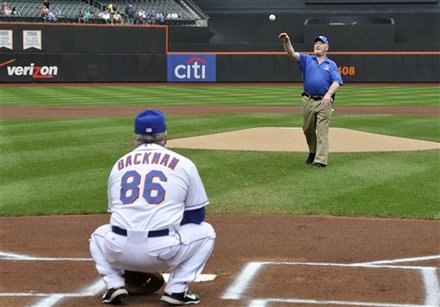
Pete Flynn throwing out first pitch before his
last game as Mets groundskeeper yesterday.

Pete Flynn's New York Mets career ended yesterday with the last game of the 2011 season. If you don't know Flynn's name that's understandable because Flynn was the team's groundskeeper and yesterday marked the end of his time with the Mets that began when the team was first formed in 1962.

Flynn is an Irish immigrant from County Leitrim. Although it's fuzzy now, I can recall what I thought the first time I heard Flynn's name and that he was from Ireland. My vague memory is that it had started to rain and the grounds-crew was rolling out the tarp to cover the infield and, I think, Flynn fell or got knocked over. Mets announcer Bob Murphy spoke his name, hoping Flynn hadn't been hurt in the fall. He then said that Flynn was from Ireland and that he had been with the team since the first days in the Polo Grounds.

Two things went through my mind at that moment. First that Flynn had been with the team since Day 1 seemed an incredibly long time in the past (this was around 1978). Next was that a man from Ireland had, what seemed to me, a dream job - tending the grass at Shea Stadium. "How does he know anything about baseball?", I wondered, not giving any thought to reality, which was that all Flynn really needed to know was grass.

____________
Read More:

Ireland used to produce baseball players

Conversion of an Irish baseball fan – how an Irishman in New York became a fan

Baseball in DC won't last
_____________

Flynn said it took him a year to understand the game after he first got the job with the Mets back in '62. It wasn't just baseball either. The Mets shared Shea with the NY Jets for 20 years and Shea also hosted many concerts, including most famously, the Beatles in 1965.

Even if being groundskeeper for the Mets was a dream job, I'm sure there were moments when it was far from easy. Shea Stadium wasn't very well built and Flynn had to contend with a field that didn't drain well.

After the Mets clinched the division title in 1986 Flynn was angry. The fans stormed the field and basically wrecked it. Flynn was angry at the club because they hadn't heeded his warnings about the need for security. He knew what was going to happen. He was angrier at the fans, saying they - we - didn't deserve a champion. There was no repeat of that destruction during the playoffs or after the final out of the World Series or any time since.

Flynn met all the great Mets, many great Jets, the Beatles, other rock stars and Presidents Nixon and Clinton. He witnessed all of Shea Stadium's special moments, including the Mets' World Series wins in 1969 and 1986. Yet, Flynn says the greatest thing he ever saw was the rain giving way to the sun over Shea just as Pope John Paul II came out to say Mass during his 1979 visit to New York.


In 2009 Flynn was inducted as a member of the Irish American Baseball Hall of Fame. No doubt about it, Pete Flynn had a dream job.

{Photo from Yahoo.com.}