Showing posts with label Irish history. Show all posts

Friday, October 4, 2013

Northern Irish town celebrates native son ... the man who burned Washington

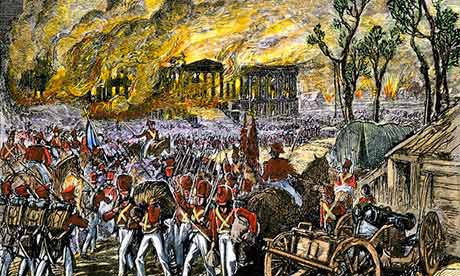
Painting of the White House in flames, August 1814.
From TheGuardian.com.

There is a conference over the weekend of October 18-20 based around the life of 19th Century British General Robert Ross, who was from County Down. Ross is a central character in one of the most famous incidents in American history yet very few Americans know about him.

It was Ross who led the British Army into Washington DC in 1814 and, as I learned in school, "burned the White House." It wasn't just the White House, though. Ross's troops set fire to the buildings that housed the Congress, to the Treasury building and essentially all public buildings, except for the Patent Office. Private property was generally not touched.

The burning of the capital city is a pretty shameful affair and it's no wonder that it is generally glossed over, save for a few lines about Dolley Madison's heroic efforts to save the portrait of George Washington. So it's understandable if Robert Ross's name is an unknown to most Americans. If his name were known it would probably be reviled.

Still Ross is probably the greatest enemy of the United States to ever come out of Ireland. He set out to humiliate the Americans and he succeeded. His motivation for wanting to humiliate the United States was probably part British chauvinism and part revenge for the Americans' burning of York (now Toronto), which was the capital of Upper Canada at the time.

Ross of Bladensburg¹ arms granted to family
of Gen.Ross. Note Army Gold Cross medal
& US flag on broken staff.
{Crest & Caption thanks to John McCavitt}
The capture and burning of Washington may have been the high water mark of Ross's career. Three weeks later he was dead, killed by a sniper during the (ultimately unsuccessful) attack on Baltimore (see Key, Francis Scott).

While at first it seemed something of an odd idea to me as an American to use "the most humiliating episode in American history" in a bid to woo tourists to County Down, specifically Rostrevor, the more I thought about it the more I found myself saying, "Sure, why not?" An awful lot of water has passed under the bridge in the 199 years since Washington was burned. Besides, it's just history. {I know what you're thinking - nothing is "just history" in Ireland - but we'll leave that alone for now.}

Thus the conference later this month to promote the life of Robert Ross. It's not just about Robert Ross either. Local man and Ross expert John McCavitt* (@) is on a one-man mission to spread the word about Ross, but also to discover and pass on the stories of all the Irish and those of Irish descent who played a role in the War of 1812 on both sides.

Look, I know the war of 1812 is not one that fires the imagination, at least not in America (see Canada. Maybe?). In Ireland or Britain it's hardly known (and the name "War of 1812" for a war that lasted 3 years? Source of mirth.) If you have an interest in history, especially the history of the Irish in America then head to Rostrevor for the conference. The line-up of speakers looks pretty good and if the weather's half-way decent that area is one of the prettiest in Ireland.

* McCavitt is also Convenor of this month's conference.

¹  Bladensburg refers to Bladensburg, MD where the Ross's British troops routed the Americans leaving the road to Washington wide open.

Monday, July 1, 2013

Ireland remembers JFK, but forgets the Irish in the American Civil War

Fr William Corby,
Chaplan NY 88th of
the Irish Brigade.
Gettysburg, PA
This week, July 1-3, is the 150th anniversary of the Battle of Gettysburg and it's being commemorated across America and especially at the battlefield itself all week. Unfortunately the anniversary will come and go in Ireland with barely a murmur.

Does this surprise me? Unfortunately, no. Yet, the Battle of Gettysburg should be remembered here as should the Civil War generally.

The Irish contribution to the American Civil War is simultaneously virtually unknown and grossly and dismissively exaggerated in Ireland. That the American Civil War involved a large number of Irish people and had a huge impact on the million or so post-famine Irish immigrants in America is barely acknowledged.

Nearly as bad is the off-handed way some talk about the war as being an almost entirely Irish affair. Such ignorance allows people to dismiss what it was really like for those Irishmen fighting a war to defend a nation that they'd only recently arrived in, a nation that didn't exactly welcome them with open arms.

Some Irishmen joined up because it was steady work. Others were simply drafted - they had no choice. Yet many enlisted because they felt an allegiance to the United States because, despite the lack of welcome, they had better opportunities for themselves and their families than they'd have had in post-famine Ireland. A number of those who had gone south fought for the Confederacy for similar reasons. There were also some on both sides of the Civil War who had joined the army because they thought the war would be quick and their military training would enable them to return to Ireland to lead a successful rebellion against British rule.

Whatever the reason for joining, they fought and they died in large numbers. Those deaths were felt keenly in the Irish ghettos in America and in Ireland, where family members who remained were left to mourn a death of a loved one in a war they probably only barely understood.

The 150th anniversaries of the start of Antietam and Fredericksburg - the Irish Brigade's worst day - passed without any real acknowledgment in Ireland so I actually expected nothing more this week.  I guess there was a small part of me that thought Gettysburg would be different simply because it's better known.

The quiet surrounding the Civil War anniversaries stands in stark contrast to the huge celebrations in June to mark the the 50th anniversary of the visit of President Kennedy. There were events in Wexford, the Kennedys ancestral home, Limerick, home to the Fitzgeralds and elsewhere across the country. Just about any place that could claim a connection to JFK or his visit had an official event to mark the occasion.

I think it's great that Kennedy's visit is remembered so fondly. His visit was a huge event for the young Irish state at the time, but it would have been nice if they had remembered some of what Kennedy said when he stood before the Irish parliament to deliver a speech that was followed by people across the country via television and, especially, radio.

His speech was about the "many and enduring links that have bound the Irish and the Americans since the earliest days." For Kennedy those enduring links were best exemplified by the Irish contribution in the Civil War. He chose to open his speech with a (somewhat garbled**) lesson on the Irish and the Civil War. He then presented a battle flag from the Irish Brigade to the people of Ireland.

Maybe that was the start of the problem. That flag was presented to the people of Ireland, but very few of them have ever been able to see it. It hangs on a wall inside the parliament building - Leinster House - where you can only see it if you work there or if you get an invite to visit the parliament.

Irish Brigade battle flag presented to the people of Ireland by
President John Kennedy, June 28, 1963.
{Photo from IrishAmericanCivilWar.com}

The Civil War battle flag should be in the National Museum where hundreds of thousands can see it each year. Moving that flag could be the start of a new understanding of the Irish contribution in the war and its impact on the Irish in America and in Ireland. Let's get going. Let's move that flag.

* There is one man in Ireland doing great work in promoting a change in the attitude towards the American Civil War – Damien Shiels (@irishacw). He writes a fantastic blog at http://irishamericancivilwar.com/

** Kennedy confused the date for the Battle of Fredericksburg, saying 13th September 1862 when he should have said December and put Fredericksburg in Maryland rather than Virginia.

Wednesday, September 19, 2012

The Irish Brigade at Antietam - passing on the stories of the Irish in America

Men of the 'Fighting 69th,' an Irish Brigade regiment.
{Photo from the 69th NYSV Historical Association}
Monday was the 150th anniversary of the Battle of Antietam, the bloodiest day in American history. On September 17, 1862 the Union and Confederate armies met in a wicked, and ultimately, indecisive battle in western Maryland that left over 20,000 Americans dead or wounded.

Given the large number of Irishmen who saw action in the American Civil War, that day must also rank up there as one of the bloodiest days for the Irish. General Francis Meagher's Irish Brigade, which included a portion, by no means all of the Irish who fought in the war, was in the thick of some of the deadliest fighting.

By chance I was in Albany, NY on Sunday and went to a lecture on the Irish Brigade in the American Civil War given by Siena College History Professor Tom Kelly (retired). Professor Kelly's talk ranged over the entire war, but as he pointed out that the Irish Brigade really made its name at two battles: Antietam and Fredericksburg.

____________
Read More:

AOH rededicate Boston cemetery to honor Irishmen who fought in Civil War

The Irish in the American Civil War: 150,000 in Union Army, 25,000 in Confederate

Compared with Gettysburg, no one goes to Antietam
_____________


Photograph of  dead Confederate
soldiers at the 'Bloody Lane'
after the Battle of Antietam.
{Photo from NPS.gov
Early in the war the Irish Brigade earned a reputation for valor and discipline in battle (and indiscipline and intemperance in camp.) Of course when a unit gets a 'good reputation' it is then often assigned to undertake the toughest jobs. That was the case for the Irish Brigade.

At Antietam the Irish Brigade was tasked with attacking Confederate troops, who were massed in a natural trench, a 'sunken road' created by man and nature over hundreds of years. Both the Irish Brigade attackers and the Confederate defenders suffered terribly.

When the battle was over the number of Confederate dead in the sunken road led to it being renamed as "Bloody Lane." The Irish Brigade's dead and wounded were also numerous and spread over a small bit of the large field immediately in front of the Bloody Lane. Half of the thousand men who went into battle that morning were dear or wounded by the day's end.

Professor Kelly had all of our attention as he relayed these details. I was standing in the back from where I could see that the audience was intensely interested in what he had to say.

I was late to arrive and like many couldn't get a seat for the talk. The event was in the Irish American Heritage Museum in downtown Albany and it attracted a lot more people than they were anticipating.

The  'Sunken Road' or 'Bloody Lane'
as it appears today.
Despite the size of the (admittedly mostly older) crowd, when one of the Museum's executives addressed us at the end he expressed a fear that interest in 'our Irish heritage' is waning, especially among the young. Like most who were there I was vaguely nodding my head in agreement. Yet later on when I was thinking about it I wondered how many of the grey-haired-heads in the audience were much interested in their Irish heritage when they were 20.

I would bet they were more interested in Elvis or Marlon Brando or Marilyn Monroe or Mickey Mantle than in the history of the Irish in the Civil War. In fact, given the proliferation in Irish Studies programs at American colleges I suspect that interest in 'our Irish heritage' has probably never been greater among the young.

What's important is that the stories of the old, the artifacts and details of history are not lost so that when today's young Irish Americans are older they can refer back and learn about the Irish experience in America. That's what makes organizations like the Irish American Heritage Museum in Albany and similar bodies across the country important. They're preserving those stories and artifacts.

There is no need for pessimism. Interest in our Irish heritage is going to grow, not wane, thanks to the Irish Studies programs, but mostly thanks to all the new technology that makes preserving the stories, history and even the artifacts so much easier than it was in the past. The Irish experience at Antietam and millions of other stories will not be lost. They will all be on YouTube.

Professor Tom Kelly delivering a lecture on the Irish Brigade in the
American Civil War at the
Irish American Heritage Museum, Albany, NY

Wednesday, July 11, 2012

Dun Laoghaire Harbour - few now emigrate from this beauty spot in Dublin

Dun Laoghaire Harbour from the more popular East Pier.
Dun Laoghaire Harbour in County Dublin is no longer the commerce and transport hub it was for more than a century after it was built in the 19th century, but it is still a functioning sea port. There is only one daily sailing from Dun Laoghaire (sounds - Dun Leary) these days, and even that is curtailed during winter months. Dublin Port has stolen Dun Laoghaire's thunder. Of course, Dublin Port would probably argue that Dun Laoghaire stole its thunder first and that turnabout is fair play. 


In the early 19th century Dublin was a growing city with a problem - it was difficult and dangerous to navigate a ship through the narrow channels that led into Dublin. The answer was to build a brand new harbor at Dun Laoghaire, eight miles southeast of Dublin.

Even before the harbor was complete - it took over 40 years to finish - Dun Laoghaire was busy providing a safe harbor for ships bringing goods and people back and forth to Britain and further afield. Dun Laoghaire was connected to Dublin by one of the first suburban rail lines in the world. 

Of course this being Ireland, one of Dun Laoghaire's less happy functions was as point of embarkation for many of those who emigrated from Ireland over the past 170 years. Most of the emigrants who left through Dun Laoghaire would have landed at Liverpool, where many settled and many others found further passage on ships going to America or Canada.

Emigrant Ship by Edward Hayes, 1853
{From the National Gallery of Ireland.}

Dun Laoghaire remained a pivotal trading hub for Dublin until recently, when new roads to Dublin port attracted away most of what was left of Dun Laoghaire's shipping traffic. Today traffic in Dun Laoghaire Harbour is mostly pleasure boats. There was a proposal a few years ago to develop a "Diaspora Centre" on a small disused pier, but I haven't heard too much about that recently.

____________
Read More:

Beautiful day for a walk up Dalkey Hill, one of Dublin's jewels

Synge's lover brought to life

Ship surgeons spurned famine and convict Irish
_____________

So Dun Laoghaire Harbour is mostly used by sailboats, but the piers themselves are also a great amenity. People come from all around to walk the piers. The East Pier, which is the most popular for walkers, rollerbladers, etc, is a mile long and finishes at the lighthouse, which is surrounded by a small 19th century fort.

The fort was recently opened to the public. It's not the most interesting old structure in Ireland, but it's having a quick look around. You do get a good view of Howth in the distance and the town of Dun Laoghaire, of course.

I always like walking the pier and inevitably as I walk back I take a good look at Dalkey Hill, which is a couple of miles away. The rock used to build the harbor was extracted from Dalkey Hill. I don't know if quarrying the rock, transporting it to Dun Laoghaire and building the harbor was an engineering marvel or not, but it always impresses me.

Today that disused quarry is part of the beauty of Dalkey Hill and useful for rock climbers, who like the sheer drops the quarry provides. Nature has covered over what I'm sure was a man-made eyesore and just down the hill the man-made harbor still tames nature.

From the end of the pier looking back towards the town of
Dun Laoghaire, County Dublin.

Tuesday, April 24, 2012

A story begging for Hollywood - surviving the mid-Atlantic plane crash

A Lockheed Constellation 1049H – the plane that ditched in the Atlantic on 9/23/1962.
Until yesterday I'd never heard the story of Flying Tiger 923, a flight from New Jersey to Frankfurt, Germany that crashed in the Atlantic Ocean 500 miles off the Irish coast on September 23, 1962. What makes the story remarkable is that of the 76 people on board 48 survived.

I stumbled across this story in a local Colorado newspaper, which had an article about one of the survivors.  Fred Caruso is in Ireland to mark the 50th anniversary of his lucky escape. At first I thought it was possible the local Colorado paper had the story wrong, but a few minutes of Googling told me it was true. There was no shortage of links with information, including the cold, official government report into what happened. However, most of what's available comes thanks to Caruso. Caruso is using his web site FlyingTiger923.com to tell the story of Flight 923*.

I can only imagine that Caruso thinks there's a story to tell here. I'm just amazed it's taken this long for it to be told (or retold as was a news item at the time). I can't believe it hasn't received the big Hollywood treatment.

I don't know about you, but when I board a plane that is going to cross an ocean the one thought that never goes through my mind is that I might actually survive a catastrophic incident. The idea that something might actually go wrong with the plane and the pilot might have to improvise a landing strip occurs to me regularly, but never over the sea. I always assume that if something disastrous happens over the ocean that I'll be soon landing in the next life.

Sure I know Captain Sullenberger managed it. He managed to land on water, but that was the Hudson River, not the Atlantic Ocean.
____________
Read More:

Ireland remembers 329 victims of Air India bombing

Cork plane crash survivor cheats death twice
_____________
Flight 923's Captain John Murray** landed his plane, mostly intact, on the ocean in waves up to 20 feet in height. It wasn't a smooth landing nor did everyone survive. The left wing tore off, the plane broke in half and 25 people were killed. It's still a tremendous feat, allowing more than half of the passengers and crew to live.

A landing, safe or otherwise, in the middle of the ocean is a guarantee of nothing, other than that death has to be defied again. The plane was equipped with five life-rafts. However within seconds four of them were blown away, out of reach, gone. The one remaining life-raft was designed to carry 25 people, but 51 were alive in the freezing waters around the ditched plane.

They all clambered aboard, some of the injured were helped by others into the overloaded inflatable raft. Then they waited. And drifted - nearly 22 miles from the crash site. The fact that there were far too many in the life raft meant it was cramped and uncomfortable, but probably saved them from freezing to death. After 6 hours the Celerina, a Swiss freighter that had monitored the SOS messages, found the floating survivors.

A Canadian aircraft carrier, the Bonaventure, was also monitoring the distress calls. Despite the stormy conditions the naval ship's helicopters ferried medical supplies to the Celerina and removed the most severely wounded. Later, when the Bonaventure was near Ireland, the helicopters again transferred the wounded to Shannon Airport.

The Swiss freighter arrived off the coast of Ireland two days after the plane crash. British helicopters removed the 17 remaining wounded. They were treated at Mercy Hospital in Cork. Fred Caruso was among them. He's back now to visit to mark the anniversary of those remarkable events and to thank those who helped him 50 years ago.

The past few weeks our televisions have been full of dramas and documentaries on the extraordinary tale of the sinking of the Titanic. I would have thought these events on the Atlantic exactly 50 years after the Titanic would merit at least some attention from Hollywood. This is a great story and it needs a big audience.


* Caruso has also published a book on the subject, Born Again Irish, the title of a reflection of the good fortune he felt to be alive in Ireland in September 1962.


** Captain John Murray moved to Ireland after the crash and flew out of Shannon Airport.

{Photo thanks to Avia Deja Vu}

Tuesday, April 17, 2012

Belfast's new Titanic center needs a little more 'Hollywood'

Titanic Centre, Belfast
I went up to Belfast on Saturday. In fact, the whole family went to Belfast on Saturday to go to the new Titanic center there and to be part of Belfast's Titanic festival.

It still amazes me how much I know about the Titanic these days. Before 2007 I knew no more than anyone else who ever watched A Night To Remember. I hadn't (and still haven't) seen Kate and Leonardo in Titanic from the mid 1990s. When I think back to the 80s the fact that someone found the Titanic only barely registered.

All that changed after my (then) 7-year-old son saw A Night To Remember. Who can understand the workings of a the 7-year-old's brain, but from that experience was born an obsession. He had to know more. No, he had to know everything.

Birthday and Christmas presents included Titanic books and Titanic DVDs - movies and documentaries. There is a cartoon Titanic movie and Barbara Stanwyck starred in a movie called Titanic released five years before A Night To Remember. Who knew? Not me anyway.
____________
Read More:

Belfast pulls out all the stops for Titanic anniversary

Cobh remembers the Titanic - last stop before the ship set sail in 1912

The Titanic Centenary - An Irish Central Commemoration
_____________

We indulged him, probably too much. We took him to Belfast for the first time in 2008. The memory still makes me laugh. We drove to the Harland and Wolff shipyard to show him the place where the Titanic was built.

My son, smiling, at Harland and Wolff, Belfast 2008.
Note the pile of rubble behind the rusty gate.
We were all looking at an industrial ruin, but he was seeing something else, something tangible to connect him to this legend he had been reading and learning about. His face was lit up with excitement. We took a free tour of the shipyard run by enthusiasts and he loved every second of it. We stood in a huge, wreck of a room, but it was the room where the Titanic was designed. He was thrilled.

Since then we've been back up to Belfast a couple of times to visit Titanic sites and exhibitions. We have also been to Cobh and Southampton touring both cities' Titanic-linked sites. We even made it to the Titanic Museum in Indian Orchard, MA.

Thanks to his keenness we have all learned a great deal about the Titanic, thrown ourselves into his interest and although some are more enthusiastic than others, I think it's fair to say we were all looking forward to the visit to the new Titanic center.

I don't want to say we were disappointed, but we were far from blown away. I came away hoping - hoping because I really want Belfast to get this right - that this was really a first effort and the exhibition can be changed to make it better.

Given that all the reviews I've seen have been glowing I'm feeling sheepish about my misgivings. However, I thought it was missing something. There are too few actual artifacts to call it a museum and there was far too much reading to call it an interactive or multimedia experience. There was so much reading, in fact, that I left with my head hurting and a sense that I'd missed a lot.

The centerpiece - the five minute 'Shipyard Ride' - fell far short of my expectations. I thought it would be a Disney-esque journey up and down, inside and outside the Titanic. Instead it was really minutes sitting down looking at recreated scenes of men working. There was no real sense of scale, which is what I was expecting.

I guess I was kind of surprised by how 'high-brow' the whole thing was. We weren't allowed to see, let alone climb, the grand staircase. They did put one in the building, but it's off limits to those plebes who merely paid for tickets to visit. Also, the building is a series of ships bows, but nowhere in the center are visitors given that "I'm standing on the bow of the Titanic" moment that I was sure would be there. There should be an outdoor Titanic bow.

There is also very little for younger children. The few hands-on exhibits for kids are a little dull and seem more adult or at least teen-focused. I was really surprised by this because when he was seven my son loved the Titanic experience he got up the road in Holywood, Co Down when we visited the Ulster Folk and Transport Museum. I just assumed the new center would borrow heavily from that.

My son, now 11, and the Titanic in the new Titanic Centre in Belfast
I don't want to be too negative. We did have a good time. I enjoyed lots of it and my son loved more. He loved the giant photographs, the model of the gantry, the giant models of the ships, the staterooms, etc. Maybe my expectations were too high.

I just can't help thinking it's a little too much history and too little Hollywood, especially too little Disney. After all, the reason we all still recall Titanic when other tragic ships are all but forgotten is thanks to Hollywood. Belfast needs to remember that.

Tuesday, April 10, 2012

Belfast deserves no criticism for cashing in on its Titanic links

Titanic Belfast - opened on March 31
Belfast is catching flak thanks to its Titanic Belfast Launch Festival. While I can understand some of the misgivings, I'm more than willing to cut Belfast some slack on this one.

Belfast man William Neill, now a Professor of Urban Planning at Aberdeen University in Scotland, was one of the more quoted critics in recent weeks. Neill worries that the memory of the Titanic is not being "treated with enough respect." Neill acknowledges Belfast's shipbuilding history and it's "unique" place in the Titanic story, but is concerned that the city is trying to cash in with Titanic "infotainment" with its new Titanic center.

While Hill may have a point, other critics went completely off the deep end with their narky comments. One columnist even compared the Titanic's sinking with Auschwitz and 9/11, saying that in "2101, it's unlikely the people of New York will want MTV staging a concert at Ground Zero."

Let's get this out of the way: there is no comparison between the Titanic and Auschwitz or 9/11. None.
____________
Read More:

A Mayo village recalls the Irish who perished aboard the Titanic

James Cameron documentary shows new animation of how the Titanic sunk

The Titanic's Centenary
_____________

Now, to be honest I found the decision to have an MTV concert this coming Friday a little weird too. However, the people of Belfast are not 'celebrating' Titanic's sinking, let alone the 1500 dead, but rather the achievement of getting the Titanic Centre built. Maybe Belfast didn't get the tone of this coming weekend pitch-perfect, but so what?

The crux of the issue for the critics is that Belfast is trying to use its Titanic connection to earn some filthy lucre. For these people Titanic and her dead should be remembered mournfully without fanfare and certainly without the ringing of cash registers. I say 'hooey' to all that.

First of all, nobody can say Belfast was quick off the mark to market its Titanic connection. It's taken them 100 years. People have been making money off the tragic events of April 14-15, 1912 for decades, but only now is Belfast trying to join them. I wonder if these same people criticized James Cameron for his Titanic or even Walter Lord for A Night To Remember for the same reason? Those two and everyone else associated with those movies were, after all, cashing in on the same tragedy with their own "infotainment." In fact, those movies created the 'Titanic industry' we have today. I see no reason to fault Belfast for getting in on the act.

Also, what about the dead? Would they really be remembered more appropriately if there were no Titanic "infotainment?" We can compare the Titanic's dead to those of other shipping disasters from the same era. How many of the 1,012 dead are remembered from the 1914 Empress of Ireland disaster? How about the 1,021 who died when the General Slocum burned and sank in New York's East River? How many New Yorkers remember even one of those people? I daresay virtually none.

Yet all this week stories of the victims of the Titanic are being aired again. Why? Because of the fanfare and "infotainment." Without that only a few would care about Addergoole, Co. Mayo and even fewer would care about Patrick Dooley or Charles Melville Hays or even the musicians who played right up to the liner's last minute. If not for the 'infotainment' the stories of the lucky survivors would be just about forgotten now. There would be no Encyclopedia Titanica online. So spare me your tears because the choice is not between remembering with respect vs "infotainment," but between forgotten and infotainment.

Also, Belfast just deserves a break. The city is only now waking up from a long nightmare. Other than 'the Troubles' what do people know of Belfast? Nothing much really, but the Titanic is a cultural icon, the subject of successful movies, commemorated in many cities with monuments and museums. Yet Belfast's connection to the Titanic* is only rivaled by Southapmton's.

The Titanic is a tragedy, sure, but it is long in the past. There is virtually nobody alive today who remembers the Titanic or who lost a loved one on the Titanic. It was a tragedy on a par with other long forgotten maritime disasters of the era. It was far less a tragedy than the one that unfolded in Europe between 1914 and 1918. Indeed, the Titanic is less a tragedy than what Belfast endured during 'the Troubles.'

That the Titanic is remembered at all is thanks to the entertainment industry's capacity to turn a horrific but largely accidental event into a romantic tragedy. Belfast is - finally - connecting itself to the legend, the myth of the Titanic. It is not cashing in on anyone's grief.

* Let's just keep that whole rivets thing quiet, okay?

Saturday, March 17, 2012

Ireland needs a "Cooperstown" for St. Patrick and Americans can help

St. Patrick - Hill of Tara, County Meath
St. Patrick's Day. A world-wide festival celebrating all that's great about being Irish and Ireland. It's upon us again and that's no bad thing. St. Patrick's Day puts us in a good mood. Heck, it puts the stock market in a good mood.

When you think about the size of Ireland the "brand awareness" of St. Patrick's Day is incredible, although the loud, celebration-style St. Patrick's Day is an American invention. In Ireland St. Patrick's Day was traditionally a Holy Day - the pubs were closed and Catholics were obliged to attend Mass*. In recent years St. Patrick's Day has turned into something of a nation-wide party in an attempt to steal some of New York & Boston's thunder.

St. Patrick's Day. If you break the name down you realize it's a day named after a person - Saint Patrick. There are very few people in Irish history who are better known than Saint Patrick, other than the four members of U2 of course. (Yes, I'm ignoring St. Patrick's Welsh birth, etc.)

St. Patrick is an important person in Irish history. He brought Christianity to Ireland and the Irish took to it like ducks to water. Not long after Patrick's death the Irish were sending out missionaries throughout Dark Ages Europe, bringing the faith and learning to the peoples of Europe and saving civilization.

So Patrick was, as it turns out, crucial to all of Europe, not just Ireland.
____________
Read More:

Top ten locations for St. Patrick's Day

Belfast pulls out all the stops for Titanic anniversary

County Down
_____________

Given all that, wouldn't you imagine that somewhere in Ireland there would be a mega-center catering to all those who want to know about St. Patrick? Don't you think there'd something touristy to appeal to the keen and, more importantly, the vaguely interested?

I have no solid ideas right now, but I'm not talking about something sedate and high-minded. I'm talking about something that will attract a lot of people. For this to work I think we'll need a lot of American input because let's face it Americans know best how to turn the teeniest bit of history into a mega tourist center. (If you don't believe me, go to Cooperstown, NY and then read the truth about Abner Doubleday and his role in the development of baseball.)

That to me is the model - "Cooperstown" devoted to St. Patrick, only one that's easier to get to than Cooperstown is. A place completely committed to telling the story of Patrick and and all the knock-on effects his mission to Ireland has had.

So the need for "Patrickstown" is established, but where?

There are places all over Ireland that can claim some connection to Patrick. There's Tara, Co Meath where he stood up to the pagan powers that ruled Ireland and won them over to Christianity. There's Armagh, where he established his main church. There's Croagh Patrick in Mayo, where Patrick fasted for 40 days. And then there's Downpatrick, where St. Patrick is buried.

"Whoa!," I hear you yell. St. Patrick's grave is known? Well, it's one of those things where you don't want to look for too much by way of evidence, but yes there is a grave in the grounds of Down Cathedral that is (supposedly) St. Patrick's grave. That gives Downpatrick a solid claim to be the host of the St. Patrick mega-center, but I think it's really too far off the beaten path like Cooperstown.

{There is a Saint Patrick Centre in Downpatrick. I was there last November. What's it like? Well, I'd like to tell you it was great, but I can't. I can't even tell you it was terrible because I couldn't get in. It was closed. It's only open part of the year—not what I have in mind.}

St. Patrick's grave - Downpatrick, County Down
Deciding where to locate the St. Patrick mega-center is another issue where American input can help. Any official attempt at developing a St. Patrick mega-center is going to lead to some heavy-duty lobbying for the various contending locations. Oh, and there's the whole north-south thing too. No harm having an independent American perspective given that complication.

We need a big solution to a big hole in our tourism offering. We need help from people who are indifferent to the pleadings of a dozen possible locations and tuned out to the problems associated with the border. All we really need is a proper business proposal and business plan for the creative attraction that respects the truth and real history on as far as makes sense for the project. The St. Patrick mega-center needs America.

* It's still a Holy Day of Obligation here, probably one of the better observed Holy Days.

Tuesday, March 6, 2012

Belfast pulls out all the stops for Titanic anniversary

RMS Titanic at the dock in Belfast - 1911 
Did you know this is the 100th anniversary of the maiden voyage and sinking of the Titanic? If you have recently been to Belfast, where the Titanic was built, there is no question that you would know because Belfast is going all out to mark the Titanic anniversary.

This is in stark contrast to how Belfast has dealt with its Titanic legacy for most of the past century. In fact, unless you knew before-hand where the Titanic was built, you would have been hard-pressed to find any sign at all that the great liner spent most of its short life in Belfast. The ship's sinking, the collapse of the ship-building industry generally in Belfast and, of course, 'the troubles' all took their toll. Memory of the Titanic wasn't so much swept under the carpet as allowed to rust and decay, much like the shipyard where it was built.

Even after the Good Friday Agreement in 1998, when the atmosphere of Belfast was transformed and the city sought to bill itself as a tourist destination, the Titanic was ignored. This was despite the fact that James Cameron had boosted the Titanic from fading tragic memory into a cultural icon, a romantic tragedy thanks to his massively successful movie.
____________
Read More:

New Titanic tourist attraction will exceed expectations

Titanic commemorations will be bigger than the Olympics, say Fodor's

Titanic tourism - opportunity for Belfast, all of Ireland
_____________

That's all changed now. This year Belfast will host a two week Titanic festival starting March 31. The city is going all out to celebrate its links to the most famous passenger ship in history. The itinerary includes: talks, exhibitions, plays, concerts, and Titanic the Musical, which I'd never heard of, but which won five Tony awards back in 1997. And, of course, there is Belfast's new Titanic Visitor Experience, which opens on March 31 and which I'm hoping to get into sometime in April.

There literally is 'something for everyone.' In fact, so wide-ranging are the various events that they're a bit jarring. On Saturday, April 14 there is a concert in St Anne's Cathedral titled "Requiem for the Lost Souls of the Titanic." To me the Titanic is so far in the past that anything with the word 'requiem' in the title seems a bit of a stretch. Yet, maybe there are others - children and grandchildren of those who built it, perhaps? - who feel the Titanic's loss still and for whom a requiem is appropriate. It doesn't suit me, but it's not inappropriate either.

Titanic Building, which will host the 
Titanic Visitor Experience
Photo – Feb 2011
However, the night before the St Anne's concert there is going to be an outdoor MTV concert at the place where the Titanic was built. I don't know about this one. I know it'll appeal to the younger generation (presumably - no line-up of acts is available yet), but 1,500 people did die on the Titanic and despite the fact it was a long time ago an MTV concert is knocking on the door of tackiness. There is definitely a disconnect between the series of commemorative events on offer and this MTV show, which will have to feel like a celebration more than a commemoration if it's to be a success.

What's ironic is that as James Cameron giveth he may also taketh away. Cameron's latest Titanic project is to get to the bottom (sorry about that) of what happened to the liner. On April 8 Cameron will present a two-hour special on the National Geographic Channel that Cameron describes as the "ultimate cold-case investigation into the tragedy."

Cameron will have a team of experts going through all the latest evidence as to what happened to the Titanic, what went wrong and, threateningly, who is to blame. I say threateningly because unless Cameron has unearthed something completely different he will be most likely talking about the quality of the metal used to make the rivets.

If that is Cameron's conclusion then the effect of his program will be to place the blame squarely on the Harland and Wolff shipyard where the Titanic was built. Although it's always been muted, the attitude of Belfast has long been that the Titanic's sinking wasn't 'their fault,' summed up by the usual refrain of "She was fine when she left here." The truth is she may not have been fine when she left Belfast and it may stick in the craw of those whose fathers and grandfathers built the Titanic. They may hope this is the last they hear of the Titanic's Belfast connection.

Tuesday, January 17, 2012

When Steve Jobs and Apple first came to Ireland

Steve Jobs opened plant in Cork in 1980
December 23, 1980 and thousands of Irish people were facing the prospect of no electricity on Christmas Day. The basics of modern life - electricity, telephones, indoor plumbing - were still relatively new in Ireland then. Anyone describing the modern, telecommunications-dominated world of today would have sounded like a science-fiction writer, not a businessman about to open a new factory. Yet, Steve Jobs was in Ireland talking about the future.

My wife and I were going through boxes of my father-in-law's papers and pictures over the weekend. We found a treasure trove of genealogical tidbits such as dates of birth, marriage certificates, which provide lost maiden names, etc.

There were also a few old newspaper cuttings, which are always interesting. Airplane, The Blues Brothers, Brubaker and The Shining were among the movies playing that Christmas in Dublin.

There were a couple of news items that caught my eye.

Christmas, of course, was a focal point. An industrial dispute at the national electricity company threatened to leave many people in the west of Ireland with no electricity for Christmas. I don't know how that turned out. There was an article about a man spotted stealing a piece of buttered bread from the sparrows and feeding it to the ducks. They were simpler times.

There was a short item on a speech by Pope John Paul II, who was warning of the dangers that arise when political blocs "seek to assert their rights over small nations." Although he was alluding to his native Poland, Ireland in 2012 is being squeezed very hard by the political bloc that currently controls the European Union.

There was, however, one article that really stood out, that leaped off the page. An American company was opening a new factory in Cork and the the head of that company was saying some radical things. The company was Apple Computers and the man was Steven Jobs (or Stephen Jobs - the caption writer didn't agree with the journalist).
____________
Read More:

Bono brands Steve Jobs the Elvis of the computer world

In Cork Steve Jobs found the perfect match for Apple

Steve Jobs was a great American genius
_____________

You can sense journalist Dick Cross is skeptical where he writes that "Irish housewives could be throwing away cookery books and taking their recipes off the screens of mini computers" and doctors will similarly store and retrieve patient histories. Cross' skepticism is tempered when he notes that Jobs has become a "millionaire in just four years."

Cross wasn't the only non-believer in attendance at the opening or at least his report indicates he wasn't. "At the Holyhill, Cork, assembly plant there is no time clock to monitor the coming and going of the workers. Many experienced trade union people lifted their eyebrows in disbelief at the concept." Jobs trusted his employees, but that was clearly not the norm in Ireland in 1980.

Nothing earth-shattering in the report, but I couldn't help wondering what those tough union folks made of Jobs and Apple over the 30 years since the Cork plant opened. Did they regale people with stories of how they were there when it all started, how they could see it in his eyes that he and Apple were going to be wildly successful and that the people of Cork were on a winner from the start? Or did they admit that they thought he was a loon and that his way of doing business would never work in Ireland?

These days "Irish housewives" don't save recipes on their "minicomputers." They call them up from the web using their iPads. Irish doctors presumably store all sorts of patient data in computer databases, although based on what I heard from the Minister for Health this morning, our hospitals have a way to go on this yet.

I don't know if other people shared Jobs' vision back in 1980, but I bet there were very few in Ireland. Possibly none, although I bet those who were the first employees of Apple in Ireland were quick converts. I can well imagine that many who read that report simply thought to themselves that they'd be happy if they could get a reliable telephone and electricity supply. They probably didn't so much disbelieve Steve Jobs as assume he was actually from "a Galaxy Far Far Away" from Ireland.

Friday, November 18, 2011

Ireland's sovereignty is probably gone for good

Enda Kenny & Angela Merkel
Enda Kenny and Angela Merkel
before this week's Irish-German spat
There is uproar in Ireland today following yesterday's revelation that last night the German parliament discussed an Irish government document on its budget for next year. Many people are outraged that our tax rates, welfare payments and other government expenditures were discussed in Germany's parliament before it was up for debate in Ireland's parliament. The Irish government is outraged that the document was leaked.

Why is the government so shocked? The shock is mostly contrived. Taoiseach (Prime Minister) Enda Kenny tried a bit of the tough guy act in Germany yesterday and his German counterpart called his bluff. The budget document was leaked by the Germans as a way of letting Kenny know that he's not in control; they are.

I don't understand why so many others, especially in the Irish media, are outraged. Haven't these people been paying attention? We had to be bailed out back in November 2010. We're still beholden to those who bailed us out. Yet the media is acting as if the implications of the bail-out are a complete shock. The penny only finally dropped today.

"Germany is our new master" is the headline across the today's front page of the Irish Daily Mirror.

Yet, Germany has been "our master" for more than a year. Ireland is not a sovereign nation. We have been giving away bits and pieces of our sovereignty for the better part of 25 years, but all pretense at being a sovereign nation evaporated last year when, essentially, we entered Chapter 11. That's the way it goes.
____________
Read More:

Enda Kenny lays down the law to Chancellor Merkel

IMF appoints Dublin representative to oversee bailout

Ireland has a new Chief Secretary
_____________

The hard truth is our sovereignty is probably gone forever. German Chancellor Angela Merkel has said that in exchange for Germany committing to fixing the problems in the euro she is seeking a fiscal union across the Eurozone (the 17 EU nations that use the euro). This is what triggered Kenny's tough talk - he told Merkel that her plans for a fiscal union were a step too far.

Yet as last night's leak makes plain, we have limited choice in the matter. If the Germans want a fiscal union, they'll probably get one. The only decision left to us at that stage will be do we want greater sovereignty and greater hardship or less of both? We will get a vote on it, but if we vote yes - as I suspect we will - that will mean the end of independence.

We will head towards the centenary celebration of the 1916 Easter Rising against British rule knowing we spent roughly the first half of that century trying to achieve greater independence and the second half giving it all away again. By 2016 we will have completed a century long swap of British rule for German.

Tuesday, November 1, 2011

John Barry - Irish hero of the United States

John Barry,
Philadelphia
John Barry, Irishman and "father of the American navy" seems to be finally getting some of the recognition he's long past due. The most important development is the decision of the United States Naval Academy to erect a memorial to Barry, thanks to the efforts of members of the local branch of the Ancient Order of Hibernians. In addition, a recently published biography of Barry is the first in 72 years. I'd love to imagine that Barry will also receive some national attention in Ireland, where he is mostly known in his native Wexford.

I have visited Philadelphia many times and each time I've taken a moment to look at the statue of Barry. It's not hard to find. It's in Independence Square, right in front of Independence Hall.

You can't miss it, but from what I've seen on my visits very few people actually pay any attention to the man whose statue greets them on exiting the building. During my visit there this summer the thought crossed my mind that many tourists from Ireland probably go on the Independence Hall tour and leave the area without ever realizing that the man who greets them in this quintessentially American location is an Irishman.
____________
Read More:

His Brother's Keeper: Commodore John Barry, Father of the American Navy

A Voyage of Rediscovery: the Irish America Hall of Fame at the Dunbrody Emigration History Centre

Notre Dame vs Navy will be security nightmare for Ireland
_____________
It's a shame that Barry is not better known - in America and Ireland - because Barry's story, while hardly unique, is fantastic. He grew up a poor kid in Ireland. His family was forced to leave their farm, supposedly by the landlord, and move to the coastal town of Rosslare. He was drawn to the sea, began working on merchant ships as a young boy and eventually sailed into Philadelphia, where he settled.

When the Revolutionary War broke out Barry, who was then captaining merchant ships, volunteered for and was given the task of outfitting fighting ships. He had a successful war as commander of a of a number of ships and even fought as a marine with Washington at Trenton and Princeton, while his ship was in dry dock. Barry's success during the war was rewarded later by President Washington, who made Barry the first head of the new United States Navy.

John Barry, Wexford
(photo: Paddy Donovan)
Philadelphia is not the only city with a Barry statue. There is one in Franklin Square in Washington, which I have not seen, and one in a prominent place in Wexford, which was a gift from "his grateful countrymen to the people of the land from which he sprung."

{Maybe it's my combative nature, but I prefer the Wexford statue that depicts Barry with the sword in his hand. In the Philadelphia statue he's pointing his hand and his sword is in its scabbard.}

While you can't miss Barry's statue if you visit Philadelphia, you can miss his grave. I know because I did every time I visited until this year. His grave is well worth visiting, however, and it's only three blocks away from the statue. {Although on the day I visited this summer - July 23 - it was over 100F and those three blocks seemed an awfully long way.}

Barry's grave is in a beautiful setting and well maintained in Old St. Mary's Church yard. The epitaph on his tomb, restored in the 1870s, is poetic. It begins with:

Let the Christian, Patriot and soldier
Who visits these mansions of the dead
View this monument with respect.
Beneath it are interred the remains of
COMMODORE JOHN BARRY
Father of the American Navy.
He was born in the County Wexford in Ireland
But America was the object of his patriotism
And the theatre of his usefulness.


Barry is not the only prominent Irishman buried at Old St. Mary's. Thomas Fitzsimons from Wicklow, who signed the Declaration of Independence, and General Stephen Moylan from Cork, who during the Revolution was Quartermaster General, Aide to General Washington and finished the war as a Brigadier General, are both buried there. These two, along with Barry, put Old St Mary's high on the list of important places in Irish-American history.

John Barry's grave
Old St. Mary's Church, Philadelphia