Showing posts with label Irish Politics. Show all posts

Friday, July 12, 2013

Nanny state reversal - Ireland's elected representatives need to be nannied

Tom Barry TD, disgraced himself and Ireland's
parliament when he dragged fellow TD,
Áine Collins into his lap in the Dáil.

To those outside Ireland today's Irish Times headline might seem opaque or of minimal importance, but to Irish people it speaks volumes: "Dáil bar stayed open until 5am."

The Dáil is the lower, but more powerful house in Ireland's Parliament, the equivalent to the UK's House of Commons. The Dáil has its own bar, one that is the subject of occasional light-hearted media coverage and occasionally the subject of what sounds like serious envy among those who are never invited in. The Dáil bar is exactly what you think it is, only with cheaper prices so that our elected and highly-paid representatives (TD's) can enjoy a tipple (or tipples) without overextending themselves financially.

Not to be a spoil-sport, but the Dáil bar should be shut down. Now. For good.

Early yesterday morning during an all-night debate one of our elected representatives, Tom Barry, pulled another of our elected representatives, Áine Collins, into his lap and held her there for a short while before letting her go. Inside the debating chamber. If it hadn't been for the live TV cameras none of us would be any the wiser.

That short, silent clip shouted out a few different things to Irish people and social media exploded early yesterday as that clip 'went viral.' Some saw in it that sexism is still an issue in Ireland. Others were simply appalled that this sort of thing could happen when the Dáil was supposed to be engaged in a serious political debate, one that required an all-night sitting. One or two hinted at the truth, which emerged later: Deputy Barry had been drinking in the Dáil bar.

This isn't the first time alcohol has been implicated in the affairs of the Irish state. There are rumors that many of the TDs were three sheets to the wind on the night they voted to approve the state guarantee of the country's banks, which eventually bankrupted the nation.

I don't care if clear headed TDs would have made no difference in how they voted. It's the principle of the matter. I can't think of any other job where drinking while on duty would be tolerated. Sure they might be working late, but they don't work year-round and they make a very good wage. If they have to put with a few late nights, tough. They should be able to do so without knocking back a few cold ones to make the work more 'interesting.'

I honestly don't understand why the Dáil needs a bar in the first place. Very few offices have one these days. On top of that, if there's one thing that marks the Dáil of recent years it's that it's full of busy-bodies: chock full of people who want to compel us by law to change our ways when it comes to drinking.

It's true Irish people probably do consume too much alcohol, but before our elected officials want to rule out drinks companies sponsoring sporting events or force supermarkets to raise the prices on beer and wine, why don't they try leading by example. They should collectively announce that they don't need a drink to get through their workday and that the Dáil bar is being shut down.

I can't imagine that happening because for our elected representatives it's a case of "do as I say and not as I do." They would much prefer to bar us from getting cheep booze than ever endure the same thing themselves.

Besides I don't want to give them a noble option. I'd rather see the Dáil bar shut in the face of our TD's opposition.

The Dáil bar should be closed because our representatives should not be drinking on the job on our dime. We pay their salaries and we pay to subsidize their cheap alcohol. Let them go to the pub or buy their own for home consumption like the rest of us. While we're at it, let's force them to take sobriety tests before they're allowed to enter the Dáil chamber to debate or vote.

It's about time we did an about turn on the 'nanny state.' We don't need the government to nanny us, but clearly, based on yesterday's antics, they need us to nanny them. Let's start by shutting the Dáil bar ... for their own good, of course.


Friday, February 8, 2013

Ireland and the debt deal - 24 hours of farce and high drama

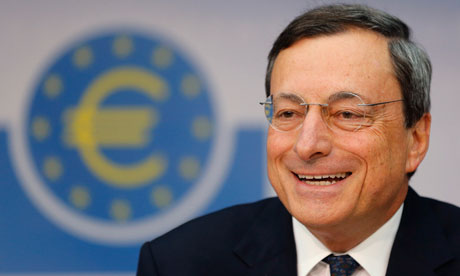
Mario Draghi, head of the European Central Bank.
The end is nigh; the sky is falling. We're all doomed, doomed I tell ya. That was Wednesday night in Ireland. It was as if the end-times had arrived.

It was a very strange 24-hours from Wednesday afternoon to yesterday afternoon. It all started with breathless reports on banking and Ireland's national debts from Irish reporters in Frankfurt. There were leaks and rumors: the Irish government had secured a deal on the bank debts that the state had absorbed. What that deal was, nobody could say exactly, but we had "a deal."

Part of the deal involved the liquidation of the Irish Bank Resolution Corporation (IBRC), which was established by the government in 2011 as something of a banking hospice for the brokist, most bankrupt bank on the planet - Anglo-Irish Bank - and its little brother, another broke institution, the Irish Nationwide Building Society (INBS). Anglo is the Bank that Broke Ireland.

So far, so good you might think. Well, maybe not for the 800 people employed by IBRC, but given how hated Anglo-Irish was there didn't seem to be a whole lot of sympathy for those people.
____________
Read More:

Enda Kenny announces deal on Anglo-Irish debt with European Central Bank

Trial date for disgraced Anglo Irish Bank boss Sean FitzPatrick set for next January

Ireland has a new Chief Secretary
_____________
As Wednesday evening turned into night that's when things started getting strange. The details of the deal were not forthcoming and then the noises from reporters with contacts "in Frankfurt" (that is, the European Central Bank - ECB) began to sound ominously like there was no deal after all.

That's when the mood of television and radio reporters went from baffled to aghast as they found there were no answers to their questions. That's also when Irish tweeters went bananas.

There was nothing on the debts, but the IBRC liquidation was going ahead. That required government involvement because everything had to be finished by 7am Thursday morning, although we weren't told why. In order to get that done the Dáil and Seanad (Ireland's lower and upper houses of parliament) would have to have a late, possibly all-night, session. We were also told that the President was cutting short his state visit to Italy so he could return to sign the bill into law on Thursday morning.

It may not sound like the makings of a high drama, but it really was. All the frantic confusion evident in the government's rushing to get 50 pages of legislation drafted and passed by 7am Thursday sent Irish tweeters over the edge. In 140 characters Irish economists and banking experts - those who weren't pronouncing on our impending doom on television and radio - were conveying their skepticism and fatalism in equal measure. The rest of Ireland's tweeters joined in, often adding humor to the fatalism.

#PromNight was soon trending in Ireland, a reference to the Anglo-Irish Bank promissory notes at the center of the whole national debt crisis. The sense that we were coming to an apocalypse was thanks to the similarity between Wednesday night and the night back in late 2008 when the parliament stayed late to approve the bank guarantee scheme that has led us to national bankruptcy and the loss of national sovereignty.

Announcements from Taoiseach (Prime Minister) Enda Kenny were pushed back a few minutes. Then another few minutes. The whole thing had the feeling of a farce or, as people here presumed, a national tragedy. Eventually, around 11pm, Kenny and his government made their way to the Dáil where they expected to have a vote on the legislation - 50 pages of it - despite the fact nobody had yet read it. A short period of shambolic parliamentary proceedings ensued as the opposition parties sought some time to consider the bill.

At this point cool economic discussion and political analysis on TV and radio was replaced with something akin to a desperate moment of national prayer. "Please God, don't let them make things any worse." The tweeting was even more desperate.

When the discussion of the legislation finally got going - around midnight - it was a welcome relief. The endless droning of politicians didn't make anyone feel better, but at least they put us to sleep. We'd have to wait til morning to find out if the verdict was death. Or worse.

Thursday morning things were calmer. Maybe it was simply that the sun had risen on a new day that provided that glimmer of hope, but the fact that we learned that the bill was passed by both houses and signed by the President after his mad dash home from Italy was at least certainty.

That calm gave way to even more hope as rumors of an ECB deal again began to circulate. The strangeness returned around lunchtime when Mario Draghi, head of the ECB was asked about the deal during his regular press conference. His response: We "took note" of the Irish actions. "Took note." And with that commentators were baffled again and twitter was aflame. A collective "I knew it! We are screwed" was the general theme. A few other journalists at the press conference asked for more clarity, but Draghi remained indecipherable.

We only had a short while to wait, however. At 2:30 the Taoiseach rose again in the Dáil to announce that we did, in fact, have a deal with the ECB. Amen.

Calm has been restored, although nobody seems too clear as to whether (a) the legislation rushed through on Wednesday night is actually constitutional or (b) the deal on the debts that we got was all that great. For many people the fact that we have removed any doubt about whether the state was going to repay Anglo's debts makes this deal a bad one. I have sympathy with that view, but that ship sailed a long time ago. There are virtually no bondholders left. The debt now is to the ECB and there was no way we were going to renege on that.

The deal may not be great, but it's better than we had. The total debt will not be paid off til 2053, which makes it more like war reparations than bank debt, but so be it. The state wrongly guaranteed those loans and now we have to pay.

The new deal makes it a bit more affordable and pushes back the pain enough so that we can at least hope that with a bit of luck and a bit of inflation and economic growth the debt will seem less significant than it was last week. We're still sick, but it's a chronic rather than terminal illness. That's progress.


Wednesday, May 16, 2012

Ireland and the EU Fiscal Treaty - it cannot be 'No' this time

Declan Ganley - bogeyman of Irish politics & a leading
'No' campaigner on EU Fiscal Stability Treaty. 
 
Europe is in turmoil. Greece is heading for an ugly exit from the Euro, possibly from the European Union itself. The big European powers are at loggerheads as to how to solve Europe's massive problems and in the midst of all this the Irish people will be going to the polls on May 31 to vote on the EU Fiscal Stability Treaty.

The 'Yes' side is desperate for us to approve the Treaty. They're pleading; they're threatening. The Treaty is about "jobs;" it's about "stability." A 'No' will mean Ireland will be denied all access to credit (ie money) and we'll be kicked out of the euro. Basically they're saying that if we don't agree to the terms on the table our European "partners" will leave us battered, bleeding and slumped over in the corner.

The problem for the 'Yes' folks is that we've heard all of their positive gloop about jobs before. Nobody's buying it this time. The Irish people have finally and thoroughly removed the wool from their eyes: we were sold a pig in a poke starting with the Maastricht Treaty when we voted to join a currency we had no business joining. The Europhiles led us into this mess. Nothing positive they say now has any meaning. As for the menacing, negative stuff, well ... more on that in a minute.

The 'No' folks are the usual hodgepodge group of socialists, nationalists and others who are just fed up with the never ceasing centralizing of power in Brussels, outsiders all of them. In the Dáil (parliament) they comprise no more than 20% of the elected representatives, but when it comes to the EU they represent a far greater percentage of the electorate.
____________
Read More:

Support grows for EU Fiscal Treaty as Declan Ganley joins the No camp

A punt comeback - will Ireland vote against austerity treaty?

Anti-immigrant surge likely as Irish economy deteriorates -- Resentment of foreign doctors and workers tip of the iceberg
_____________

The most "unofficial" leader of the 'No' campaign is businessman Declan Ganley. If anyone in Irish politics can be called a bogeyman, it's Ganley. He's scorned by the left - his allies in these treaty referendums - and he's scorned by the center and pro-EU right.

One reason Ganley is so distrusted and disliked by so many, is that he appeals to a large segment of the population and he never fails to turn up when it's EU referendum time. He never takes the unthinking 'Yes' for an answer.

Ganley is not among the group generally called "Euroskeptics," but rather he's a Euroidealist. Ganley believes in a federal Europe with democratic institutions. Ganley wants the Irish people to reject this treaty because it doesn't solve the serious economic problems we in Ireland and people across Europe face now and it doesn't address the democratic deficit at the heart of the European Union.

Ganley's right, of course, but he's also wrong. It's too late. The EU is doomed and voting 'No' in the hope that this is going to trigger the change Ganley hopes for is just pie-in-the-sky thinking. There is no appetite for a new EU, although it's badly needed. Those who founded the United States had the sense to revisit the Articles of Confederation and draft a new Constitution, but they didn't wait for 25 years to realize the error of their first attempt. The EU has waited too long and the Germans and other creditors have too much to lose fixing it now.

All of which brings me back to the menacing, negative stuff that is bubbling up in Brussels, Berlin and elsewhere in Europe. Ganley says voting 'Yes' is like buying a ticket on the Titanic. He's wrong about that. We're already on the Titanic. The only hope now is that sucking up to those who control the lifeboats will work in our favor when we hit the iceberg. Voting 'No' will not endear us to those people.

In the past when we voted 'No' to EU treaties we were told to go try again, like the Irish people were disobedient children being asked to leave the room and come back to the table in a mannerly fashion. That will almost certainly not be the case this time. This time we can't stop the Treaty, so if we vote 'No' it will only affect us. We may well be taught a serious lesson by those who now control the purse strings here. They may well tell us to leave the table, go to our room and not return.

I love the idea of voting 'No' and toughing it out, but we're in a very weak position right now. If we were actually cut loose by those calling the shots in the EU the hardships we currently face would seem as nothing. Civil disorder or mass emigration are possible in such a scenario.

If this were 1999 when we were riding high I'd be all in favor of telling the EU leaders where to get off. I've only once before supported a 'Yes' in an EU treaty referendum. I won't be voting 'No' this time, however. I'm definitely not in the 'Yes' camp either, but I am in the 'Not No' camp.

{Photo thanks to Independent.ie}

Tuesday, March 27, 2012

Ex-Irish Premier Bertie Ahern's spectacular fall mirrors Ireland's

Former Irish Prime Minister
Bertie Ahern
Bertie Ahern's name is mud. The former Taoiseach (Irish Prime Minister) was named and shamed in a report published last week by the judge who headed the 15-year-long tribunal into corruption in the planning process here. Since then Ahern's name has been more spat out than spoken.

All of this would have seemed almost unthinkable a few years ago. Then Bertie Ahern was feted as a political genius. He was the pragmatic deal-maker who helped bring peace to Ireland. He was the efficient manager orchestrating Ireland's economic surge. He was the longest-serving Taoiseach since Éamon de Valera was running the country in the 1930s, 40s and 50s.

There were no airs about Ahern. He was comfortable in his skin and the people were comfortable with him. He loved his sports, loved being seen out supporting his teams, here and like so many Irish soccer fans, in England watching Manchester United. He drank in his local pub and was a proud Dub (person from Dublin). He had an everyman's Dublin manner of speaking. Yet he was admired across the island: north, south, east and west.

There were frailties too. Before he became Taoiseach he opened up on a TV program about the problems in his marriage. He was separated from his wife. Yet from what we could see his relationship with his two daughters was about as good as any separated father could want.

When his girlfriend began accompanying him on foreign trips it was hardly even a talking point. He was a true representative of the new Ireland, the one shorn of the rigid social strictures of the past, but confident in business and management.

Bertie – he was always Bertie to the people – was loved. Sure there were detractors, but as far as any high-ranking politician can be loved, Ahern was. Even people who didn't vote for his Fianna Fáil party liked him personally.

His smiling face more than any other was the human face of the Celtic Tiger. He was a success. We were a success.
____________
Read More:

Former Prime Minister Bertie Ahern gave false evidence says Mahon Tribunal investigation

Clueless Bertie Ahern and Brian Cowen handled Irish economy like 'drunken joyriders'

Bertie Ahern quits and leaves a divided legacy---Celtic Tiger collapse and North peace
_____________

Unfortunately for Ahern he more than anyone else in Irish politics is held responsible for the terrible turn of fortune over the past four years.

Today Ireland is a failure; it's hard-won sovereignty lost when the EU and IMF came in to oversee our elected leaders' work. Irish people are leaving in droves and those who remain are seeing massive cutbacks in public services along with punishing tax increases. Ahern's smiling face now looks to the Irish people like he's smirking, like he got away with something and we're paying for it.

None of this was in the Mahon Report, but it's the underlying context for the animosity now being directed at Ahern. I doubt anyone would be paying too much attention to the allegations against Ahern if the economy was still flying high.

The Tribunal found that Ahern had been untruthful in his testimony, was evasive about the source of payments he received. He was completely bizarre and unbelievable when he said he had no bank account.

I have no time for corruption in politics so my sympathy for Ahern is near nil. The only thing that bothers me is that unlike Ireland's other corrupt leading politicians, Ahern doesn't seem to have any of the trappings of a wealthy life. No island, no yacht, no 3 houses, no "insatiable appetite for money." The tribunal said Ahern got £165,000 (approx $275,000), which in the early to mid 90s was not a bad sum. What then did Ahern do with that money?

I guess it doesn't really matter now. His 'good name' is in tatters. Everyone is jumping on the anti-Bertie bandwagon, including many of those in his party who owe their political positions to him. Those people I hold beneath contempt because they're now pleading that they 'had no idea' when everyone in Ireland knew the Fianna Fáil way of doing things consisted of a nod and wink to the rules, the law. They should all get out of politics and see if a younger, untainted Fianna Fáil can revive the party.

You know what else is bothering me? We all knew. We didn't know the specifics, but we all knew that Fianna Fáil had this element to it – the shady operations, the 'look-the-other-way' method of enforcing the law when it came to their pals. We went along with it because despite (or maybe because of) that slick used-car-salesman approach we thought they were the best at "getting things done."

Now, thanks to the fact that what they got done was our undoing we want not so much justice as vengeance. We must have our pound of flesh and Bertie's flesh looks more tempting than all others right now.

Tuesday, March 20, 2012

Ireland needs to "drill baby drill"

Tony O'Reilly Jr, head of Providence Resources,
which discovered oil off the Cork coast.
Last week we had the delicious news that an Irish oil exploration company had found a commercially exploitable oil field off the south coast of Ireland. The high price of oil and new technologies used in the discovery and recovery of oil make this oil field 30 miles off the coast just the first of what is hopefully many Irish oil fields.

It's exciting news, but I can't say I'm shocked by it because it always struck me as a little strange that the seabeds off the coast of Scotland should be full of oil and ours barren. Not barren, however, just a little trickier to get at. Presumably that's all changed now and Ireland is about to go into the oil production business.

One of the least discussed factors in the rise of the Celtic Tiger was the low price of oil in the 1990s. Ireland is heavily dependent on oil. Our small population means most of what's produced here has to be exported and there is also a high level of imports. Transporting goods in and out of our small island is a very oil-dependent exercise. In addition, tourists all have to travel here on fuel-hungry jets and road transport is the primary means by which people get to and from work. All modern economies are dependent on oil, but Ireland is particularly so.

The Celtic Tiger ran on cheap oil. It's no coincidence that our economy weakened as the price of oil shot up during the the last decade.
____________
Read More:

Massive Irish oil find as company hits major well off Cork coast

Dublin oil find may upset U2, Enya, top Irish celebs

Ireland is green, but her people are not
_____________

Sure I know. We are heading towards 'peak oil' and we're all supposed to be planning for a future without oil. Great, fine. If that's true, then that makes last week's news all the more exciting because for too long the cost of oil has been a one way street here. When oil was plentiful and cheap Ireland boomed. Now that it's scarce and expensive we're in deep trouble. What last week's find possibly heralds is that Ireland can, at least, hope to cushion the blow of rising oil prices by (a) cutting imports and (b) maybe even selling some oil on the open market. That would be special.

The same company that made the Cork discovery, Providence Resources, wants to explore the seabed off the east coast of Ireland, four miles off the coast of Dalkey, Co Dublin to be more exact. That too must happen, although the drilling will be a lot closer to the shore.

The usual the forces of 'No' can count on the support some of the wealthiest people in Ireland in their bid to prevent the drilling. Dalkey is a millionaires' enclave and many of those who own mansions with see views worry that their views will be spoiled by the sights of oil rigs along the distant horizon. "C'est la vie." My interest in their view is less than minimal.

As my mother used to tell me whenever I mentioned Ireland's beauty, "You can't eat scenery." Too true and if oil really is going to continue to get more expensive then it would be nationally irresponsible at best not to get from the surrounding seas what we so badly need: oil. A few rigs dotted along the coast will be a small price to pay.

A rendering of what the view of the Irish Sea will be like with
an oil rig on the horizon.
Besides, how spoiled will the view be? I remember a few years ago someone called to me door asking me to sign a petition against a massive wind-farm proposed for the waters off Wicklow, where I live. Our view would be ruined. I remember the look of horror on his face when I told him that I loved looking out over the sea, but it was really more interesting when there was something to break the monotony of the endless sea: something like a ship or a lighthouse. Then I added "or a wind-farm or even oil rigs." He scurried off without saying good-bye.

I won't mind the sight of oil rigs on the horizon and that's with me being skeptical that they'll be as unobtrusive as they're rendered in the oil company's prospectus.

I know the green folks are going to rant, rage and scream bloody murder. Their shrill voices will ring out in desperation, pleading with us to install solar panels in our roofs, to eat only locally produced produce, and to travel by bicycle. In other words, they want us to live the lives that the subsistence farmers enjoyed here in the 1950s.

Well, you know what? There's a good reason why that lifestyle was shunned by the very people who were living it: it's hard. Most Irish people prefer the variety, the comforts and the opportunities that our oil-based economy provides. If there is oil off the coast of Ireland and this oil can help maintain our lifestyles then there is only one thing to do: drill, baby, drill.

Tuesday, February 7, 2012

Ireland's leader Enda Kenny pays no price for bad-mouthing the Irish people

Ireland's Prime Minister Enda Kenny addressing the World Economic Forum in Davos, Switzerland.
Enda Kenny speaking at the
World Economic Forum
in Davos, Switzerland.
Ireland's Prime Minister Enda Kenny will be speaking at Harvard University on February 16 and if his past form is anything to go by, he will denounce the Irish people as a bunch of over-educated elitists in the hope of eliciting praise from the Harvard audience. Or something like that.

I can hear you from here. "This guy's nuts. No elected leader would do such a thing."

You may well be right about his upcoming Harvard appearance, but ten days ago Kenny did essentially that when he 'explained' to a gathering in Davos, Switzerland that the Irish people "went mad borrowing," which led to "a spectacular crash" in our economy.

When I heard what the Taoiseach had said I was gobsmacked. I fully expected there to be political uproar in Ireland. At a minimum I was expecting him to be forced into some form of ignominious climb-down. I was sure there would be blood.
____________

Read More:

Bill Clinton to host New York round-table forum on Irish economy this week

Irish leader Enda Kenny was unfairly slammed for telling the truth

Ireland's Prime Minister Enda Kenny – the wrong man at the wrong time
_____________

I was wrong. A few people made noise arguing that the Taoiseach was wrong, but some popped up to back-up Kenny including the editor of The Irish Times.

Within a few days it was all over. Done, dead, forgotten. The firestorm I anticipated less than a lighted match. Once again I totally misread the political mood of the Irish people.

It wasn't what Kenny said that I thought would excite people. It was where he said it and to whom.

Sure there was some truth in what Kenny said. Many of us did "go mad." There was a fever here in the years running up to 2006/07. People - regular people, not millionaires or whatever - were desperate to own that second home to rent out or to own an apartment in Bulgaria or Croatia. There were ads on the radio from law firms and businesses offering their legal, translation and other services to people keen to own that little slice of the Baltic region. Others spent like there was no tomorrow, usually on their credit cards. I didn't understand it then and I understand it even less now.

However, the madness of the people was more a symptom than a cause of our troubles. And what, exactly, caused our troubles you may well ask?

The old saying holds that success has a thousand fathers and failure is an orphan. Well, in Ireland our orphan - the economic failure - has a thousand paternity suits. Nobody is claiming the baby, but a lot of people are pointing the finger at those who might be the father.

The truth is there were many factors that led to our collapse. Our bankers, our regulators, our central bank, our government, even ourselves all failed to keep in check what should have been kept in check. Too many impulses were allowed to run riot.

However, some of the factors that drove us into this dismal state were external. The people who designed the euro failed Ireland. Europe's banks - the kingpin drug dealers who fed our banks' habits - failed Ireland. The European Central Bank and other European regulators failed Ireland. EU economists and civil servants failed Ireland.

And it was this latter group who were in the audience that day when Kenny pointed the finger of blame as those at home. I still can't believe he did that.

Only a short eight weeks earlier Kenny had gone on live prime-time television to tell us we weren't to blame, but we'd have to shoulder the costs. If he believed it was the fault of the Irish people, that our "greed" got the better of us, he should have said so in that television address. He would have annoyed some people, but many would have acknowledged there was some truth in his view. He would have been seen as providing some leadership.

He didn't do that however. No, he waited until he had an audience of wealthy fat cats, many of whom were complicit in what happened here and whose bone-headed investments in our banks the Irish people were covering, to explain that it was the Irish people's fault.

Implicit in his speech was that those bone-headed European bankers were not to blame. Eurocrats - in the clear too. Same goes for all those involved in the design and management of the euro. He left Ireland to go to an exclusive gathering of the world's elite at a ski resort in Switzerland to tell them not to worry, it was all our fault. They weren't to blame.

This is why I was so sure that there would be a major political backlash against Kenny. Surely such gutlessness would require a price. Surely the press and opposition and the people generally would be all over him, possibly even calling for him to resign. How wrong I was.

Kenny read the Irish public's mood correctly - too cast down to speak up. By doing so he won some friends in Davos. Maybe someday they'll be able to return the favor.

{Photo - Michel Euler of the Associated Press.}

Thursday, January 26, 2012

Ireland's President Michael D Higgins says intellectual crisis is worse than economic crisis

Ireland's President
Michael D Higgins
I suspect I'm the only person in Ireland taking new President Michael D Higgins seriously. Truly. That's the only way I can explain why his comments yesterday have received so little attention.

Yesterday in a lengthy (and tedious) speech Higgins said: "There is now I believe an intellectual crisis that is far more serious than the economic one, the one which fills the papers; dominates the programmes in our media."

What utter tripe. I only wish Higgins had said this before last October's election because he would not be President now if he had. Oh no, during the campaign the media talked about Higgins as a poet, an academic, an activist, but they failed to press home the fact that he is also a pompous windbag.

Honestly, what planet is Higgins living on? Ireland is littered with the wreckage of a failed economy, of the effects of poor regulation and inept regulators, of a European Union that is anything but united, of a government that saddled us with public expenditures far in excess of what we can afford and Higgins thinks none of this is as serious as the need for academics to revisit the social theories of Max Weber.

{Read the whole thing for yourself, but have plenty of coffee at the ready. I told you it was tedious.}

I'm not disputing that Ireland has major issues and I welcome the input of intellectuals and academics on these issues. However, to imply that the anything that's going on in the halls of Irish academia is more important than the business failures, job losses, emigration and budget cuts in the real world is insulting to the rest of us plebeians, a.k.a. the citizens of Ireland.

I would bet that even some of those academics listening to Higgins yesterday were thinking to themselves, "Easy there Michael. All we do is argue among ourselves and then toss out occasional papers printed in journals. We don't really have any solutions. We're not going to create new businesses that will employ the jobless thousands."
____________

Read More:

New Irish president Michael D Higgins will visit US in May

President Michael D Higgins requests his salary cut to $336,755

Elected: Michael D Higgins - Ireland's most anti-American President
_____________

Higgins fancies himself as an intellectual. His speech is full of clues as to what he really believes should be done: people like him - thinkers - should be given a lot more authority to set down what is and what is not allowed in terms of economic policy, social policy and everywhere else that matters.

Higgins believes not only that the free market is irrational, but evil. It is sin. It must be avoided if possible, tightly controlled if not. He will tell us what we should want and when we should want it.

Higgins says the market has failed, but his model has failed too. His model was tried before and it produced a society and an economy that was great at producing chess players, but not washing machines; great at producing ballets, but not food; great at unaccountable bureaucracy, but terrible at change and freedom.

Yes, the market has wreaked havoc on Ireland, but much of that was thanks to the failure of our central planners in Dublin and Brussels. I see no reason to suppose that Higgins and his intellectual friends could do better. I'll take my chances with the market and freedom any day over Higgins' model society.

Wednesday, January 25, 2012

Michael Noonan doesn't get that emigration is a disaster for Ireland

Michael Noonan - Ireland's Minister for Finance
Ireland's Minister for Finance garnered a healthy heaping of headlines for himself last week when he decided to give his two cents on what is a very sensitive subject in Ireland: emigration. In answering a question from a reporter Noonan provided a handy soundbite for the press to hang him with when he said that there were a lot of families for whom emigration was a "free choice of lifestyle."

Frankly, I think Noonan's language was a bit clunky, but the gist of his full answer was not as insensitive as was portrayed by the media.

He cited his own family as an example of what he meant. Noonan said his three grown up children were living abroad, but this was a "free choice of lifestyle and what they wanted to do with their lives." He added that he didn't think "any of the three could be described as an emigrant."

I disagree with him on that last point. His children are emigrants even if they were not, as he admitted others have been, "driven abroad." Noonan noted the differences between his children's experiences and those thousands who have left Ireland recently after losing their jobs in a bloated construction sector. Most of those people have "absolutely no hope ... of being re-employed in the building industry again in Ireland."

Is that really all that insensitive? It's candid, but true too. Would it be better if he'd said that he hoped one day all of those people would be able to come back and find positions in construction even though he knows that cannot - and should not - happen? Of course not because that would be insulting to them and to all of us still living in Ireland.
____________
Read More:

Michael Noonan slammed after branding emigration a lifestyle choice

Ireland's Finance Minister talks economics & immigration

America's losing out to Canada, Australia on luring ambitious Irish people
_____________

Although I don't accept that Noonan was being insensitive, I wouldn't have a problem with him even if he had been insensitive. I'm sick of sensitive politicians. I don't want them to 'feel my pain.'

The problem with what Noonan said is that emigration is a huge negative for Ireland, but he doesn't seem to understand that..

If emigration is a positive for the country then by all means let's hear Michael Noonan make the case. We won't hear anything of the kind, however, because emigration is a loser for the nation whether the people emigrating are "driven abroad" or not.

Noonan's comment about it being a "lifestyle" choice is ridiculous. It's been a "lifestyle choice" for decades. Even those who left in the 1950s left not because they were facing death by starvation, but because they couldn't face a lifetime of subsistence farming or life as one of the many urban poor. They knew there was a better life out there and they went to find it. That was the choice they made. Others made the opposite choice. It was a choice, a "lifestyle" choice if you like.

Every emigrant is a loss, a loss of someone with the spunk and ambition enough to strike out for a foreign land, with the desire for change that a belief that there can be something new and they can make that happen. These people are risk-takers, the same people who might open a new business if they saw sufficient light at the end of the tunnel. In Ireland today, as in the 1980s and the 1950s, the light at the end of the tunnel is too dim and too far away to keep these people here.

Noonan concluded his remarks with, "What we have to make sure is that our young people have the best possible education right up to third level so that when they go, they’re employed as young professionals in their country of destination rather than the kind of traditional image of Irish emigrants in the 1950s."

In other words, we should tax ourselves til it hurts to provide a first class education - "right up to third level" - for people who are then going to take all that expensive book learning and head overseas and enhance the economy of some other country.

What's the sense in that? Are we better off because we paid so much to prepare these people to be productive in some other nation's economy? Those who left in the 1950s were a big loss in terms of energy and ambition, but at least they weren't taking tens of thousands of dollars worth of education with them.

Here's an analogy. What if the New York Mets General Manager proclaimed himself satisfied that at least when Jose Reyes left for the Florida Marlins that he took with him the years of training and development the Mets had provided him? Now imagine if Reyes had left the Mets not after six years in the Major Leagues, but just as he was ready to begin his big league career, to begin helping his team win games. The GM would be fired for saying something so stupid, but that's essentially what Noonan said last week.

The Minister for Finance of a bankrupt nation doesn't recognize that losing people who have just completed years of expensive education, who are on the cusp of becoming productive citizens, is a disaster for the country.

Noonan didn't need to soothe our hurt feelings and he shouldn't have tried. That's not his job. What he should have done is demonstrate that he understood what emigration really means to Ireland. He should have expressed disappointment that the government has so far failed to find the means to entice those people to stay. He needed to show a determination to stem that flow immediately.

He didn't do so because he doesn't get it. To Noonan and to the governing classes generally, emigration is a safety valve, a means of getting the most disgruntled out of their hair. For that reason, history will go on repeating itself.

Tuesday, December 13, 2011

Ireland's Prime Minister Enda Kenny – the wrong man at the wrong time

Enda Kenny addressing the nation
on December 4
The past ten days have shown that Ireland's Prime Minister is not really up to the job of leading the country through the current crisis.

Kenny might have been fine as Prime Minister, or Taoiseach, in less turbulent times, but unfortunately for him Ireland is being tossed about in a perfect storm of national economic calamity and tremendous uncertainty surrounding the European Union and the euro. Kenny gives the impression of having memorized his copy of "How to be Prime Minister for Dummies," but he's demonstrated no instinct for real leadership. He knows he needs to act Prime Ministerial, but does so at the wrong time and goes to ground when the country really needs to be reassured that it's being properly led.

Two weeks ago Kenny announced to great fanfare that he was going to address the nation, live on national television. Initially one of the two national networks balked at preempting their normal Sunday night programming – the X Factor – and announced instead that they would air Kenny's speech on Monday night. Pressure was brought to bear, however, and they agreed to show Kenny's speech on Sunday night, albeit on a delay of half an hour or so.

The news media were all of aflutter. After all it had been 30 years since the last such "State of the Nation" speech. What would he say?

We all knew Ireland is in dire straits economically and financially - was there something about this Kenny needed to address? We also knew the government was due to announce its budget for 2012 the following Monday and Tuesday – perhaps he was going to deliver a bombshell headline item from the budget?

And then there is the EU and the euro. By that weekend there were all sorts of rumors about what might happen with the euro and the EU and what might be the outcome of the crunch EU leaders' summit the following Friday. I convinced myself that Kenny was going to say something big on this topic.
____________
Read More:

Ireland may require a referendum as part of Europe’s plans for fiscal union

Enda Kenny's 'State of the Nation' address - more than words?

France and Germany now calling the shots in Ireland
_____________

In the end Kenny said nothing. Nothing new, anyway. The speech was an utter flop. Kenny gave us was nothing more than a summary of what had been in every news bulletin and in every newspaper for weeks. The government 'must cut spending and raise taxes' was the gist of it and there's “uncertainty” surrounding the euro. Oh, and the economic disaster is "not your fault." Gee, thanks.

Fast forward a few days to the EU leaders' summit.

Everyone in Ireland knows the score. We all know that (a) Ireland is one of the smallest members of the EU and (b) our position is made even weaker by the fact we had to be bailed out. We're in a tough spot. We didn't expect Kenny to work any miracles in Brussels.

However the summit was a disaster for Ireland, although there was little Kenny or any Irish person could have done to stave off this disaster. The summit was a disaster because Ireland, as a eurozone nation, is compelled to join the EU's new fiscal union yet our primary trading partner, Britain, rejected the Franco-German deal and will not cede any fiscal controls. We'll be competing with Britain with one hand tied behind our back by the Germans and French. When it comes to EU affairs, Ireland is generally pretty tight with Britain, but Britain now stands at a great remove from the center of EU decision-making. We'll be largely on our own in the EU.

The summit was also a disaster for Ireland because (a) EU leaders didn't come up with a credible plan to end the uncertainty about the euro and (b) Ireland may have to impose a new financial transactions tax that could drive tens of thousands of jobs out of Ireland to Britain, which won't be imposing the tax. There's that competition thing again.

Things are very bad now, but thanks to last week's summit they could get a heckuva lot worse. If there was a moment when the nation needed to hear from Kenny this was it. He should have addressed the nation this past Sunday on what happened at the summit, what it all means for us and what he plans to do now.

Yet we've heard very little. On Friday evening we heard Kenny say that he had told the summit that we are going to "pay back every cent" of Ireland's massive bank debts - even though it's "not your fault" we owe all that money - and that he had "placed that firmly on the table" that we have gone through "exceptional difficulty" borrowing to pay back all those banks debts. That'll show 'em. He also said the Attorney General will determine whether we need a referendum on the EU deal, but even that we won't know for months.

He has said nothing to allay anyone's concerns or clarify what the government's position is with regards to all those financial services jobs that now may be at risk. He's insisted that Ireland's "economic security has been defended and protected," although there's no evidence that any of that is true - whatever it means - and he's offered nothing to back that up.

Ireland's situation is serious and it looks like it may get a lot worse. Thanks to the proposed fiscal union we won't have the flexibility to adopt the type of policies that worked during the late 80s and 90s to get Ireland out of the last recession.

Ireland needs its leaders, especially the Taoiseach, to rise to the occasion. Grandstanding and placing things "firmly on the table" is not going to cut it.

Kenny needs to show that he's out front on these matters. He needs to explain what we may have to accept and what we will not accept. He needs to lead.

Friday, December 9, 2011

France and Germany now calling the shots in Ireland

The EU's power brokers
Germany's Angela Merkel and France's Nicolas Sarkozy
They started yesterday and they're still talking in Brussels. Well, 26 European Union leaders are still talking because Britain's David Cameron sort of excused himself early this morning when he basically said, "out, out, out" to everything that was being discussed.

Of course, among the 26, two are doing nearly all the talking and each of the others is nodding vacantly or looking into their coffee cup wondering why they didn't take that university job they could have had.

Sure some of the others are less unhappy than others, but they all know they're being told to take it or leave it. That's how the European Union works. Nobody officially says that, but there's a reason why Germany's Angela Merkel and France's Nicolas Sarkozy had their own pre-summit summit earlier this week. They were hammering out what is to be done and now they're telling everyone else.

The answer to Europe's troubles, according to current rumors, is what they're calling a "fiscal compact," which is basically centralized control over each state's budgetary process. In short-hand this means each EU state remains a free country ... so long as they do exactly as the Germans and French want.
____________
Read More:

Wall Street Journal speculates Ireland ready to print Irish punts

Ireland's sovereignty is probably gone for good

Photo highlights tensions on day Michael Collins signed the Anglo-Irish treaty
_____________

And what of Ireland? Well, to coin a phrase, we are between a rock, a hard place and the deep blue sea. All options look extremely unfavorable. Right now it looks like we'll swallow hard, look back longingly at all those nice sentiments and the long, historical struggle for independence and say good-bye to all that. Almost certainly Taoiseach (Prime Minister) Enda Kenny will come home from Brussles and try to put a brave face on what is a surrender, even if it's a surrender to reality in the eyes of many people.

The other options include turning away from the rest of the EU and asking if Britain will take us under its wing. This might be preferable to a Franco-German domination, but Irish people are not ready to accept that.

The last option is to - as much as possible - go it alone. "Ourselves alone" (Sinn Féin) again. This option will have a lot of appeal to the more hard core nationalists and could even carry the day if we get a vote on the new deal. It would mean severe financial hardship. Yet, Irish people are pretty stubborn when someone tries to tell them what to do and if we have a referendum any attempt by the Germans or French to bully us into a 'Yes' could well back-fire. We may well spurn the money if the mood is determined enough.

Oh, but that's the other rumor: we won't be getting a referendum on this new treaty to amend the rules of the European Union. We have had referendums for every EU Treaty until now, but this time, when the issue is fundamentally about Ireland remaining an independent state or becoming part of a United States of Europe we may not have a say. It's a rumor coming from Brussels.

There's a lot of gallows humor and jokes about German rule here at the moment. Irish people excel in laughing in the face of utter disaster, which is where we are now. I've indulged in it myself, calling the proposed new treaty the Anschluss Treaty.

However, a lot of the anger being directed at the Germans is not fair either. They're owed a lot of money and they want it back. They have a culture of saving and not borrowing and they're an old and aging population. They're fearful.

All of which is understandable, but that doesn't mean it's necessarily the right move for Ireland to be part of this new revised EU, this United States of Europe. In fact, with the United Kingdom outside our life inside the EU - the new tighter euro in particular - might easily leave us with the same boom/bust existence we've had since the euro was born.

Our peculiar place inside the euro, but trading mostly to non-euro countries leaves us exactly where we were before all these changes. As of now we still owe far more than we can pay back. I've seen nothing that says in exchange for agreeing to this new treaty that the EU powers will write off our over-sized debts. Without a big pay-off in terms of debt forgiveness it seems we may have opted for the worst least option available to us.

Friday, November 18, 2011

Ireland's sovereignty is probably gone for good

Enda Kenny & Angela Merkel
Enda Kenny and Angela Merkel
before this week's Irish-German spat
There is uproar in Ireland today following yesterday's revelation that last night the German parliament discussed an Irish government document on its budget for next year. Many people are outraged that our tax rates, welfare payments and other government expenditures were discussed in Germany's parliament before it was up for debate in Ireland's parliament. The Irish government is outraged that the document was leaked.

Why is the government so shocked? The shock is mostly contrived. Taoiseach (Prime Minister) Enda Kenny tried a bit of the tough guy act in Germany yesterday and his German counterpart called his bluff. The budget document was leaked by the Germans as a way of letting Kenny know that he's not in control; they are.

I don't understand why so many others, especially in the Irish media, are outraged. Haven't these people been paying attention? We had to be bailed out back in November 2010. We're still beholden to those who bailed us out. Yet the media is acting as if the implications of the bail-out are a complete shock. The penny only finally dropped today.

"Germany is our new master" is the headline across the today's front page of the Irish Daily Mirror.

Yet, Germany has been "our master" for more than a year. Ireland is not a sovereign nation. We have been giving away bits and pieces of our sovereignty for the better part of 25 years, but all pretense at being a sovereign nation evaporated last year when, essentially, we entered Chapter 11. That's the way it goes.
____________
Read More:

Enda Kenny lays down the law to Chancellor Merkel

IMF appoints Dublin representative to oversee bailout

Ireland has a new Chief Secretary
_____________

The hard truth is our sovereignty is probably gone forever. German Chancellor Angela Merkel has said that in exchange for Germany committing to fixing the problems in the euro she is seeking a fiscal union across the Eurozone (the 17 EU nations that use the euro). This is what triggered Kenny's tough talk - he told Merkel that her plans for a fiscal union were a step too far.

Yet as last night's leak makes plain, we have limited choice in the matter. If the Germans want a fiscal union, they'll probably get one. The only decision left to us at that stage will be do we want greater sovereignty and greater hardship or less of both? We will get a vote on it, but if we vote yes - as I suspect we will - that will mean the end of independence.

We will head towards the centenary celebration of the 1916 Easter Rising against British rule knowing we spent roughly the first half of that century trying to achieve greater independence and the second half giving it all away again. By 2016 we will have completed a century long swap of British rule for German.

Tuesday, November 8, 2011

Ireland's cowardly government closes Vatican embassy

Villa Spada in Rome
Ireland's Embassy to the Holy See since 1946
{picture from DFA.ie}
Last week the Irish government announced that it is going to close its embassy to the Holy See. Despite what everyone believes, the government claims that the embassy's closure has nothing to do with the souring of relations between the Vatican and the Irish government over scandals in the Catholic Church in Ireland. In fact, Taoiseach (Prime Minister) Enda Kenny "reacted angrily" to the suggestion that the closure was due to anything other than budgetary constraints.

That Kenny and Tánaiste (Deputy PM) Eamonn Gilmore are willing to claim that the closing of Ireland's embassy to the Holy See is due to the need for the state to make savings says more about their cowardice than it does about the state of Ireland's finances. This decision is transparently NOT about saving money.

The Irish government will save €1.2m ($1.65m) with the closing of the embassy. While that's a lot of money to the average Joe, that's not a whole lot of money for a state, even a bankrupt state like Ireland.

Sure the government has to cut back and, yes, Gilmore's Department of Foreign Affairs has to do its share, but it doesn't take long to realize that there are inconsistencies in this tale of budget cuts that make a nonsense of the government's tale.

Start with the building itself.

Ireland's embassy to Italy
{picture from Google.com}
The Irish embassy to the Holy See is in a beautiful building, the Villa Spada {see photo above}, in a beautiful setting on the top of the Gianicolo. Selling that would probably net the government a fair amount, but they're not selling it. No, they're moving Ireland's embassy to Italy from its cheap, rented accommodation {see photo left}into the Villa Spada. If they were serious about saving money they would not give up those cars-parked-in-the-doorway, paint-peeling-off-the-walls offices for a perfectly maintained hilltop Roman villa.

Then there is the Department of Foreign Affairs (DFA) budget.

This same government department that decided it cannot afford the $1.65m for the embassy at the Vatican is still spending over €400m ($550m) on "Official Development Assistance" or foreign aid. Okay, yes, of course we can't simply cut all foreign aid to poorer countries simply because, well, we're bankrupt. We may be bankrupt, but the people in those poor countries who are dependent on our aid still need to be helped, even if it adds a dollar or two or half a billion to our debt mountain.

Fair enough because those countries are really poor. Right?

Well, if they're really poor and need our aid how come countries like Ethiopia, Malawi, Mozambique, South Africa, Tanzania, Uganda, Zambia and Zimbabwe are all able to afford an embassy to the Holy See in Rome when we cannot afford the same? After all, those countries are receiving aid from us, yet somehow they can afford that which we can no longer afford. Will the DFA cut off aid to countries rich enough to afford a Vatican embassy? Of course they won't because the cost of a Vatican embassy is not worth worrying about. If it was only about the money we could probably share office space and administration costs with the Malawians.{Here's a great map of the world showing which countries have diplomatic relations with the Vatican and a resident mission, which is what Ireland is closing.}
____________
Read More:

Prime Minister slams suggestion that sex abuse row prompted embassy closure

Shock closure of Irish Embassy in Vatican Announced -- Further evidence of deep problems between Ireland and Holy See

More news stories on the Catholic Church in Ireland from IrishCentral
_____________

No, it was never about the money. That is a fib they're peddling because they're worried about alienating the still fairly sizable minority here who take their Catholicism seriously. At the same time they want the kudos for taking a populist stand, for confronting the Catholic Church over its mishandling of its many scandals.

How gutless. How wimpy. If they want to make a statement on the Catholic Church in Ireland then make the statement and stand over it. They should take the flak.

They didn't. They used prevarication and obfuscation in an attempt to hide the truth from those 'knuckle-dragging' voters who still go to Mass on a Sunday. It didn't work. Now those same voters feel that the government insulted their faith and their intelligence.

This is what angered Kenny. Everyone saw through the official twaddle to the essence of what was happening. Even those Kenny and Gilmore probably assumed would support them conceded that cost was only a smokescreen. The Irish Times admitted it in the first sentence of its editorial. The Irish Examiner said that by its decision the government "has essentially thumbed its nose at the Vatican."

The Examiner then went even further noting that the Catholic Church's tremendous influence across the globe. This is why the United States has full diplomatic relations with the Holy See. "The U.S.-Holy See relationship is best characterized as an active global partnership on a wide range of global issues."

Mary Kenny in the Irish Independent noted that the list of countries with full representation at the Vatican includes many non-Catholic, even non-Christian countries. Thanks to this decision Ireland will now be "a less important link in the globalized network connected to the Holy See."

This is what diplomatic relations are all about. Even when you are in dispute with another state you try to maintain diplomatic relations. Closing the embassy in a fit of pique is short-sighted. Lying about it is stupid.

Friday, October 28, 2011

Elected: Michael D Higgins - Ireland's most anti-American President

Ireland's 9th president -
Michael D Higgins
Today Ireland elected Michael D Higgins as president. Higgins, who lived and worked in America 40 years ago, is the most anti-American president Ireland has ever had.

As an American living in Ireland it has been clear to me that since the early 1980s Higgins has been among the most outspoken opponents of American policy in Ireland. He's been at the forefront of organized protests and rallies directed at America for 30 years.

In the 1980s it was President Reagan that riled Higgins. During Reagan's short visit in June 1984 Higgins was a keen participant in the protests against Reagan at Shannon Airport, in Galway and then outside the Dáil (parliament) in Dublin when Reagan was speaking there.

During the 90s Higgins was opposed to the Gulf War and  opposed various aspects of America's defense policies during the Clinton years.

Flash-forward to the Bush years. In the run-up to the Iraq war, Higgins was with the majority of Irish people in opposing the war, but he went further than most here when he declared that the American military was going to "wage war on a civilian population." Visions of American war crimes came easily to him. When the fighting started he denounced the Irish government's policy on allowing American troop planes to land and refuel at Shannon.

While he hasn't been a fan of a number of America's presidents, he has allied himself with some of America's enemies. He has been an admirer of Fidel Castro's regime in Cuba, cited Castro favorably in the Dáil and simultaneously demanded that America lift its embargo on trade with Cuba.

He also courted Sandinista leader Daniel Ortega. Higgins was also a supporter of the Sandinista revolution in Nicaragua and in 1989 he hosted Nicaragua's Sandinista President Daniel Ortega in his own home. In early 2003 he visited Iraq in order to get the Baathist perspective before the war had begun. In 2004 he took part in a candlelight vigil to mourn the death of Yasser Arafat.

Before you worry that Ireland has gone off the deep end with Higgins, there are a few caveats: (1) a majority of people were totally dissatisfied with options on offer during the election and Higgins' win was more a rejection of the others and an embrace of him and his views; (2) Higgins only polled around a third of the electorate, but gained a majority on transfers from the other candidates; and (3) the position he's won is mostly ceremonial with no influence on policy.
____________
Read More:

Micheal Daniel Higgins, the man who will be Ireland’s new president

Irish Diaspora has spoken - vote Michael D Higgins as Ireland’s president

True Irish welcome for U.S. troops at wedding party
_____________

The last factor should mean that if Higgins does his job properly we'll hardly notice that he's in office during the next seven years. Higgins' is entitled to his views, which are to the left of the Irish population, but as President he's not in a position to make or even influence policy so his views shouldn't matter.

Yet, over the past 20 years Presidents Robinson and McAleese have managed to expand the role of the office beyond what was ever imagined when the constitution was first passed in 1937. One of the new roles of the President is leading trade and cultural delegations on trips abroad. Mary McAleese has made many such visits to different parts of America, where she never put a foot wrong.

Will Higgins be able to follow suit? I'm doubtful.

If Higgins were to go on a visit to America he would have to temper his reactions to those who hold opposing views to his. I'm not sure he can do this.

Last year Higgins turned the air blue during what had been a robust, but good-natured live radio debate between himself and Boston talk show host Michael Graham. The discussion ranged over a number of topics and Higgins got more and more wound up. Eventually he went off on Graham, urging him to support a national health care initiative for America and to "be proud to be a decent American rather than just a w****r". Whatever you may think of Graham's views they are not outside the American mainstream and Higgins couldn't cope with them.

The government would do well to take heed of Higgins' contempt for some aspects of the American people. An explosion like the one at Graham during a trade mission might cause the kind of upset that would drive potential jobs away from Ireland. In addition, his views on Israel might cause consternation in other quarters.

Overall, it would probably be a good thing if the next seven years did not include any Irish presidential visit to America.

Thursday, October 27, 2011

Americans, like the Irish, should have to provide photo ID to vote

Irish election officials checking voters' registration details

When considering American politics, Irish people almost universally side with the Democrats over the Republicans. However, when it comes to the requirements for actually voting in an election, the Irish demand the sort of proof of identity that would make America's Republicans envious.

Irish people are voting today for a new President. Anyone intending to vote must (a) be on the register, (b) bring the Polling Information Card mailed to them and (c) bring an additional form of photo ID with them.

Registration involves filling in a form and submitting that to the local election officials. Annually someone from that office comes to the door to make sure that the register matches what they find at each household. (This is not tricky. It consists of "Is this you?" and "Does this other person live here?"}

Anyone properly registered will receive a Polling Information Card in the weeks before a vote. A voter must bring that card with him to the polling station along with a photo ID - driver's license, passport, student card,  etc. In some cases bank statements and birth certificates can be used.
____________
Read More:

Polling stations open in Ireland to elect new president

Irish emigrants watching Ireland's presidential race

The Irish Presidency and the vision thing
_____________

I've never heard anyone complain that these requirements are too steep a hill to climb for any voters. So, what exactly is the problem with implementing similar measures for American elections?

Yet, across America people object when a photo ID is required for voting. That there is little evidence of voter fraud doesn't mean a thing. Until you actually demand that a voter verify they are who they say they are how do you know they're not committing a fraud?

If voter fraud is a non-issue what's the concern with demanding ID? Last time I was home in New York I was asked for proof of age when I wanted to buy a bottle of wine. I was told it was mandatory. I thought it was a little strange because it was the first time I was asked for ID in over 20 years. That's all it was, though. Strange. Nothing more. Not even inconvenient.

It's not just buying alcohol either. These days you're always asked to provide photo ID. Want to enter your workplace, you're likely to be asked to produce a photo ID card. You want to cash a check? Photo ID. You want to buy an Amtrak ticket? Photo ID.

It seems so minor an imposition that the only conclusion I can come to is that those who oppose it do so because they know it's a bigger problem than they're letting on. Get over it. Photo ID for voting should be mandatory.

{Photo from UK's Foreign and Commonwealth Office.}

Tuesday, October 25, 2011

Smearing Sean Gallagher has propelled him towards Irish presidency

Presidential contender Sean Gallagher
Sean Gallagher has risen from the bottom to favorite to become Ireland's next president when the country goes to the polls on Thursday. A few weeks ago he was so far out of it that some in the media were wondering why he didn't just pack it in. He was a 'no-hoper.'

So what happened?

A couple of the other candidates self-destructed, but in early October Labour's Michael D Higgins seemed to have an insurmountable lead. He hasn't really put a foot wrong since.

So what happened?

A month ago Gallagher was virtually unknown. He had made something of a name for himself on a television program, but politically he was unheard of. There have been many debates - I've lost count - in the interim, but nobody could argue that Gallagher's performances have been so astoundingly good that they're the reason he's gone from last to first. If anything, the more Gallagher appears on television the more 'iffy' his prospects seem.
____________

Read More:

Gallagher rocked by new allegation of collecting money for Fianna Fail

Gallagher now looks certain to be Irish president after weekend polls

Sean Gallagher promises action on emigration and Irish abroad
_____________

So what happened!?

He got 'smeared' that's what happened. The media and the opposition parties went to town on him for ... wait for it ... having been associated with the Fianna Fáil party.

Fianna Fáil, if you don't know, dominated Irish politics from the early 30s until this year's election. In February's election Fianna Fáil got 17% of the vote, easily their worst ever performance. In fact, I don't think Fianna Fáil will ever recover. For a real measure of how damaged the Fianna Fáil brand is watch the results from the by-election also being held on Thursday.

The party may be finished, but that doesn't mean that the 40% of the population that voted for them necessarily believes that anyone who was associated with the party in the past is so damaged that they cannot be President of Ireland.

That's what makes this attack campaign so ridiculous. It's one thing to denounce those who were in charge, who were ultimately responsible for bringing the nation down, but it's another to lump in everyone else who ever touched the party.

Now those people have their backs up and whereas early in the campaign they may not have known who Sean Gallagher was, now they know: "He's one of us and they say we're not fit to be president."

This sort of thing happens regularly in Ireland. You'd think the media and the political elitists would learn. When "one of us" is attacked it doesn't matter what they say about him/her, "we vote for our own."

The dumbest thing the political elitists and the media - and they are almost all entirely in the tank for the Labour candidate - did was to point out to the average Fianna Fáil person that Gallagher was "one of us." When he gets the keys to the Presidential Palace - Áras an Uachtaráin - on Friday he should thank the sneering elitists for all their help.

Tuesday, October 11, 2011

America's Irish immigrants - not Irish enough to be President of Ireland

Irish Presidential candidate
Dana Rosemary Scallon
Irish Presidential candidate Dana Rosemary Scallon found herself at the center of a controversy she clearly never anticipated when she decided to put her name forward for Ireland's top job. Although it was couched in a variety of ways, the accusation essentially was that Scallon was an American.

It's true too. She is. Scallon became an American citizen during the 1990s. The Irish Times said she'd become American in 1997 before her last bid to become President of Ireland. Scallon said it was 1999 and it seems to probably be the case as the source for the Irish Times' story has rowed back somewhat on her testimony.

As the story unfolded on Friday I got more and more annoyed as Scallon's American citizenship took on the aura of a social disease. Twitter and talk radio were ablaze with people indignant that this woman who had taken out American citizenship should want to be President of Ireland.

It is vaguely amusing because the Irish Constitution doesn't actually disallow an Irish citizen from the Presidency simply because they happen to also be a citizen of another country. You may well think that's a bit lax, but the Irish Constitution was "written"* by American-born Eamon De Valera. He somehow failed to exclude himself from any governmental role, including President when the Constitution was being drafted.

So, there is no restriction on an American citizen becoming President of Ireland.

Fortunately the matter of the Oath of Allegiance provided an out for those who prefer their political assassinations to be less obviously based on bigotry. The Irish Times got the ball rolling by "helpfully" reproducing the oath Scallon had to take when she became American. They pontificated on the fact that she had declared that she does "entirely renounce and abjure all allegiance and fidelity to any foreign prince, potentate, state or sovereignty ..." when she became a citizen.

That's true too. She said those words, or some form of them, when she became an American citizen. However, Ireland, like the United Kingdom and other countries, doesn't accept the renunciation in the American oath. She retained all rights of citizenship after taking the oath that she had before she did so. There is absolutely no legal impediment to her becoming President of Ireland.
____________
Read More:

Dana offers to renounce US citizenship in latest Presidential row

An American in the Irish government?

Niall O'Dowd: Day one on the presidential campaign in Ireland
_____________

There is nothing legally preventing Scallon from becoming President, but the Irish Times and others are keen to prevent someone of that type from becoming President. What type is that? Irish immigrants to America.

Niall O'Dowd ran into the same bigoted nonsense earlier this year when he was only exploring a possible run for the Presidency.

And, yes I am convinced it really is only Irish immigrants to America who would be targeted in this way. If one of the candidates had spent years living in France, speaking French and living as an immigrant in France we'd be told over and over how great it would be to have such a sophisticate in the post. If the person had lived in Indonesia, we'd hear about how the candidate could help us renew our ties to the third world.

However, if you go to America and live as immigrants to America live you're told you are no longer Irish. Not really. You're sort of tainted Irish. Good enough for us to woo if you're successful in business or to invite to a "homecoming," but don't for one minute think you're still one of us.

One thing O'Dowd got right that Scallon got wrong was that he didn't apologize or run away from his decision to become an American. Millions have made the same journey over the past two centuries and to give into this bigotry would have been an insult to all those who went to America, many because they were driven there by poverty and political ineptitude, but who nonetheless remained proud to be Irish and passed that pride down to their American born children, grandchildren and so on.

Scallon, unfortunately, said she "would have no problem giving up my US citizenship if that was the wish of the Irish people." How craven.

She should have spit in their eye and told them that she was proud to have become an American and saw no conflict between being an American citizen and serving as President of Ireland. She could have just said she would abstain from participating in the American political process while serving as President. That would have been fine.

The President of Ireland has limited constitutional responsibilities. The role of the President these days is one of national cheerleader and promoter. An American, whether an immigrant from Ireland or of Irish descent, would be a great idea. It would demonstrate that all this talk about harnessing the diaspora's potential isn't just guff or a cash call. Even in a losing effort Scallon could have been that candidate, but instead she chose to accept the Irish Times' denigration of America's Irish immigrants.

* The Constitution is often said to have been "written by Dev," but in fact he closely oversaw the drafting process.