Tuesday, November 19, 2013

Part Messier, part Mattingly and part LT, Roy Keane returns to Ireland's soccer team

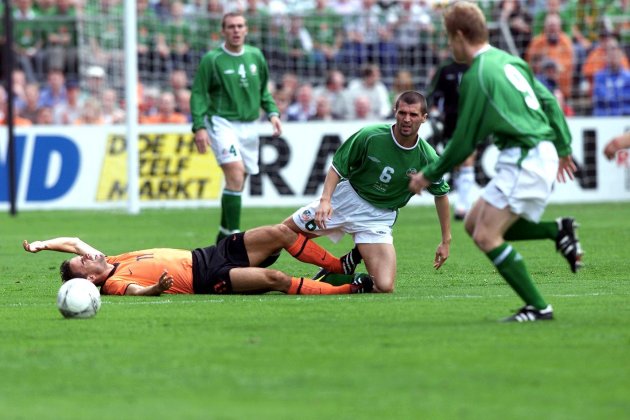
Memorable Keane moment: in the must win 2001 match against
Holland Keane 'took care' of Dutch star Marc Overmars in the
 first minute, setting the tone for an Irish win.
{Photo: TheJournal.ie}

If you follow soccer you probably know Roy Keane is back with the Irish national soccer team, this time as a coach, not a player. Tonight Ireland has its second match under its recently appointed regime with Martin O'Neill as head coach assisted by Keane. It's really Keane, however, who has Irish fans excited – not for what the team will do, but for what he will do.

If you don't know who Roy Keane is, if you never saw him play, well he was something else. Keane was a unique combination of will and anger, skill and thuggishness – a great player who made his teammates better players, but often let them down with his own indiscretions. He was never theatrical, but always dramatic.

He was like Don Mattingly, but without the even temper. He was like Lawrence Taylor, but without the cocaine and convictions. He was like Mark Messier, but without the smile (or tears).

Like Mattingly, Keane always seemed prepared, a professional. Like Taylor, Keane combined talent, will and aggression to become the most feared player in the league. And like Messier, Keane was a captain, a leader and a winner. Just as Messier willed the Rangers to victory in 1994 that was what Keane was like for Manchester United in 1999 when they won the Champions League.

With Ireland Keane played mostly with players who were not the caliber of his Manchester United teammates. Regardless, he played hard and lifted his teammates to higher levels. His greatest achievement with the Irish team was when they qualified for the 2002 World Cup.

Then came Saipan. To most of the world Saipan is a small island in the Pacific, site of a bloody WWII battle. To the Irish Saipan is one of life's great 'If onlys'.

The Irish team arrived in Saipan before the 2002 World Cup full of joy at having qualified, but without the equipment they needed to prepare for the tournament. A “Sure, it'll be grand” attitude ruled. Except with Keane.

Keane arrived without joy, but with a fire in his belly for the tournament ahead. He wanted to win – to win the World Cup. To Keane everyone else was 'just happy to be here.' He couldn't take it and what followed was a slow motion eruption that ended with Keane sent home by the manager, Mick McCarthy.

The people of Ireland were riven between those who backed Keane and those who backed McCarthy. It was a civil war with brother against brother. It was the main story on the nightly news for weeks. Would Keane return to the team or remain 'offside'? People beseeched the government: 'Fix this!'

In the end, Keane stayed home. The team played admirably, but they were eliminated in the second round when they failed to recognize that Spain was playing one man short during extra time – a definite failing of leadership.

Would they have done better with Keane? Undoubtedly. Would they have won the World Cup? Probably not, as the eventual winners, Brazil, looked far superior to every other team. However, given how things played out the Irish team may well have been Brazil's opponent in the final if Keane had been there. 'If only ...'

But it was not meant to be. What we learned then is that the Ireland of 2002 wasn't much different than the Ireland of 1902. Roy Keane, like other difficult geniuses Ireland has produced, could not cope with Ireland nor Ireland with Keane.

Yet, now he's back and the nation is agog. The media is following his every move, dissecting every twitch, seeking meaning in every word. 'How long will it last?' is what everyone wants to know.

For now all is peaceful, but more than any other people the Irish know that this is not how things stay. The plot thickens, the drama intensifies and builds to the climax which, inevitably, ends in tragedy. Then it will be 'Exit Keano – stage left.'

Saturday, November 9, 2013

HSBC survey says Ireland's a terrible place to live if you're an expat

The International Financial Services Centre in Dublin. One place in Ireland where
expats can be found in sizable numbers.
“There is no such thing as bad publicity” goes the old saying. Well, I'm not sure that holds true for Ireland this week following the publication of HSBC's “Expat Explorer Survey” for 2013.

This marks the first time Ireland has featured in the “Expat Explorer Survey,” now in its seventh year. The views of those expatriates living in Ireland who took part in the HSBC survey must be sending a nervous shudder up the spines of those whose job it is to entice overseas investment to Ireland.

Let's face it: Ireland has done remarkably well attracting FDI (foreign direct investment). Most of that investment comes from America, of course, but HSBC surveyed expatriates from all over the world, living all over the world.

This highlights the greatest issue with this report: HSBC doesn't tell us how they selected the respondents to their survey. How did they find them? How was the survey administered? Are those who took part representative of the expat community that lives in Ireland? How do the views of those who took part in the survey match those of the American business executives whose views would be pretty important to Ireland?

We simply don't know, which makes the survey less useful, but still it cannot be ignored. The Washington Post featured it on the World Views section of their web site. It will probably be picked up elsewhere. And the HSBC imprimatur may not mean much to you, but it may well mean a lot to those executives who are weighing up where to locate their European base.

So what did the report say about Ireland?

Well, nothing good. HSBC broke down the findings into four categories: Expat Economics, Expat Experience, Raising Children Abroad and Expat Expenses. Which ones did Ireland do well in? None.

The first category measured the expats' satisfaction with their earnings and the economy of the host country. Ireland finished 36th out of 37. Only Italy fared worse. Maybe this is to be expected given what has happened to the Irish economy lately, but if this is true then these are not the sort of expats who I would have expected to answer a HSBC survey.

I don't know why HSBC separated out expenses from earnings for the measure of Expat Economics, but Ireland finished 37th out of 37 on this list. Italy jumped up to 34th so we can say with certainty that in terms of standard of living for expats, the HSBC puts Ireland firmly in the bottom: below every other EU country surveyed, below America, Canada and Australia, below Taiwan and Brazil. Heck, Egypt, South Africa, Vietnam and Indonesia were all well above Ireland.

Obviously life for the average person in Egypt, Vietnam and Indonesia is much tougher than for the average person in Ireland. These are the expats' experiences. Still are the expats in Ireland that much different than those in Indonesia? If not, why do they rate Ireland so badly?

Those were the money categories. What about the Expat Experiences and Raising Children Abroad, the so-called “quality of life” factors?

Again, the results are abysmal. Childcare is expensive and overall, expat parents see Ireland as pretty poor for children in terms of education, health and experience. There were only 24 countries in the 'raising children' comparison. Ireland was 23rd, above Qatar, but below Saudi Arabia, Turkey and Mexico.

Then there's Expat Experience: quality of life, ease of setting up and integrating into the local culture. This was where Ireland fared best. Well, least badly. Ireland was ranked 30th of the 37 countries. However, of the seven states listed below Ireland only one could be called “western” - the Netherlands. The others are Indonesia, Vietnam, Kuwait, Oman, Egypt and Saudi Arabia.

Again, it doesn't seem a scientifically credible survey, but that may not matter. HSBC is a trusted source for many and the Washington Post for many more. With this sort of thing reality matters far less than perception and the perception is Ireland's not that great a place to live.

That's the sort of perception that absolutely cannot be allowed to take root in the boardrooms of corporate America, particularly in the IT and biotech firms that the Industrial Development Authority (IDA) has been successfully targeting for many years. It wouldn't be a bad idea for the IDA to begin working on a counter strategy.

The IDA is probably longing for last six years when Ireland was simply ignored by HSBC. Then it was a case of 'no news is good news.'

Thursday, October 24, 2013

Only the soon-to-be-extinguished bonfire left of Ireland's Halloween traditions

Irish Halloween bonfire - note the wooden pallets, always a favorite
with kids at this time of year.
{Photo: thanks to Independent.ie}

It's Halloween season in America and I do mean season. The day I remember as a kid has exploded into a massive season of Halloween-themed celebration.

Where I grew up - north of Albany, NY - Houses are decorated as if it's Christmas and those decorations are up for a month. I guess the cardboard pumpkins on the windows and skeleton on the front door, taped up on the 29th of October, are insufficient to meet the modern American family's need to express its enthusiasm for Halloween.

There are also 'haunted hayrides' and, apparently, every kid has to visit a pumpkin patch these days.

Then there are the stores. They are overflowing with candy, store-bought costumes (adult as well as children sizes), decorations, greeting cards - who sends a Halloween card? - and, of course, pumpkins. Every fast food joint has a pumpkin flavored something or other. Pumpkin coffee? Eh, no thanks.

The thing is, none of this is in the least bit surprising. That people are putting up lights and inflatable vampires is a harmless, if overdone, effort to make things bright and fun for kids. I do wonder if the over-supervised kids of today have anywhere near the fun we had, but these things are hard to gauge.

Slightly more surprising is that it's nearly exactly the same in Ireland. It wasn't always like that. It wasn't even vaguely like that.

When I first arrived in Ireland Halloween was barely a blip. Young kids got dressed up - in whatever their mothers could find in the house - and went to a few doors asking "Any apples or nuts?" That's what they got too. Apples and nuts.

There was no candy. There were no store-bought costumes. There were no decorations. There were no pumpkins.

That's all gone now. In 20 years the American Halloween has become Ireland's Halloween. Kids go door-to-door in store-bought costumes, ringing doorbells on decorated houses, declaring (more than asking) "Trick or treat!" all in the expectation of romping home with bags full of candy. The kids are older too - often 12+. (Substituting candy for apples probably explains that.)

And there are pumpkins. Everywhere. You can get them in the supermarket and your coffee!


One of the better suburban Halloween scenes.

Yup, Ireland's Halloween is just about indistinguishable from America's except for one last vestige of the old customs - the bonfire.

The bonfire on Halloween in Ireland is an ancient tradition, but the bonfire isn't so much dying out as being snuffed out. The fire authorities are doing all they can to discourage the continuation of this tradition and I don't really blame them.

Kids gather up all sorts of junk - wooden pallets are a particular favorite - for weeks in advance of Halloween. Old mattresses and even car tires are added to the giant piles. I'm sure that in the past the bonfires were much smaller simply because people threw away so much less, but these days they're huge and dangerous.

On the October 21 Dublin City Council announced that they had seized over 500 tons of pallets, tires and other junk destined for bonfires. That's ten days before Halloween and that's only what they've found. What's not found is probably far greater because kids are on to the adults. They gather and hide this stuff as if it's gold dust, waiting for Halloween night to pile it up and light it on fire.

Of course it isn't just the fire authorities who worry about these bonfires. In my neighborhood parents keep a watchful eye for any hint of a bonfire. None of us wants them, even those who grew up with the tradition. They all seem to accept that today's bonfires are just out of hand. Nobody wants to be downwind of burning tires or mattresses.

I'm with them. I want to see the bonfire disappear. It's against my nature, but I'm with the forces of modernity and keen to see this ancient practice vanish.

** Traditional Irish Halloween foods such as the Barm Brack and Colcannon haven't gone away. Fortunately.

Saturday, October 19, 2013

University of Notre Dame - the "Fighting Irish" now and forever

Let's get one thing straight right off: the name "Fighting Irish" is non-negotiable. Notre Dame was, is and must remain the "Fighting Irish." The PC brigade cannot be allowed to change that.

There has been a lot of hoopla lately about the Washington Redskins' name. Is the name Redskins based on racial stereotypes? Certainly. But is it insulting? Maybe it is, maybe it isn't. The name was originally chosen by the Boston (yes, Boston) NFL franchise because there was a local Major League baseball team called the Braves. (Yes, Boston Braves. Atlanta came later.)

So the owner was only doing as so many business leaders have done before: copying a successful model. With hindsight he could have chosen a less racially insensitve name, but he certainly didn't mean it as an insult. No owner would want the players and fans to feel anything but pride in their team's name.

The name and the logo were chosen to invoke a certain spirit, the spirit of a warrior people. By choosing the name 'Redskins' the owner was saying, 'We want our players to show the same indomitable spirit on the gridiron as the Indians showed on the battlefield.'

I don't think that's insulting, but I haven't seen the Redskins play in over 20 years. I have no idea how that name and logo are employed and deployed by the club.

In fairness to the PC brigade the name Redskins does 'sound' awful, especially to our über-sensitive racially tuned ears. And, let's face it, the name 'Redskins' was neither chosen nor adopted by Native Americans.

The same is not true of "Fighting Irish." The name goes back to the Civil War, when it was used to describe the Irish Brigade. The name "Fighting Irish" had nothing to do with drinking or loutishness. It was a compliment, one that said, "These men are resolute, bold, courageous ... admirable. We're glad they're on our side." That was BIG for the Irish in America at that time.

One of those Fighting Irish was Father William Corby, chaplain to the Irish Brigade. Fr Corby, who was recommended for a Medal of Honor for his service during the war, became President of Notre Dame after the war. The fact that Corby was known as "The Fighting Chaplain" and was well known for his Irish Brigade service may be the source for the name "Fighting Irish" coming to be associated with Notre Dame. Maybe. Nobody knows.

How Notre Dame became the "Fighting Irish" is lost to time, but by the 1920s the team was known as the "Fighting Irish" and their fans were more than just their students and alumni. As Paul Gallico wrote before a Notre Dame–Army game in New York during the 1920s:

This is the annual gathering of that amazing clan of self-appointed Notre Dame alumni which will whoop and rage and rant and roar through our town from sunup until long after sundown tomorrow in honor of a school to which they never went.

Those are the Subway Alumni - unique in college sports. And why? What caused this phenomenon? Why the allegiance? The name is the key: these people who never went to college, who only hoped and prayed that their children or grandchildren would have such an opportunity were loyal to the name, to the "Fighting Irish."

I suspect that if I hated Notre Dame I'd want to see the nickname changed. Not because "Fighting Irish" was an insult to the Irish, but rather because I'd think Notre Dame unworthy of such a name. The name "Fighting Irish" is one that should be spoken in reverence. Notre Dame is fortunate to have had their playing teams dubbed with so noble a moniker.

The only way I'd want to see Notre Dame change their nickname is if the university proved itself unworthy of the name. And how will I know when that day's arrived? I'll know if they don't shout down those who demand a change. That will be the moment.

If those who run Notre Dame can't muster the will, the courage, the stomach to withstand the threats of the PC bullies, if they're too lily-livered to stand up and fight for the name "Fighting Irish"  I'll know, indeed we'll all know - Notre Dame is no longer worthy of its nickname.

Until that day we root for the Fighting Irish of Notre Dame. If that dark day should ever come we'll have to find a new home for the "Fighting Irish."

Go Irish. Go Fighting Irish.

Friday, October 4, 2013

Northern Irish town celebrates native son ... the man who burned Washington

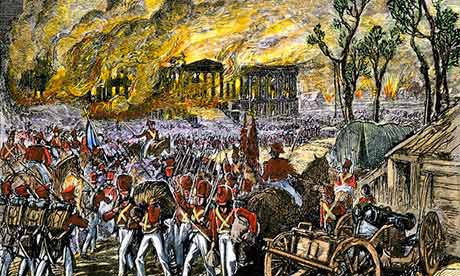
Painting of the White House in flames, August 1814.
From TheGuardian.com.

There is a conference over the weekend of October 18-20 based around the life of 19th Century British General Robert Ross, who was from County Down. Ross is a central character in one of the most famous incidents in American history yet very few Americans know about him.

It was Ross who led the British Army into Washington DC in 1814 and, as I learned in school, "burned the White House." It wasn't just the White House, though. Ross's troops set fire to the buildings that housed the Congress, to the Treasury building and essentially all public buildings, except for the Patent Office. Private property was generally not touched.

The burning of the capital city is a pretty shameful affair and it's no wonder that it is generally glossed over, save for a few lines about Dolley Madison's heroic efforts to save the portrait of George Washington. So it's understandable if Robert Ross's name is an unknown to most Americans. If his name were known it would probably be reviled.

Still Ross is probably the greatest enemy of the United States to ever come out of Ireland. He set out to humiliate the Americans and he succeeded. His motivation for wanting to humiliate the United States was probably part British chauvinism and part revenge for the Americans' burning of York (now Toronto), which was the capital of Upper Canada at the time.

Ross of Bladensburg¹ arms granted to family
of Gen.Ross. Note Army Gold Cross medal
& US flag on broken staff.
{Crest & Caption thanks to John McCavitt}
The capture and burning of Washington may have been the high water mark of Ross's career. Three weeks later he was dead, killed by a sniper during the (ultimately unsuccessful) attack on Baltimore (see Key, Francis Scott).

While at first it seemed something of an odd idea to me as an American to use "the most humiliating episode in American history" in a bid to woo tourists to County Down, specifically Rostrevor, the more I thought about it the more I found myself saying, "Sure, why not?" An awful lot of water has passed under the bridge in the 199 years since Washington was burned. Besides, it's just history. {I know what you're thinking - nothing is "just history" in Ireland - but we'll leave that alone for now.}

Thus the conference later this month to promote the life of Robert Ross. It's not just about Robert Ross either. Local man and Ross expert John McCavitt* (@) is on a one-man mission to spread the word about Ross, but also to discover and pass on the stories of all the Irish and those of Irish descent who played a role in the War of 1812 on both sides.

Look, I know the war of 1812 is not one that fires the imagination, at least not in America (see Canada. Maybe?). In Ireland or Britain it's hardly known (and the name "War of 1812" for a war that lasted 3 years? Source of mirth.) If you have an interest in history, especially the history of the Irish in America then head to Rostrevor for the conference. The line-up of speakers looks pretty good and if the weather's half-way decent that area is one of the prettiest in Ireland.

* McCavitt is also Convenor of this month's conference.

¹  Bladensburg refers to Bladensburg, MD where the Ross's British troops routed the Americans leaving the road to Washington wide open.

Tuesday, September 17, 2013

The Seanad is not a problem that merits any attention from the Irish government or voters

Gordon Wilson campaigned for peace after his
daughter was killed in an IRA bombing in 1987.
He was appointed to the Seanad by
Taoiseach Albert Reynolds in 1993.
{Photo: from the BBC}
Ireland has problems. The economy has a pulse, but not much more than that. Young people are streaming out of the country in search of jobs and opportunity. Tens of thousands of families all over the country are living in homes they can no longer afford, under pressure from our bankrupt banks.

Yes, Ireland has problems. However, one of those problems is not the upper chamber of the country's parliament. Yet the Irish government is holding a referendum next month and going all out to convince the public to vote to abolish the the Seanad (Senate).

Why? For the same reason governments do things everywhere: things are going wrong and they want to divert us by throwing smoke in our face. So we're being bombarded with daily government statements on how costly, elitist and ineffective the Seanad is. You'd swear it was the source of all that ails us.

The funny thing is they may be right that the Seanad is costly, elitist and ineffective, but it's far short of being a big issue. Already a member of the governing party has been forced to concede that the the cost-savings from eliminating the Seanad have been grossly overestimated. Even the government's faulty figure was hardly a significant sum. Now the savings are even punier.

But it's "elitist." I can't tell you how many times I have heard or read that word with regards to the Seanad. I don't think I've actually heard anyone explain what makes the Seanad elitist. The only thing that makes it elitist as far as I can determine is that six of the 60 Senators are elected only by graduates of Ireland's universities. Non-graduates have no vote.

I guess that's elitist and not all that fair to those who didn't have the opportunity to go to college. However, it doesn't seem anything like the injustice of forcing those who didn't have the chance or the wherewithal to go to college to subsidize the education of those who will someday be the elite."

The rest of the Senators are either selected by the Taoiseach (Prime Minister) or appointed/drafted/whatever by the local county councils. I don't know anyone who thinks our County Councilors are "elite." The process of electing the members of the Seanad may be somewhat undemocratic, but "elitist" is a bit of a stretch.

The last charge, that the Seanad is ineffective, is indisputable. It is and it always has been. It was designed that way. The power is supposed to reside in the lower the chamber, the Dáil. It's hard to think of any real accomplishments of the Seanad, although by the same token when compared with its more powerful sister chamber it has done very little harm. Every so often someone is appointed as a Senator as a way of honoring their contribution to the nation, which may be the only mark in the Seanad's favor.

The truth is if the Seanad is abolished I won't really miss it. Occasionally a Senator makes a speech that entertainingly badly thought out, but for the most part nobody knows or cares when it meets.

If the people vote to abolish the Seanad I will not shed a tear. I'll be voting 'No' however because the arguments against the Seanad are fatuous: "elitist?" - change the voting process; expensive? - cut the wages and budget; ineffective? - give it teeth.

Seriously, the answers are so obvious, and all in the gift of the government, that it's obvious that the referendum to abolish the Seanad is a diversion. This is the government's way of saying, "Look at me and not that car wreck over there." Thanks, but I'd rather keep my eyes on the car wreck of Ireland's economy and I'd sure prefer if the government did the same.

Saturday, August 31, 2013

Louder cheers for "Old Notre Dame" thanks to my daughter

My daughter will be among the students cheering
on the Fighting Irish today.
{Photo: thanks to ND.edu}
Today is Notre Dame's first game of the new season. Like many fans of 'the Irish' I have a renewed interest in the team and the college, although my renewed interest is not connected to the team's unexpected, meteoric rise to the top flight last year.

No, for me the keenness for ND is due to one of the university's new freshman students: my daughter.

Yup, last week my wife and I did as so many other parents did and dropped off our daughter at college – in South Bend.

Before last summer I never imagined any child of mine going to college in America, let alone Notre Dame. However, when our daughter got the idea in her head she went after it with vigor. Despite the workload she had with the Leaving Cert – I might resurrect this topic, but believe me no US high school student is as stressed in their senior year – she found time to do all that she had to do to go to college in America.
____________
Read More:

Preview: Notre Dame ready to kick off season with a win over Temple

American Football blitz comes to Ireland for The Gathering Bowl 2013

Financial worries for American students despite third level education being 'an economic necessity'
_____________
From the moment it came into her head during the summer she worked at it: reading about  how the American college system worked; preparing for the SAT's; investigating all the possibilities with regards to finance; filling in applications and getting teachers to write recommendation letters – something Irish teachers generally don't have to do. Her Principal chipped in with a great letter and her Guidance Counselor didn't miss a beat, going back into the complex fully-online college application system to provide some missing bits of information.

After all that there was the waiting. Just like any college-bound American, our daughter had to wait to see what colleges accepted her. Only, she couldn't sit back and relax. That's when she really put her head down to get ready for the Leaving Cert. Staying late in school everyday, even Friday, working all weekend. Study, study, study. That was it. She knew she wanted to go to college in America, but she couldn't take anything for granted.

Eventually the acceptance letters started to arrive (a few colleges never responded; I should seek a refund of the application fees). Notre Dame was the most exciting one. Still she studied, other things had to fall into place before we'd know for certain.

Eventually, in early May it all came together. She knew, we all knew that she was going to Notre Dame. She picked her head up, smiled, had some chocolate cake to celebrate and then put her head back down to finish studying. The Leaving Cert was only a month away and she wasn't going to throw it away now, whether it ultimately meant anything or not.

Last week was the culmination of all her efforts. Now she has to start all over – not only learning what it means to be in college, but learning what it means to be in America, living with Americans.

We couldn't be prouder parents. Or sadder. Her liveliness and humor will be missed around the house.

So as Notre Dame takes the field today, one of their fans will be an 18-year-old girl with only the vaguest notion of what's happening. That won't matter to her, however. She'll be whooping it up with the best of them, even if she has no idea what clipping or a linebacker or the two minute drill are. And from far away we'll be missing her, but hoping Notre Dame wins and that she has a great time. Actually, we already know that she will.

Friday, July 12, 2013

Nanny state reversal - Ireland's elected representatives need to be nannied

Tom Barry TD, disgraced himself and Ireland's
parliament when he dragged fellow TD,
Áine Collins into his lap in the Dáil.

To those outside Ireland today's Irish Times headline might seem opaque or of minimal importance, but to Irish people it speaks volumes: "Dáil bar stayed open until 5am."

The Dáil is the lower, but more powerful house in Ireland's Parliament, the equivalent to the UK's House of Commons. The Dáil has its own bar, one that is the subject of occasional light-hearted media coverage and occasionally the subject of what sounds like serious envy among those who are never invited in. The Dáil bar is exactly what you think it is, only with cheaper prices so that our elected and highly-paid representatives (TD's) can enjoy a tipple (or tipples) without overextending themselves financially.

Not to be a spoil-sport, but the Dáil bar should be shut down. Now. For good.

Early yesterday morning during an all-night debate one of our elected representatives, Tom Barry, pulled another of our elected representatives, Áine Collins, into his lap and held her there for a short while before letting her go. Inside the debating chamber. If it hadn't been for the live TV cameras none of us would be any the wiser.

That short, silent clip shouted out a few different things to Irish people and social media exploded early yesterday as that clip 'went viral.' Some saw in it that sexism is still an issue in Ireland. Others were simply appalled that this sort of thing could happen when the Dáil was supposed to be engaged in a serious political debate, one that required an all-night sitting. One or two hinted at the truth, which emerged later: Deputy Barry had been drinking in the Dáil bar.

This isn't the first time alcohol has been implicated in the affairs of the Irish state. There are rumors that many of the TDs were three sheets to the wind on the night they voted to approve the state guarantee of the country's banks, which eventually bankrupted the nation.

I don't care if clear headed TDs would have made no difference in how they voted. It's the principle of the matter. I can't think of any other job where drinking while on duty would be tolerated. Sure they might be working late, but they don't work year-round and they make a very good wage. If they have to put with a few late nights, tough. They should be able to do so without knocking back a few cold ones to make the work more 'interesting.'

I honestly don't understand why the Dáil needs a bar in the first place. Very few offices have one these days. On top of that, if there's one thing that marks the Dáil of recent years it's that it's full of busy-bodies: chock full of people who want to compel us by law to change our ways when it comes to drinking.

It's true Irish people probably do consume too much alcohol, but before our elected officials want to rule out drinks companies sponsoring sporting events or force supermarkets to raise the prices on beer and wine, why don't they try leading by example. They should collectively announce that they don't need a drink to get through their workday and that the Dáil bar is being shut down.

I can't imagine that happening because for our elected representatives it's a case of "do as I say and not as I do." They would much prefer to bar us from getting cheep booze than ever endure the same thing themselves.

Besides I don't want to give them a noble option. I'd rather see the Dáil bar shut in the face of our TD's opposition.

The Dáil bar should be closed because our representatives should not be drinking on the job on our dime. We pay their salaries and we pay to subsidize their cheap alcohol. Let them go to the pub or buy their own for home consumption like the rest of us. While we're at it, let's force them to take sobriety tests before they're allowed to enter the Dáil chamber to debate or vote.

It's about time we did an about turn on the 'nanny state.' We don't need the government to nanny us, but clearly, based on yesterday's antics, they need us to nanny them. Let's start by shutting the Dáil bar ... for their own good, of course.


Wednesday, July 10, 2013

Ireland in the hot sun - melting roads, water shortages, but no better place on Earth

Children playing in the Irish Sea. Don't be fooled -
that water is freezing cold.
And the Lord said, "Let there be light," and there was light and quite a bit of heat too. I'm sure God saw that it was good, although he doesn't like to do it too often. 'What's seldom is wonderful' seems to be God's motto when it comes to Ireland and warm summer weather.

We are in the middle of one of infrequent heat waves. Temperatures have been as high as the mid 80s and we have about 15 hours of sunshine a day. Who could complain?

No one Irish anyway. We may have water shortages and melting roads, but nobody much minds. That's the real beauty of it - this fine weather really lifts the mood. It's such a rarity that the good weather just seems to cheer everyone. In weather like this Ireland can rival the Magic Kingdom for the "happiest place on Earth."

The only people I can imagine who might be slightly disgruntled are American tourists because away from the coasts it is actually pretty warm through the nights and there is no air conditioning anywhere here. Even fans are fairly rare. Hotels and restaurants can actually be uncomfortably warm. When darkness doesn't totally set in until well after 11pm and light starts breaking through around 4:30 sleeplessness can come into play. Whereas Irish people shrug that off at times like this, I would understand if a few tourists are a little grumpy and bleary-eyed with it all.

As for me, well I may be American, but I'm as sun-starved as any of the locals. I'm thrilled to see the sun for such long stretches. My family has been doing as all Irish families have: enjoying the sunshine immensely. We've gone swimming in the frigid Irish Sea, dined in the back yard, gone on excursions without even considering bringing umbrellas or rain jackets. That last one is a rare treat indeed.

On Sunday we went back to County Meath, which is, as advertised, Ireland's "heritage capital." This time we visited the site of the Battle of the Boyne, the Hill of Slane and the birthplace of Irish patriot John Boyle O'Reilly.

The Battle of the Boyne Visitor Centre is in a lovely location. A big old house, pretty green fields with some period cannon scattered around, but ultimately the center is disappointing. Maybe there isn't much that can be done when you have no artifacts - a few replicas is about it - and the battle was 323 years ago. Still I left there feeling no wiser just poorer for having gone there.
Churchyard at Slane, Co Meath
If you're in Meath and have to choose between the Battle of the Boyne Visitor Centre and the Hill of Slane go to the Hill of Slane. The good weather helped, of course, but the Hill of Slane has great views, history and it's free. You have to do your own research to learn of Slane's importance, but just walking in the ancient friary and churchyard can be rewarding enough. I hadn't been there in years and was really glad to visit again on Sunday.

The last stop on our brief tour of the area was one my specialties. I caught a glimpse of a sign advertising a memorial to John Boyle O'Reilly and ignoring the wails from the back of the car I headed off in pursuit. One lucky guess at an unsigned crossroad (follow signs for Dowth) and I was there. The old school his father ran and the tower house he was born in are still there, although they've recently been refurbished.

John Boyle O'Reilly memorial
Dowth, Co Meath
O'Reilly - Irish patriot and
advocate for Catholics
in 19th Century Boston.
O'Reilly is another example of the links between Ireland and America. He was a determined Irish patriot, a Fenian. He was transported to Australia in 1868 after the failed Fenian uprising. From there he escaped to America. He settled in Boston where he argued for Home Rule, helped organize a rescue of his fellow Fenians in an Australian prison and became an advocate for Catholics in his adopted homeland. Oh yeah, and he edited a newspaper and wrote poetry too.

All in all, O'Reilly packed a lot of living into his 46 years. He is remembered with a memorial near Fenway Park in Boston, which I've never seen but I assume is much easier to find then the one at his birthplace. Finding that was the perfect end to a perfect day in sun-drenched Ireland. Hurry over before it goes, unless you prefer it damp and cool. If you do, just wait a week and I'm sure you'll be satisfied.

Monday, July 1, 2013

Ireland remembers JFK, but forgets the Irish in the American Civil War

Fr William Corby,
Chaplan NY 88th of
the Irish Brigade.
Gettysburg, PA
This week, July 1-3, is the 150th anniversary of the Battle of Gettysburg and it's being commemorated across America and especially at the battlefield itself all week. Unfortunately the anniversary will come and go in Ireland with barely a murmur.

Does this surprise me? Unfortunately, no. Yet, the Battle of Gettysburg should be remembered here as should the Civil War generally.

The Irish contribution to the American Civil War is simultaneously virtually unknown and grossly and dismissively exaggerated in Ireland. That the American Civil War involved a large number of Irish people and had a huge impact on the million or so post-famine Irish immigrants in America is barely acknowledged.

Nearly as bad is the off-handed way some talk about the war as being an almost entirely Irish affair. Such ignorance allows people to dismiss what it was really like for those Irishmen fighting a war to defend a nation that they'd only recently arrived in, a nation that didn't exactly welcome them with open arms.

Some Irishmen joined up because it was steady work. Others were simply drafted - they had no choice. Yet many enlisted because they felt an allegiance to the United States because, despite the lack of welcome, they had better opportunities for themselves and their families than they'd have had in post-famine Ireland. A number of those who had gone south fought for the Confederacy for similar reasons. There were also some on both sides of the Civil War who had joined the army because they thought the war would be quick and their military training would enable them to return to Ireland to lead a successful rebellion against British rule.

Whatever the reason for joining, they fought and they died in large numbers. Those deaths were felt keenly in the Irish ghettos in America and in Ireland, where family members who remained were left to mourn a death of a loved one in a war they probably only barely understood.

The 150th anniversaries of the start of Antietam and Fredericksburg - the Irish Brigade's worst day - passed without any real acknowledgment in Ireland so I actually expected nothing more this week.  I guess there was a small part of me that thought Gettysburg would be different simply because it's better known.

The quiet surrounding the Civil War anniversaries stands in stark contrast to the huge celebrations in June to mark the the 50th anniversary of the visit of President Kennedy. There were events in Wexford, the Kennedys ancestral home, Limerick, home to the Fitzgeralds and elsewhere across the country. Just about any place that could claim a connection to JFK or his visit had an official event to mark the occasion.

I think it's great that Kennedy's visit is remembered so fondly. His visit was a huge event for the young Irish state at the time, but it would have been nice if they had remembered some of what Kennedy said when he stood before the Irish parliament to deliver a speech that was followed by people across the country via television and, especially, radio.

His speech was about the "many and enduring links that have bound the Irish and the Americans since the earliest days." For Kennedy those enduring links were best exemplified by the Irish contribution in the Civil War. He chose to open his speech with a (somewhat garbled**) lesson on the Irish and the Civil War. He then presented a battle flag from the Irish Brigade to the people of Ireland.

Maybe that was the start of the problem. That flag was presented to the people of Ireland, but very few of them have ever been able to see it. It hangs on a wall inside the parliament building - Leinster House - where you can only see it if you work there or if you get an invite to visit the parliament.

Irish Brigade battle flag presented to the people of Ireland by
President John Kennedy, June 28, 1963.
{Photo from IrishAmericanCivilWar.com}

The Civil War battle flag should be in the National Museum where hundreds of thousands can see it each year. Moving that flag could be the start of a new understanding of the Irish contribution in the war and its impact on the Irish in America and in Ireland. Let's get going. Let's move that flag.

* There is one man in Ireland doing great work in promoting a change in the attitude towards the American Civil War – Damien Shiels (@irishacw). He writes a fantastic blog at http://irishamericancivilwar.com/

** Kennedy confused the date for the Battle of Fredericksburg, saying 13th September 1862 when he should have said December and put Fredericksburg in Maryland rather than Virginia.