Tuesday, June 26, 2012

Sunburn warnings in Ireland - more amusing than useful

Ireland's weather has been miserable for weeks.
Sunday we got a sunburn warning.
{Photo from Google images}
Late Saturday night Ireland's national weather service, Met Eireann, issued the following warning: "Sunburn index for Sunday. High countrywide." As soon as I read that I re-read Met Eireann's forecast for Sunday and I smiled.

The forecast for Sunday called for "a bright day with sunny spells. Many places dry, but there will be some well scattered showers. Highs 16-19 or possibly 20C." You can read that as 'Highs 61-66 or possibly 68.' We got a sunburn warning for a day where the temperature wasn't expected to reach 70F. Nor were we expecting hours of unbroken sun. We were going to have "sunny spells."

Now I know sunburn is a serious business and we all have to be "sun aware," but I couldn't help thinking that only in Ireland would you get a sun warning for a day with such a forecast.

The day unfolded almost exactly as Met Eireann forecast. We had "sunny spells." We also had lengthy cloudy spells, a brief shower and our temperature probably reached 65F. I didn't spend all day outside, but while I was out I thought it was very pleasant, but at no time did it occur to me that I might be at risk of a serious sunburn.
____________
Read More:

Terrible weather, European Championship failure and ailing economy but 'You’ll Never Beat the Irish'

Ireland's "changeable" weather - colder now than during the winter

Aidan Quinn loved the Irish weather and home cooking making 'A Shine Of Rainbows'
_____________

The thought that my pasty white face and arms (I wore shortsleeves) might acquire a slightly pinker hue was about all I imagined, although at one point while I was out walking the wind kicked up and I thought I might get a bit of windburn.

Don't get me wrong. I don't blame Met Eireann for cautioning us. Ever since we had a great week in late March the weather has been so cool, damp and dark that people around here are starting to resemble the mole people from "Beneath the Planet of the Apes." And Met Eireann knows only too well that at the first hint of sun many Irish people strip down to the bear minimum in order to soak up as much sun as they can, safely or not. 'No problem, just use a little sunscreen,' is all Met Eireann is saying.

Which reminds me, when did sunscreen become medicine? Until I read the story of young Violet Michener of Tacoma, WA and the sunburn she got on a field day with her school I never knew that sunscreen was medicine.

All states, other than California, bar the use of sunscreen in school by children because "the creams are considered an over-the-counter drug." What? Is there really any sense to this? Do sunscreens pose such a threat or is this just more over-bearing statist nonsense?

It's not against the law in Ireland, which is a good thing because if school kids are having a day out and it's sunny there's a good chance that it could be the children's first sighting of the sun in weeks. Unlike when I was growing up in upstate New York, kids here often don't get gradually browner as spring turns to summer.

Summer can be delayed by weeks and then just erupt, as it seems to have done today. Even Met Eireann was caught off guard. They forgot to issue a sunburn warning last night.

Tuesday, June 19, 2012

You can help create jobs in Ireland and earn a tidy sum doing so

Connect Ireland founder Terry Clune
So you're enjoying your hot dog at the annual 4th of July barbecue organized by your neighborhood when your heart sinks because your annoying neighbor Bob spots you and heads over to talk. Last year he cornered you for 15 of the longest minutes of your life and here he comes again.

Bob's a braggard. He loves to tell you how great his life is; how great his job is; how great the company he works for is. You're barely listening when Bob says something that causes your ears to prick up. You ask him to repeat himself and you hear, "Yeah things are going so well that the rumor is we're going to be looking expand overseas."

There it is. "Expand overseas." You know Bob has told you before what his company does, but you never paid attention. Now you're interested and you casually learn what they do - they produce medical devices - and you get a few other details about the company's size and management structure.

You endure a few more minutes then you make your excuses and walk away from Bob, whip out your phone and save a few notes for later. Why? Because Bob's bragging might well earn you some easy money.
____________
Read More:

Botox maker to make new $350 million investment in Ireland’s economy

When Steve Jobs and Apple first came to Ireland

Bring Them All Back Home
_____________

Connect Ireland is a new Irish government initiative designed to help drive jobs to Ireland. If you are the first to register Bob's company on the Connect Ireland web site you'll be in line to get a payment from Connect Ireland if the company locates some jobs in Ireland.

It really is that easy. Most of the work will be done by the Irish government agencies. They're really only asking you to tip them off. If you hear a rumor about a company expanding or just relocating, let them know. That's your part done. It's their job to actually sell Ireland as a base to Bob's company.

When Bob's company decides to open a small plant in Cork employing 35 people you'll get a nice reward. For your "trouble" the Irish government will pay you €750 for each of those 35 people working in the plant 12 months after opening. That's €26,250 ($33,000) for enduring Bob's bragging for 15 minutes. That's great, but it's not the best part. The best part is they'll send you another €26,250 ($33K) if those 35 jobs still exist a year later. That's a €52,500 ($66K) pay-off for 15 minutes of suffering.

So get started today. Register with Connect Ireland and then keep your ears open this summer. You don't know what you might hear from your annoying neighbor at the barbecue or your son's friend's mother at the local pool or even from that father who never stops yellling at his son at the ball field. People love to talk about their work and it might well pay for you to listen.

{Photo from SligoToday.ie}

Thursday, June 14, 2012

Eucharistic Congress has returned to Ireland and it's (almost) 1932 again

Closing ceremony of the Eucharistic Congress, Dublin 1932
{Picture from Nat'l Library Ireland.}
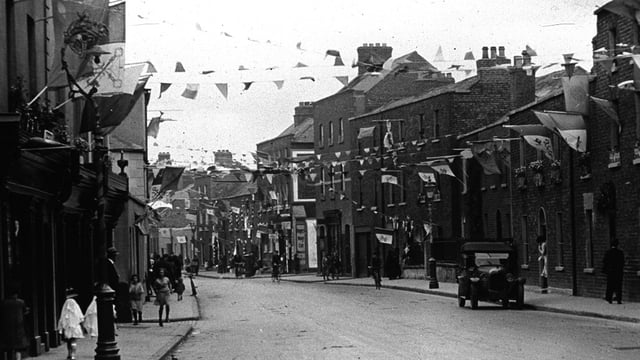
In 1932 Ireland was caught up in religious fervor. Flags, bunting and other decorations were everywhere - draped across public buildings, hung from trees and lampposts and pictures and other items. They prayed together in public, including one particularly large celebration along the Liffey that drew thousands.

Here we are in 2012 and it's almost as if history is repeating itself. The Eucharistic Congress is again in Dublin and there flags and decorations everywhere. The people are gathering in groups large and small to sing out as one and beseech the almighty to look benignly upon them.
____________
Read More:

Cardinal Timothy Dolan to host special radio broadcasts from Ireland’s Eucharistic Congress

Giovanni Trapattoni urges Ireland fans to believe in his team and his ways for remaining Euro fixtures

Damien Duff and Richard Dunne remain confident ahead of game against Spain
_____________

There is, of course, one slight difference this time: the mass gatherings are not at Mass, but at soccer games. The large gatherings along the Liffey this time are watching a giant screen showing Ireland's games at the European Championships in Poland and the flags and bunting are green, white and orange and not the yellow and white of the Papal flag as was the case in 1932.

Dublin street decorated for 1932 Eucharistic Congress.
{Photo from RTE.}
Yes I'm being flippant, but there's truth in what I'm saying. The Eucharistic Congress that's taking place in Ballsbridge in Dublin has hardly scratched the surface of the public's consciousness thanks to the obsession with the Irish team and the soccer tournament.

There are probably some Catholics here who are disappointed or worse that the Eucharistic Congress is getting so little attention. It doesn't worry me. I actually think it's good for the Church that Catholics can gather this week without the pressure of a lot of media attention.

Even those attending the Congress are probably glued to the Ireland soccer matches. I can well imagine Archbishop Martin has his schedule cleared for tonight.

Although hope of a victory is slim, the whole country will be tuning in again this evening to watch the Irish team play Spain. Everyone is "praying for a miracle" as even the most casual fan knows that the Spanish team is significantly more talented than the Irish team. The fans are just hoping that somehow will power will do the trick.

A few prayers wouldn't hurt either.

Dubliners celebrating Ireland's participation in the
European Championships.
{Photo from the Irish Times.}

Wednesday, June 13, 2012

The crisis in Europe is thanks to Europe's "betters"

John Bruton, former Prime Minister of Ireland

John Bruton, ex-Taoiseach (Irish Prime Minister) and ex-EU Ambassador to the United States and unwavering EU enthusiast is worried, really worried. Bruton fears that "we could lose, in five months, something it took over 50 years to create."

Bruton is right, but if "we" do lose the 'European dream' it will be because "we" didn't create it; "they" did. The European Union as it exists today is a construct of people like Bruton drawn from all over Europe. People who turned a free trade area into an unaccountable, undemocratic superstate that neither sought nor wanted a mandate from the people of Europe.
____________
Read More:

Euro’s future looks shaky as Greece almost certain to exit

European Union leader Olli Rehn offers Ireland hope on bank bail-out deal

George Soros slams treatment of Irish by European Union
_____________

It didn't have to be this way. The EU as it was originally constructed was a loose confederation of democratic states. Then, just as the future for democracy in Europe looked brightest with the fall of the Soviet Union, Europe's elite decided it was time to go for broke and launch the superstate of their dreams.

From there groupthink took over as the various national leaders bureaucratic chieftains in Brussels convinced each other that they were going in the right direction, that all would be well.

A series of agreements between 1992 and 2007 enhanced the power of Brussels at the expense of the national governments, the biggest being the single currency. There was a mad rush to get a new agreement before the previous changes had time to settle. All the while the people of Europe, or rather the peoples of Europe, were dragged along, unconsulted.

Now it's all hitting the fan. The Europhiles are discovering that the disparate peoples of Europe, with their different histories and cultures and distinctive national views on money and economics, have contradictory expectations of what should be done in the current crisis.

The tensions are pulling the EU apart. It's hard to imagine the EU would survive if the euro disintegrated. While we're still a long way from war, it's no longer an impossibility.

It's no wonder Bruton and his like are worried. They did this. It's their fault. There was no need to rush, no need to put at risk the nascent unity of the people of Europe. The cause of European unity and peace and prosperity would have been better served if the political elite had worked on getting the people of Europe to buy into their dream, to unifying them.

It didn't happen. Europeans are much happier to defer to their "betters" than are Americans and their "betters" are used to be deferred to. Unfortunately, the "betters" have got it wrong.

They built a massive structure on a foundation of sand and it's falling down. The "betters" are now pursuing the only option open to them - trying to spoof us into believing that they know what they're doing and all will be well. They don't and it won't.

{Picture from SligoToday.ie}

Wednesday, June 6, 2012

The Olympics torch relay – the greatest sales job on Earth

The Olympic Torch tour included the Carrick-a-rede rope bridge
in County Antrim. 
Thousands of people lined the streets of Dublin this morning to see the Olympic torch and for the life of me I can't understand why. RTE, Ireland's national television station, is providing live coverage of the torch's procession through the streets of Dublin and, again, I can't understand why. I don't understand why anyone cares about the Olympic torch.

Okay, if I was a former Irish athlete I'd care. Many of of Ireland's ex-Olympians and former sports stars are carrying the torch. The torch tour affords them an opportunity to remind everyone in Ireland who they are. Also, I suppose if I was in charge of tourism I'd care because there's always the vague hope that the staged pictures of the torch in scenic locations will entice a tourist or two to visit the country.
____________
Read More:

Thousands turn out as Olympic torch starts five-day tour of Ireland

Sonia O’Sullivan will carry the Olympic torch through Dublin en route to London 2012

"Save Lennox" campaigners petition that Olympic torch should boycott Belfast
_____________

So I can understand why those few might care, but why are "thousands" reportedly out to see the torch? Why is there so much television and newspaper coverage?

It's no skin off my back, I suppose, although there is a cost to the public purse with the closed streets and gardaí (police) providing security for the event. Still, it's a torch, a flame. What is so exciting or interesting about that?

I'm at a total loss.

The the torch relay was invented by the Nazis for the 1936 Games in Berlin. It was a propaganda tool. I'm surprised it has survived given its origins.

The Nazi roots don't really bother me, but the phoniness of the whole thing sticks in my craw. First of all, the flame goes out. Apparently that happens fairly regularly. It was extinguished on the third day of its tour of Britain last month. No problem because the organizers keep the "mother flame in specially designed miners' lanterns so if the flame does go out for some reason on the relay we re-light it from the source of the flame."

"Source of the flame?" "Mother flame?" Is this the mother of all contrivances or what? Gimme a break. If it goes out, just grab a lighter and light it again. But no, they keep "the mother flame" in a following van in "specially designed miners' lanterns." Puhleeeeze. I cringe in embarassment at anyone who takes this seriously and isn't being well compensated by the money-grubbing Olympic Committee.

That's another thing. Once upon a time the Olympics were not all about money. The games were infused with idealism and amateurism. Those days have passed. What the Olympic torch once stood for is no longer part of the Olympic Games.

These days amateurism is actively discouraged. This was demonstrated by the International Olympic Committee when it eliminated baseball from the Olympics because the Major Leagues would not release their players to take part. Idealism be damned. The IOC wants the world's best pro athletes and that's that.

As you might expect, the IOC is awash with cash. It's a two-week long marketing extravaganza. All those "Official candy bar (or whatever) of the London Olympics" bring in plenty. Then there are the tickets sales and television rights - NBC has paid $4bn for the rights to next four Olympics. Big money.

All of which brings me back to the torch run. The torch represents a one long advertisement for the Games. The torch is on a promotional tour, encouraging us to care, to watch when the games and - excepting us, thank God - softening up taxpayers who might object to the tens of billions of dollars of public money spent on building the venues and infrastructure needed to host the games.

The cynic in me applauds the IOC for the job they do selling the whole Olympics package, including the torch relay tour. It still functions well as a propaganda tool, only rather than promoting a the host state it now serves the Games themselves. I just don't understand why so many people care.

{Pictures thanks to TheJournal.ie and Olympic-Museum.de.}

Saturday, June 2, 2012

Mets manager Terry Collins - making all the right calls

Mets Manager Terry Collins hugs pitcher Johan Santana after
Santana had thrown the first no-hitter in Mets history last night.
"I never thought I'd live to see this day." That's how I feel today; that's how all of us Met fans feel today after watching Johan Santana throw the first no-hitter in club history.

Many Mets have come close before. As we watched we knew we'd seen this movie before, but still we hoped we'd see the improbable. We'd see 50 years of history vanquished.

While Santana did the hard work on the mound, one man had a very difficult call to make as the game wore on: manager Terry Collins.

The Mets have been a revelation this year and a lot of the credit must go to Collins. The team has a self-belief and never-say-die attitude that was totally lacking in the talented, but under-performing teams in the years before Collins took over.

The Mets used to be considered soft, quick to buckle when the pressure was on. Now the Mets are bulldogs, a reflection of their manager.
____________
Read More:

Conversion of an Irish baseball fan - how an Irishman in New York became a fan

Mets' Irish groundskeeper calls it a day after 50th season

Ireland used to produce baseball players
_____________

Collins, a college football player at Eastern Michigan, has a football mentality when it comes to playing baseball and playing with injuries. He doesn't care for the molly-coddling that seems so much a part of the modern game.

That brings me back to Santana. Nobody is closer to Collins in that bulldog mentality than Santana.

Collins managed the Mets last year without Santana, who missed all of 2011 after major shoulder surgery. He's back this year and Collins and his team of coaches have managed Santana perfectly. No pitcher has ever successfully come back from the operation Santana underwent. For that reason, Collins' main issue with Santana is holding him back, removing him from games when Santana would rather stay in.

That's why last night must have been such torture for Collins. He has set a limit for Santana of 110 pitches per game. Santana went past that limit with 5 outs remaining in the game.

Collins left Santana in. He threw 134 pitches to complete the game. I'm sure this morning Collins, with the euphoria fading, is wondering if he made the right decision. Did he hurt Santana? Did he hurt the team's chances of having a magical 2012? Did he risk too much for the sake of a number?

That's what makes baseball great and strange at the same time. I don't think there is another sport where a manager would take such a chance that had no bearing on winning either a game or championship. That's what Collins did last night, however.

I can't speak for Santana, but I bet he feels it was a risk worth taking. I think I can speak for the fans, however, when I say that we all wanted last night. No matter how the rest of this year plays out we won't second guess Collins' decision to leave Santana in to finish last night's game. We wanted that moment, a moment we thought we would never see.

Wednesday, May 30, 2012

Irish government promotes Guinness with President Obama, but wants to stop it sponsoring sporting events

Guinness sponsors the Hurling Championship.
Kilkenny's James Fitzpatrick
.celebrating
last year's All Ireland title.
In an attempt to curtail drinking by young people the Irish government is considering a proposal to ban alcohol companies from sponsoring sporting events.

Look, I'm as keen as the next 45+ year old to see fewer Irish people in their early 20s, late teens or even younger drunkenly stumbling around our streets at night, but that doesn't mean I see this as a problem that requires the government to "do something."

First of all I'm not convinced the problem is greater now than it was 25 years ago when sponsorship was much less prevalent. My own observation was that when Ireland was awash with cash it was frequently in a drunken stupor. Now we're broke (again) and people are drinking less. Irish people drank 10% less alcohol per capita in 2011 than in 2006. It's possible young people are drinking less now than they did during the Celtic Tiger years.

Regardless, young Irish people drink more than their peers in most European countries. It would be better if they drank less, but if the problem is no greater now than it was before alcohol sports sponsorship became the norm there must be other factors at work.

That doesn't stop people like Minister of State for Health Róisín Shortall. Young people are drinking "too much" and she's going to marshal the forces of state and do ... something, even if it's the wrong thing. Hence the proposal to ban Guinness and others from sponsoring sporting events.

The thinking is that young people are impressionable and sports stars are their heroes so when they see the captain of the championship team lifting the cup off a stand draped in Guinness advertising that's sending a message to the young fan that it's good to drink. I'm not going to argue that advertising and sponsorship don't work, especially on a subliminal level, but does a Guinness sign tell you to drink or to choose Guinness when you're buying that drink? I suspect the latter.

____________
Read More:

Proposal for new minimum alcohol prices in Ireland

Irish teenagers have one of highest rates of drinking alcohol

Guinness cash in on Obama's Moneygall visit
_____________


Banning Guinness from sponsoring the Hurling Championship - probably the biggest Irish sporting event sponsored by an alcohol company - could well have more negative than positive effects on the health of young people. Guinness pumps a lot of money into the GAA through the sponsorship deal, money the GAA uses to develop facilities and promote playing their games to young children, teenagers and adults all over Ireland.

The GAA gets people moving and the Guinness money helps with that. The Guinness sponsorship is probably a net positive for the health of the nation.

Of course the government's proposal would only affect sporting events in Ireland. English and European soccer, rugby, golf and other major television sports that originate in other countries would be out of reach. So the government's ban would serve only to weaken Irish sports without really doing much about children and young people witnessing alcohol-sponsored sporting events.

Besides, if the government is that worried about drinking and the susceptibility of star-struck young people why does it organize celebrity drinking events? Last year we had two major ones: the Queen, who actually spurned the Guinness that was offered to her, and the coolest cat to visit Ireland in years - President Obama - were both invited to drink for the cameras.

Without doubt the happy scenes of President and Mrs Obama downing Guinness in Moneygall would have had far more influence on young people than the sight of Kilkenny's hurlers lifting the championship trophy adorned with Guinness streamers.

The Irish government organized a trip to the pub for President and Mrs Obama
during their visit to Ireland in May 2011.
If I were in charge of the GAA or any other Irish sports organization I'd tell the government to get its own house in order before coming after our revenues. If the government feels the need to "do something" they can start by not foisting pints of Guinness into the hands of every visiting world leader.

{Hurling photo thanks to the Belfast Telegraph.}

Tuesday, May 22, 2012

When Irishwoman Katie Taylor goes for Olympic gold I won't be watching

Irish boxer Katie Taylor, favorite to win gold at the London Olympics.

Katie Taylor is Ireland's best hope for a gold medal at the Olympic Games, which take place in London two months from now. I hope she wins her gold medal, but I won't be tuning in to watch her. Taylor is a boxer and, although this possibly puts me at odds with 'modernity,' I will not watch women's boxing.

From everything I've picked up through the television, radio and newspapers Taylor is a fantastic boxer, extremely skilled in the "manly art of self defense" and is favorite to win gold. This past weekend she won the gold at the World Championships, a title she has held since 2006.

Of course women's boxing is a minor sport, unlikely to create much of a stir in most countries, but in Ireland Katie Taylor is on the verge of becoming a superstar. Public misgivings about women's boxing are non-existent either because people are afraid of falling afoul of the PC police or they're too desperate to see the Irish flag fly above all others as the Irish anthem rings out at this summer's games. Irish Olympic gold medals are pretty rare, especially if you exclude Michelle Smith's three golds for swimming in Atlanta in 1996.

____________
Read More:

Katie Taylor realises her Olympic dream as she secures place in London games

Irish boxing champion Katie Taylor says she 'won’t be wearing miniskirts in the ring'

Why on Earth is London hosting the Olympic Games?
_____________

Undoubtedly Taylor's undamaged face and perfect smile owe a lot to her skills in the ring. My wife met her once and was surprised at how pretty Taylor is.

An attractive woman boxer seems unlikely, but there you go. I'm sure this fact is not lost on marketing people, who are probably drooling at the ways Taylor can be put to work once she wins that gold this summer. The people in charge of women's boxing have probably noticed too. I wouldn't be the least surprised to learn that it was Taylor that they had in mind when they "suggested" that women boxers wear skirts in the ring rather than shorts.

Maybe they didn't know Taylor well enough before making the suggestion. The new sport's biggest star was having none of it. She said the miniskirts they wanted the women to wear were a "disgrace," that she didn't "wear miniskirts on a night out, so I definitely won't be wearing miniskirts in the ring."

Taylor is a female boxer, which is rare enough, but she is also a born again Christian and unafraid to talk about her faith. Among young Irish people that makes her even rarer than a female boxer.

American sports fans are used to athletes making reference to God in interviews, but here that sort of overt religiosity is unknown. Taylor is more Jeremy Lin than Tim Tebow, but regardless I'm sure the Irish media is hoping she keeps those "glory of God" references to a minimum. It invites awkwards silences from interviewers.

My wife may have been surprised by Taylor's appearance, but it was Taylor the person that really got her. Taylor is "humble, friendly, polite, and extremely generous," a real credit to her parents and she'll be a great ambassador for Irish athletes when she wins that gold.

From all I've learned about Taylor I admire her greatly. I really wish her well. It's just that she's only a few years older than my oldest daughter and, although I'd have loved it if my daughter were great at running or soccer or basketball, I would never have wanted her to box.

I expect to watch a fair amount of this summer's Games, but I won't watch women's boxing even when our local hero goes for gold.

{Picture from SpiritRadio.ie.}

Wednesday, May 16, 2012

Ireland and the EU Fiscal Treaty - it cannot be 'No' this time

Declan Ganley - bogeyman of Irish politics & a leading
'No' campaigner on EU Fiscal Stability Treaty. 
 
Europe is in turmoil. Greece is heading for an ugly exit from the Euro, possibly from the European Union itself. The big European powers are at loggerheads as to how to solve Europe's massive problems and in the midst of all this the Irish people will be going to the polls on May 31 to vote on the EU Fiscal Stability Treaty.

The 'Yes' side is desperate for us to approve the Treaty. They're pleading; they're threatening. The Treaty is about "jobs;" it's about "stability." A 'No' will mean Ireland will be denied all access to credit (ie money) and we'll be kicked out of the euro. Basically they're saying that if we don't agree to the terms on the table our European "partners" will leave us battered, bleeding and slumped over in the corner.

The problem for the 'Yes' folks is that we've heard all of their positive gloop about jobs before. Nobody's buying it this time. The Irish people have finally and thoroughly removed the wool from their eyes: we were sold a pig in a poke starting with the Maastricht Treaty when we voted to join a currency we had no business joining. The Europhiles led us into this mess. Nothing positive they say now has any meaning. As for the menacing, negative stuff, well ... more on that in a minute.

The 'No' folks are the usual hodgepodge group of socialists, nationalists and others who are just fed up with the never ceasing centralizing of power in Brussels, outsiders all of them. In the Dáil (parliament) they comprise no more than 20% of the elected representatives, but when it comes to the EU they represent a far greater percentage of the electorate.
____________
Read More:

Support grows for EU Fiscal Treaty as Declan Ganley joins the No camp

A punt comeback - will Ireland vote against austerity treaty?

Anti-immigrant surge likely as Irish economy deteriorates -- Resentment of foreign doctors and workers tip of the iceberg
_____________

The most "unofficial" leader of the 'No' campaign is businessman Declan Ganley. If anyone in Irish politics can be called a bogeyman, it's Ganley. He's scorned by the left - his allies in these treaty referendums - and he's scorned by the center and pro-EU right.

One reason Ganley is so distrusted and disliked by so many, is that he appeals to a large segment of the population and he never fails to turn up when it's EU referendum time. He never takes the unthinking 'Yes' for an answer.

Ganley is not among the group generally called "Euroskeptics," but rather he's a Euroidealist. Ganley believes in a federal Europe with democratic institutions. Ganley wants the Irish people to reject this treaty because it doesn't solve the serious economic problems we in Ireland and people across Europe face now and it doesn't address the democratic deficit at the heart of the European Union.

Ganley's right, of course, but he's also wrong. It's too late. The EU is doomed and voting 'No' in the hope that this is going to trigger the change Ganley hopes for is just pie-in-the-sky thinking. There is no appetite for a new EU, although it's badly needed. Those who founded the United States had the sense to revisit the Articles of Confederation and draft a new Constitution, but they didn't wait for 25 years to realize the error of their first attempt. The EU has waited too long and the Germans and other creditors have too much to lose fixing it now.

All of which brings me back to the menacing, negative stuff that is bubbling up in Brussels, Berlin and elsewhere in Europe. Ganley says voting 'Yes' is like buying a ticket on the Titanic. He's wrong about that. We're already on the Titanic. The only hope now is that sucking up to those who control the lifeboats will work in our favor when we hit the iceberg. Voting 'No' will not endear us to those people.

In the past when we voted 'No' to EU treaties we were told to go try again, like the Irish people were disobedient children being asked to leave the room and come back to the table in a mannerly fashion. That will almost certainly not be the case this time. This time we can't stop the Treaty, so if we vote 'No' it will only affect us. We may well be taught a serious lesson by those who now control the purse strings here. They may well tell us to leave the table, go to our room and not return.

I love the idea of voting 'No' and toughing it out, but we're in a very weak position right now. If we were actually cut loose by those calling the shots in the EU the hardships we currently face would seem as nothing. Civil disorder or mass emigration are possible in such a scenario.

If this were 1999 when we were riding high I'd be all in favor of telling the EU leaders where to get off. I've only once before supported a 'Yes' in an EU treaty referendum. I won't be voting 'No' this time, however. I'm definitely not in the 'Yes' camp either, but I am in the 'Not No' camp.

{Photo thanks to Independent.ie}

Thursday, May 10, 2012

Ireland's "changeable" weather - colder now than during the winter

Ireland's changeable weather. It's felt colder since Easter 
 than it did during the winter. 
It's been wet too,
but that's a given.
If you know Ireland then you know you cannot count on the weather. It seems to defy all prediction, making monkeys of the weather forecasters.

In fact, the weather seems so far beyond prediction that most Irish people are more willing to accept the word of a man who predicts the weather based on the behavior of frog spawn and nanny goats than those who use the latest scientific equipment and models. Modern science can't compete with old wives tales when it come to weather forecasts, something that can irk the professional weather man/woman.

Tuesday was a perfect example. Unfortunately I didn't have access to frog spawn man's latest thinking on what might happen, but at lunchtime I checked the Met Eireann web page before deciding that I could include a walk of just about a mile and a half after a meeting. I didn't want to use the car or take a bus. I wanted to walk.

So I checked the forecast. There was a chance of a light shower in the early afternoon, but the evening was to be dry. Seeing as I knew I wouldn't be on my way til after 4:30 I left the car behind and set off knowing I was going to have a healthy, lengthy stroll to close the day.

The meeting had just ended and I started my walk. I was half way - equidistant from start and finish and well off any bus route - when it began to absolutely pour. This was no light shower. It was a heavy rain and not the huge-drop, thunder-storm type rains, but the finer, more soaking rains that just drenches you. The proverbial drowned rat would be drier than I was when I finally finished my walk.

I know what you're thinking: 'that happens to me where I live to.' I'm sure it does, but it just seems to happen far more often here than elsewhere.
____________
Read More:

Irish summer weather set to continue all week - clear skies and high temperatures

Mildest Irish Christmas in decades says weather experts

Only in Ireland - wet Dublin's water shortage
_____________

The weather in Ireland is "changeable," which also just happens to be the forecasters' favorite word. They use it to describe days that are warm, cool, dry, wet, calm, windy and anything else you can think of. That seems to describe a large number of days in any calendar year.

Changeable. That could also be used to describe the actual seasons. 18 months ago Ireland experienced one of the coldest winters of the past hundred years. Cold, snowy, icy weather lasted for weeks. Then just around Christmas 2010 it went away. And stayed away. January, February, March right on through to December 2011 the weather was pretty much the same.

Before last winter those who like to provide seasonal forecasts were telling us we were in for another dose of freezing weather. They couldn't have been more wrong. The weather was fine. Drier and warmer than usual, which carried on through January and February. We essentially had no winter whatsoever. Non-winter then gave way to beautiful, warm weather in late March. It was like we'd suddenly found ourselves living on the Mediterranean.

All that ended in April. Don't go looking up the stats because I won't believe them anyway, but it's been colder since April 9 than any month since the snows of December 2010 melted. It's not ice cold as it was on occasion during the winter months, but it's been an almost constant damp, chilling month since Easter.* We even had a funnel cloud (water tornado) just off the coast here. The temperature wasn't even 40F at the time and the accompanying hailstones didn't melt for hours.

I hardly had the heat on during long stretches of January through March, but it's been working overtime since then.

Who knows, maybe this is evidence of climate change, but I think it's more likely that it's just another sign that Ireland's climate has always been changeable. You get your wintry days and you get your summery days, but you never really know when they might come. In between you get long stretches of changeable weather. Climate change? The Irish laugh in its face.

* The odd thing is that on this little island the weather can be so different. I don't think the weather's been anywhere near as dire away from the east coast.