Thursday, May 9, 2013

Ireland as Britain's wind farm - weighing up the pros and cons of ugly and heavily subsized Irish windfarms

Wind turbines at Richfield Windfarm, County Wexford
If you have been to Ireland recently then you have seen the wind turbines. Like daffodils in the spring they seem to be popping up all over. Unlike daffodils, the wind turbines aren't vanishing weeks later. They're much more permanent.

I have two problems with wind turbines: they're ugly and they're heavily subsidized. That doesn't mean, however, that I'm entirely opposed to them.

Ugly doesn't really matter at all. In fact, I know quite a few people who don't mind the look of them one bit. Some people even seem to like them. I disagree with them.

When I'm driving through County Leitrim in Ireland or Livingston County in upstate New York and I see windmills on the distant hills I feel like my view is spoiled. I like the natural look.

I know, I know. Scenery - is it really that important? My mother has often said to me, "you can't eat scenery." So if there's money to be made in wind farms then that takes precedence over whether I can enjoy an unspoiled view of the treeless hills of Ireland.

Ah, but then again, there are quite a few people in Ireland who are now "eating the scenery." Or at least they're earning enough to put food on their tables and a roof over their heads thanks to the money that tourism provides. Would as many Americans, Germans and others travel to Dingle or Connemara or wherever if the views on offer were predominantly giant white wind turbines? Doubtful.

So the financial benefits from wind turbines have to be assessed against possible losses in the tourism trade.

All of which brings us to ... money. This is where the subsidies come in. Wind energy cannot compete with its natural gas competition so the Irish government subsidizes wind-generated power.  Without the subsidies there would be far fewer (read ZERO) wind turbines on the Irish landscape or offshore.

This is the problem with subsidies: the wind turbines we have are not efficient enough to warrant using them. Rather than wait for the day when they will be cost-effective - and that day may be coming soon - the Irish government forces us to pay to have our view spoiled. Yes the government subsidizes other industries, but at least in all those other cases there is an arguable benefit to Ireland. With these turbines the only benefits accrue to a few landowners and subsidy-chasing investors. Oh, and there is the vague possibility that there will be one inch less erosion of the coast in 2163.

Recently a new twist has been added to the wind farm mania: Britain. The idea is that the British government will subsidize wind energy companies to turn a chunk of the Irish midlands into a giant British wind farm, with the support and assistance of the Irish government. The obvious question is why: two "why's" really. Why aren't the British companies erecting these wind turbines in Britain and why is the Irish government keen on this idea.

The answer to the first "why" is that the people of rural Britain are fed up with wind farms. They don't want any more. They're sick of the sight of them; they're sick of the sound of them. So Britain looked across the sea, saw all those complacent people only barely occupying Ireland's midlands and thought, "let's see if we can put those things up there?"

The second why is even easier: money. Again. The Irish government is talking this up as a windfall for the national coffers, which it may or may not be. Even if it nets a gain for the government I still don't like it. Why? Because there will be no benefit to the locals other than those few landowners.

Wind farms don't produce jobs, save a maintenance job or two. There will be no wind industry in the area. There isn't even a local tax benefit. Local planning regulations are to be ignored. There will be nothing for the locals other than huge wind turbines dominating the landscape.

That is simply wrong. There has to be a general, local benefit to these sorts of projects - especially one like this where the very idea arises out of vehement local objections in Britain. It isn't right for the Irish government to rent a piece of Ireland to Britain to soothe the British government's climate conscience. It isn't right for the government to treat the concerns of those who have to live with these things with disdain.

Monday, April 15, 2013

Justin Bieber's perfectly judged comment on Anne Frank - "Hopefully she would have been a belieber"

Justin Bieber stirs up trouble with Anne Frank comment


Justin Bieber has stirred up more trouble for himself with his comment in the visitor's book at the Anne Frank House in Amsterdam. I just wish I could understand why there's any controversy.

Bieber wrote: "Truly inspiring to be able to come here. Anne was a great girl. Hopefully she would have been a belieber." The world has been going to town on poor lil Justin ever since.

For the past few days I've seen the headlines and the tweets about Bieber's remarks. Many were outraged and others were just mocking him. I only got around to reading his actual words this morning and my reaction was, "Wow! That's actually an intelligent and thoughtful and mature comment. What's the problem?"

I get the mocking - what a conceited, arrogant so and so - thanks to that last line about from Bieber that he hopes Anne Frank "would have been a belieber." I just don't think he was being arrogant or conceited at all.

Bieber is 19 years old and millions of teenage and pre-teen girls world-wide absolutely adore him. He's obviously aware of that. During the years Anne Frank was writing her diary she was right in that age bracket. His comment acknowledges these facts.

Bieber could have done the teenage thing and written, "How sad" and left. It would have been a perfectly judged - and empty - gesture. Words without meaning, unthinkingly scribbled down. That would have been conceited.

lieber didn't do that. Although we see Bieber and his fellow teeny-boppers as cartoon characters, my guess is that Bieber was moved by his experience at the Anne Frank House. It probably struck him that Anne Frank could have, indeed should have, had the chance to be a teeny-bopper worshiping young girl.

She should have had the chance to be a 'belieber.' Young girls should get the chance to be 'beliebers' rather than living in cupboards, dreading the day when the Gestapo finally discovers them and ships them off to Bergen-Belsen to meet a gruesome death.

Furthermore, Bieber wasn't presumptive and arrogant despite the outrage and derision. He used the word "hopefully" indicating that he didn't assume Anne Frank would have been a 'belieber,' but if she had been a 'belieber' he would have been honored. He couldn't have said it any better.

Here's  Anne Frank House in Amsterdam's tweet:


Tuesday, April 9, 2013

The Irish property tax problem - everyone wants to own some and no one wants to be taxed on it

Ireland's controversial property tax has the nation in a frenzy
Every country has its quirks. God knows America has the odd one or two. Well, Ireland is no different.

One Irish quirk seems to be property: it's an obsession. Maybe it's some national collective memory dating back to the evictions and the famine, etc. Maybe it's just that most people are only two generations removed from subsistence farming. I don't know.

Whatever the cause, the Irish are obsessed with property.

It was this obsession that fueled the property buying frenzy that broke first the banks, then the nation and has left hundreds of thousands of Irish families over-borrowed, under-waged and facing years of negative equity on their homes. 

It's not just that Irish people want to own their own home. I can understand that. 

It's that so many Irish people want to invest in property. This is why banks which would would cast a cold eye on lending money for a venture in information technology or new food products were falling over themselves to lend money to property developers. This is why people who would never consider investing in the stock market invested what they had - or often what they borrowed - to buy property with a view to renting it out. 

They gobbled up “buy to let” properties all over Ireland, in Britain, in Spain, in Florida, even in Poland, Croatia, Bulgaria, Romania – just about anywhere. If someone was selling a time-share in Timbuktu there was an Irishman there with his checkbook. Like I said, it's a national quirk.

So now, possibly in a bid to correct this quirk, our economic and financial overlords, also known as the Troika, also known as the ECB, EU and IMF, declared that we must have a property tax. And, thus, we now have a residential property tax.

I mentioned this a few weeks ago, but in my 20+ years of living in Ireland there has never been a tax on people's homes. Needless to say, people are not pleased with this new tax. They're already struggling to pay the old taxes so as you can imagine people aren't best pleased at this further invasion of their wallets. There are even some organized protests against the property tax.

This is where Ireland's relationship with property gets even quirkier. Those groups organizing protests against Ireland's new property tax include … labor unions. There's even a teachers' union opposed to the property tax.  I never thought I'd see the day when a teachers' union would oppose a hike in property tax. 

Then there's my favorite. The Socialist Party is opposed to the property tax. Let me say that again, but read it slower: The Socialist Party is opposed to the property tax. That is, they're  against it, not happy with it, would rather see it go away. The Socialist Party. 

I've been shaking my head in disbelief at this information ever since the leaflet came through the door the other night. I mean, a property tax is basically a tax on wealth and the Socialist Party is opposed to it. They love taxes and government spending so, …, are they just happier to have the taxes come from earnings rather than wealth? 

Ireland's socialists have to be the only socialists on the planet opposed to the property tax. Amuses me no end. I only wish I'd have come up with this description of the phenomenon: “Tea Party socialists.” That sums it up perfectly.

Saturday, March 23, 2013

American fans right to ignore the World Baseball Classic

Major League Baseball Commissioner, Bud Selig.
{This is still on IrishCentral.com, but incorrectly listed as by Cormac Eklof.}

The United States has, again, come up way short in the World Baseball Classic. Long may it be so.

The World Baseball Classic is a vanity project from the same people who have managed to reduce baseball from America's Game to one where the championship is barely a blip on the American radar nowadays.

I was in America last October. Few watched and baseball barely figured in conversations. People just don't care that much about baseball. Football - pro, college, high school, Pop Warner probably - were far more important.

Anyone born before 1970 can remember when it wasn't like that. Baseball used to dominate the American sports agenda. That was when the World Series was the event on the American sports calendar.

Maybe those days are gone forever, but that doesn't mean that those in charge of Major League Baseball should just throw up their hands and say, "Oh well."

And don't talk to me about profits, etc. I know, I know. Baseball is making money hand over fist. They're making so much they can only see one thing to do, which is make more.

____________
Read More:

The Irish boys of summer - “The Emerald Diamond” and how the Irish transformed baseball

Conversion of an Irish baseball fan - how an Irishman in New York became a fan

Major League Baseball defaces Ireland's national flag
_____________

That's what the WBC was designed to do: expand the reach of Major League Baseball into new markets, to get more people to pay for the rights to their broadcasts, buy officially sanctioned and trademarked baseball caps and shirts.

Yet baseball, Major League Baseball, has a lot more pressing issues than selling Yankee caps in China. Maybe if I was an owner I'd think differently, but as a fan I want the game to thrive, not just earn profits. And thriving means caring (sorry Barney).


It's more exciting when people care. When I was a teenager people just talked about baseball, especially during September and October. Finding Twitter buddies to tweet with on the day is not the same as random conversations with people in the supermarket or whatever.
As a fan I want that. Yet when I was in America in October I may as well have been in Dublin because it was only on Twitter that I could find people who were keen to discuss the games.

Elsewhere on this site Cormac Eklof argues that it's time America cared about the WBC. All I can think is, "Why?" The serious fans, the core of people that Major League Baseball takes for granted, don't care. They can see that the WBC is merely a MLB money-grab, an exhibition, one in which their star player runs the risk of injuring himself.

What Major League Baseball is learning is that you can't contrive to invent a new competition that's clearly inferior and expect the fans you ignore/neglect/disdain to pony up simply because you believe "If we build it they will come." Well you know what? We won't. And long may it be so.

Wednesday, February 27, 2013

Will Ireland's emigrants catch a break on property tax?

Ireland's Minister for Finance, Michael Noonan,
introduced the new property tax.
In all the time I have lived in Ireland there has never been a property tax. That is all about to change as the government is rolling out a tax on residential property this year.

Irish homeowners will start to see the bills for tax owed on their homes from next month. As you can imagine, no one's all that happy about this.

The biggest losers of course are all those struggling homeowners, the people who took out huge mortgages to  family homes during the boom, have taken substantial pay cuts or even lost their jobs and are now faced with a new tax that will cost them hundreds each year.

I know if you live in America your initial reaction will be something like, "What are they moaning about? I pay $4000 per year." And you'd have a point. However, the American system has a series of taxes - Federal, state, local, - the sum total of which can be substantial, but probably not on a par with what the average Irish person is paying. For example, does anyone in America pay a 23% sales tax? I don't think so.
____________
Read More:

Property tax unveiled for Irish homeowners as Michael Noonan reveals Budget 2013

Irish homeowners are not "revolting" - they're treating their incompetent government with contempt

Google pays just $10 million Irish tax bill by routing €9 billion profits abroad
_____________
It is always difficult comparing tax rates in different countries because there are so many different taxes and what those taxes are supposed to provide is different too. Take my word for it: Irish people pay a lot in taxes, this is a new one and they're not happy about it.

Right now many people are saying they "are not going to pay." Sure many of them are blustering, but the Household Charge that was introduced last year was seen as a precursor to this year's full property tax was ignored by a large percentage of households. Maybe the government will someday catch up with those who refused to pay the Household Charge, but the fact is at the end of December nearly 30% of householders had not paid the tax. No matter how you slice it, that's a significant level of non-compliance.

Unless the government ups its game they can expect at least the same level of non-compliance. So far all we've heard is that they're upping their threats. The head of the Revenue Commissioners recently noted that they had the power to take the money from any non-payer's salary or pension or even bank account. In other words they have you. Unless ...

When I heard those comments the other day the thought struck me that there's one group of homeowners who might slip through the Revenue Commissioners' net: emigrants. I don't know how many there are, but anecdotally there are quite a few. Families, couples and singles who have bought homes have had to leave Ireland and their homes (rented, if they're lucky). There's a good possibility I'm missing something, but from the looks of it right now emigrants might owe the property tax, but it doesn't look like the Revenue Commissioners have any way to force them to pay.

I'd like to think that emigrants will catch a break here. I'd really like to believe the government would waive the property tax for those who have had to leave Ireland due to the dire economic conditions, but if there is one group the government doesn't really care about (ignore those crocodile tears) it is emigrants because they cannot vote. Thanks to that and thanks to the fact that most of them had to leave due to circumstances not of their making I hope they can avoid the property tax. It's the least they deserve.

Friday, February 8, 2013

Ireland and the debt deal - 24 hours of farce and high drama

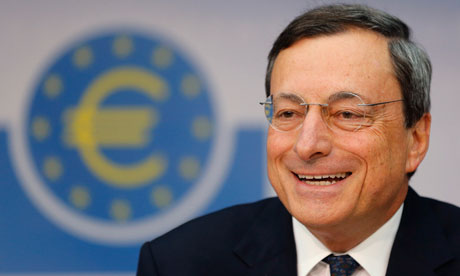
Mario Draghi, head of the European Central Bank.
The end is nigh; the sky is falling. We're all doomed, doomed I tell ya. That was Wednesday night in Ireland. It was as if the end-times had arrived.

It was a very strange 24-hours from Wednesday afternoon to yesterday afternoon. It all started with breathless reports on banking and Ireland's national debts from Irish reporters in Frankfurt. There were leaks and rumors: the Irish government had secured a deal on the bank debts that the state had absorbed. What that deal was, nobody could say exactly, but we had "a deal."

Part of the deal involved the liquidation of the Irish Bank Resolution Corporation (IBRC), which was established by the government in 2011 as something of a banking hospice for the brokist, most bankrupt bank on the planet - Anglo-Irish Bank - and its little brother, another broke institution, the Irish Nationwide Building Society (INBS). Anglo is the Bank that Broke Ireland.

So far, so good you might think. Well, maybe not for the 800 people employed by IBRC, but given how hated Anglo-Irish was there didn't seem to be a whole lot of sympathy for those people.
____________
Read More:

Enda Kenny announces deal on Anglo-Irish debt with European Central Bank

Trial date for disgraced Anglo Irish Bank boss Sean FitzPatrick set for next January

Ireland has a new Chief Secretary
_____________
As Wednesday evening turned into night that's when things started getting strange. The details of the deal were not forthcoming and then the noises from reporters with contacts "in Frankfurt" (that is, the European Central Bank - ECB) began to sound ominously like there was no deal after all.

That's when the mood of television and radio reporters went from baffled to aghast as they found there were no answers to their questions. That's also when Irish tweeters went bananas.

There was nothing on the debts, but the IBRC liquidation was going ahead. That required government involvement because everything had to be finished by 7am Thursday morning, although we weren't told why. In order to get that done the Dáil and Seanad (Ireland's lower and upper houses of parliament) would have to have a late, possibly all-night, session. We were also told that the President was cutting short his state visit to Italy so he could return to sign the bill into law on Thursday morning.

It may not sound like the makings of a high drama, but it really was. All the frantic confusion evident in the government's rushing to get 50 pages of legislation drafted and passed by 7am Thursday sent Irish tweeters over the edge. In 140 characters Irish economists and banking experts - those who weren't pronouncing on our impending doom on television and radio - were conveying their skepticism and fatalism in equal measure. The rest of Ireland's tweeters joined in, often adding humor to the fatalism.

#PromNight was soon trending in Ireland, a reference to the Anglo-Irish Bank promissory notes at the center of the whole national debt crisis. The sense that we were coming to an apocalypse was thanks to the similarity between Wednesday night and the night back in late 2008 when the parliament stayed late to approve the bank guarantee scheme that has led us to national bankruptcy and the loss of national sovereignty.

Announcements from Taoiseach (Prime Minister) Enda Kenny were pushed back a few minutes. Then another few minutes. The whole thing had the feeling of a farce or, as people here presumed, a national tragedy. Eventually, around 11pm, Kenny and his government made their way to the Dáil where they expected to have a vote on the legislation - 50 pages of it - despite the fact nobody had yet read it. A short period of shambolic parliamentary proceedings ensued as the opposition parties sought some time to consider the bill.

At this point cool economic discussion and political analysis on TV and radio was replaced with something akin to a desperate moment of national prayer. "Please God, don't let them make things any worse." The tweeting was even more desperate.

When the discussion of the legislation finally got going - around midnight - it was a welcome relief. The endless droning of politicians didn't make anyone feel better, but at least they put us to sleep. We'd have to wait til morning to find out if the verdict was death. Or worse.

Thursday morning things were calmer. Maybe it was simply that the sun had risen on a new day that provided that glimmer of hope, but the fact that we learned that the bill was passed by both houses and signed by the President after his mad dash home from Italy was at least certainty.

That calm gave way to even more hope as rumors of an ECB deal again began to circulate. The strangeness returned around lunchtime when Mario Draghi, head of the ECB was asked about the deal during his regular press conference. His response: We "took note" of the Irish actions. "Took note." And with that commentators were baffled again and twitter was aflame. A collective "I knew it! We are screwed" was the general theme. A few other journalists at the press conference asked for more clarity, but Draghi remained indecipherable.

We only had a short while to wait, however. At 2:30 the Taoiseach rose again in the Dáil to announce that we did, in fact, have a deal with the ECB. Amen.

Calm has been restored, although nobody seems too clear as to whether (a) the legislation rushed through on Wednesday night is actually constitutional or (b) the deal on the debts that we got was all that great. For many people the fact that we have removed any doubt about whether the state was going to repay Anglo's debts makes this deal a bad one. I have sympathy with that view, but that ship sailed a long time ago. There are virtually no bondholders left. The debt now is to the ECB and there was no way we were going to renege on that.

The deal may not be great, but it's better than we had. The total debt will not be paid off til 2053, which makes it more like war reparations than bank debt, but so be it. The state wrongly guaranteed those loans and now we have to pay.

The new deal makes it a bit more affordable and pushes back the pain enough so that we can at least hope that with a bit of luck and a bit of inflation and economic growth the debt will seem less significant than it was last week. We're still sick, but it's a chronic rather than terminal illness. That's progress.


Friday, January 25, 2013

Irish-America - let's back our Scottish cousins in their bid to overturn the USDA's haggis ban

Poet Robert Burns, whose "Address to a Haggis"
inspires the desire for the 'plucky' Scottish dish
at this time every year.

{Photo from CeltNet}
Haggis is banned in America and our fellow Celtic-Americans (new to me too), Scottish-Americans if you will, are none-too-pleased about this. Haggis is a traditional Scottish dish, the composition of which is probably best not considered around meal-time.

As explained recently by the BBC's Jon Kelly, Haggis is made from a 'sheep's "pluck" (heart, liver and lungs) minced with onion, oatmeal, suet and spices, all soaked in stock and then boiled in either a sausage casing or a sheep's stomach.' Mmm mmm. Don't that sound good.

Okay, to be quite honest, it doesn't sound like my cup of tea. Although I'm sure if I knew what was in the white and black puddings I enjoy as an essential part of my Irish breakfast it might be equally off-putting. Maybe if I could blank out what I know and force a forkful of haggis into my mouth I might really enjoy it. I'm at least open to the possibility that I might enjoy it, if not quite as open to the possibility of actually tasting it.
____________
Read More:

Brave Scotland - as the Scottish prepare for their independence the make-up of Britain could shift

Irish whiskey now outsells Scotch single malt in the United States

Gutter a good place for Haggis
_____________
Whatever about my personal preferences, Scottish people like to eat Haggis, especially on January 25, when they celebrate Burns Night commemorating the birth of their national poet Robert Burns, aka Rabbie Burns.

So in Scotland later today they'll be sitting down to a fine haggis dinner, but their cousins over in America won't be able to do the same because the US Department of Agriculture has banned haggis.

The ban has been in place since 1971. The USDA apparently doesn't care for human beings eating sheep lungs. Who can blame them, but is it really that unhealthy? I mean sure the Scots are nuts, but I doubt the nuttiness is caused by the food so much as the desire for the food is caused by the nuttiness.

So the Scots are battling the American bureaucracy and not getting very far. It's not hard to understand why either. Let's face it, the Scots' star has waned in America just as the Irish star has waxed. Irish-America is a much more potent force than is Scottish-America. On this issue I say let's give them a hand or at least offer some moral support.

Sure it's not our battle and I'm not asking people to go to the wall for the right to eat a sheep's lung, but we do like to toss around the word "Celtic" now and again, even impress upon our friends that it should be pronounced with a hard 'C' (Keltic). Some of us even (secretly) enjoy the Thistle and Shamrock radio program, which celebrates the music of Scotland as well as Ireland.

I'm not asking you to abandon the rivalry with the Scots, such as it is. We can still smirk when Braveheart comes on the television, knowing that those beautiful "Scottish scenes" were mostly filmed in Ireland. We can continue the fight to see Irish whiskey reclaim its place on top in America, having seen it swiped by the Scots during prohibition. I just think we could and should join in the chorus demanding that our Celtic cousins be allowed to eat sheep's lung.

Ye Pow'rs, wha mak mankind your care,
And dish them out their bill o' fare,
Auld Scotland wants nae skinking ware
That jaups in luggies;
But, if ye wish her gratefu' prayer
Gie her a haggis!

{From Address to a Haggis by Robert Burns.}

Monday, January 21, 2013

New York Times paints a picture of a mythical 'green' Ireland

Electric car charging point - they're not hard to find in Ireland,
but you're more likely to see a unicorn than to see someone
using one of these.
Perhaps over Christmas you came across a NY Times article about Ireland and carbon tax. The article essentially claimed that the Irish people had swallowed Al Gore's Kool Aid en masse and have experienced an environmental and economic miracle thanks to our new found environmentalism.

If you did happen to see that article you were hopefully asking yourself one key question: is any of this true? The answer, in a word, is 'no.'

Ireland may well be "40 Shades of Green", but that sort of 'green' is not among them. Granted Irish people are wary of messing with their beautiful green land and that sometimes frustrates me, but they are far removed from the picture of a nation of environmental devotees that the Times' Elisabeth Rosenthal painted. In fact, most of Rosenthal's article is a complete nonsense. I'm not sure it even qualifies as journalism.

____________
Read More:

Ireland and global warming – electric cars, but colder winters

Archbishop Dolan right to slam NY Times for anti-Catholic articles

‘Suffering of Irish people outrageous’ says NY Times Paul Krugman
_____________

Rosenthal interviewed one politician for the piece - former Minister for the Environment Eamon Ryan. Ryan was one of six Green Party TD's (MP's) in the last Dáil (Parliament). His Green Party was the junior partner in the last government, which brought in the carbon tax. That government is also widely blamed for the bank guarantee that has bankrupted the nation, destroyed our economy and (temporarily we all hope) ended Ireland's 90 year experiment with sovereignty.

In the election that followed our economic collapse not a single Green Party TD managed to be elected. The party barely exists now, but Rosenthal tracked down Ryan to get a positive assessment of the carbon tax. If the carbon tax was the blessing Rosenthal claims how is it she couldn't find a single current government minister or even elected official to sing the carbon tax's praises? None of the remaining Fianna Fáil TD's was willing to speak in favor of the carbon tax despite representing the senior partners in the government that brought it in. Odd if the carbon tax is all Rosenthal claims it to be.

Rosenthal's economic claims were even more laughable. What little good news Ireland had in 2011 was entirely due to the Irish operations of large US technology and pharmaceutical companies. The domestic economy declined in 2011.

Rosenthal's entire article is a sham. Carbon taxes were introduced just as the economy was going into free fall. The sharp decrease in emissions is ENTIRELY due to the fall in economic activity. So many companies have gone to the wall that production has decreased sharply. Unemployment has sky-rocketed so fewer people are driving to work and emigration has taken off again so there are actually fewer people here burning oil and gas. That's the real carbon emissions story. Everything else is a green fiction.

The carbon tax is just another tax. Taxes have risen across the board. Our VAT rate (sales tax) is now 23.5%. All sorts of other new charges have been introduced, often with little or no protest because we all know the government is broke and we all know that our European masters love all these new charges. So they come in, we moan and then we pay them. That's what happened with the carbon tax.

Rosenthal ties in charging people for their garbage collection service with the carbon tax. That's a completely different issue. Ireland has limited landfill space and it's filling up fast. Garbage collection was getting too expensive for local governments so they sold off the routes and now we have to pay. I don't think this situation would be unfamiliar to many Americans.

My absolutely favorite part of Rosenthal's fairytale was the accompanying photograph of an electric car recharging its battery. The picture was taken at a car dealership. Funny that, considering there are hundreds of these electric charge points all over Dublin. You know why she didn't get a picture of someone charging their car at one of those curb-side charging points? Yup, you guessed it, NOBODY uses them because NOBODY has an electric car.

I was in California two weeks ago. In first the ten minutes I was in Pasadena I saw more electric cars charging their batteries than I have in the two years since the Irish government began rolling out the unused infrastructure for the non-existent national fleet of electric cars.

The Ireland I live in is not the one Rosenthal wrote about. The one I live in is still bankrupt, still hemorrhaging young people, still awaiting further tax hikes, still governed by people sensible enough to know that the average Irish person is still unconcerned by 'climate change.' The Ireland she described is a mythical green land experiencing an environmental-policy-led economic turn-around. You can probably find the 'Little People' running Rosenthal's Ireland.

Wednesday, January 9, 2013

An American solution to Rory McIlroy's Olympics conundrum

Rory McIlroy clowning with fans of Europe at the Ryder Cup.
The Ryder Cup is safer for McIlroy because he doesn't have to choose 
between Britain and Ireland. He represents both playing for Europe.
{Photo from the Belfast Telegraph}
Rory McIlroy's caught in a bind not of his own making (mostly, anyway). Golf is coming back to the Olympics in 2016 and he'd like to participate, but he has to choose between playing for Ireland or the United Kingdom.

I generally steer clear of these topics that touch on nationality and Northern Ireland, but in this case I can't stop my American brain working on a possible solution. My American solution might not satisfy anyone in Ireland - north, south, Loyalist, Republican, Unionist, Nationalist, Protestant or Catholic - but might actually be a win-win for the sporting bodies involved.

My idea revolves around television and money - could it be more American? - and is basically this: The Decision II.
____________
Read More:

Rory McIlroy could skip Olympics rather than choose between Britain and Ireland

Rory McIlroy can be British if he wants

Why Rory McIlroy is happier to be British and not Irish -- No history of Irish nationalism in area where he grew up
_____________

Do you remember the hour-long program a couple of years ago during which LeBron James (eventually) announced his decision as to whether he was going to remain in Cleveland playing for the Cavaliers or move to Miami to join the Heat? Do you remember that nonsense?

At the time I thought it was the dumbest thing I'd ever seen, but ESPN knew better than me. Millions of people watched. It was the highest rated program on American TV that night.

So there's the precedent. I would, however, tweak the James program somewhat. Rather than having McIlroy announce his decision I would go for a coin flip. Yeah, that's right - a coin flip. A flip of the coin will relieve McIlroy of making the decision himself, which he is clearly uncomfortable doing, or letting others do it for him. And using a coin flip will make the program genuinely suspenseful because even McIlroy won't know which team he is going to play for, unlike in The Decision.

I can easily see how this could be played out for an hour on TV - with huge ratings in Ireland and Britain. But I suspect that McIlroy's choice could even be pretty big television in America and that would make it a financial gold mine.

Big ratings and millions of advertising dollars rolling in. The program will be a winner for whatever network gets the rights, but McIlroy will be due a substantial fee. This is where the win-win comes – McIlroy donates his entire fee for the program to the Olympic committee of the 'losing' nation.

He hardly needs the money now that he has his new $200m contract with Nike so donating his fee will be fairly painless for him. Yet the amount should be big enough to be a substantial boost to either the Irish or even the UK Olympic committee. He could even go further and donate his sponsorship money from participating in the Games. By donating his money to the 'losing' nation's Olympic committee McIlroy will soften the blow for those who will be disappointed to see him wearing the 'wrong' colors in Rio.

Of course, there is one other possible American solution: McIlroy could take out American citizenship and play for the United States in 2016. By so doing he will annoy everyone equally in this part of the world (while simultaneously enhancing his own financial bargaining position with sponsors in America). Just consider the headlines and the build-up: 'Olympian Rory McIlroy from Holywood to Hollywood.' What a fairytale!

Tuesday, December 11, 2012

Irish people, shivering in their own homes, have only themselves to blame

Irish people have been turning off the heating in their homes because of the cost of gas
Irish people have been turning off the heating in their
homes because of the cost of gas

Saturday's Irish Independent reported that many Irish people are turning off the heat and shivering in their homes thanks to the cost of natural gas in Ireland. Frozen Irish people is a result of a combination of the collapse in the Irish economy and the doubling in the residential price of natural gas over the last 7 years.


The real kicker here is that for the most part Irish people have no one to blame but ourselves. In order to ensure that natural gas is as expensive as possible we have added taxes onto the price of gas and worked tirelessly to stymie any attempt at increasing production of natural gas in Ireland.

The additional "carbon tax" was added a few years ago. The purpose of this tax was two-fold: (1) to provide subsidies for the wind energy production boondoggle err, industry and (2) to encourage Irish people to simply use less gas - that is, they want us to heat our homes less and cook less.

At the time the carbon tax was imposed on us the Irish government was a coalition of a big party - Fianna Fáil - and a small party - the Green Party. The carbon tax was a case of the Green Party tail wagging the Fianna Fáil dog. Yet, even after we threw them out of office and obliterated the Greens' political representation the new government didn't have the courage to reverse the "carbon tax."

The carbon tax is frustrating, but not as frustrating as what's going on with the production of natural gas. It's becoming increasingly clear that the seabeds around Ireland are rich in oil and natural gas, especially natural gas. Yet we have been unable to properly exploit this resource thanks to small groups of protesters holding up production.

It's the same with the gas held deep beneath the rocks in Ireland. The process to free that gas and bring it to the surface so that it can be distributed to the homes and schools and businesses of Ireland is called hydraulic fracturing, or fracking.

The introduction of fracking is the source of America's energy revolution, which has seen prices of natural gas fall sharply and will lead America to energy independence. Fracking could well work a similar miracle in Ireland, but we lack the political will to ensure that local concerns are allayed and trouble-making environmentalists* are sidelined.

We can't even import cheap natural gas from America thanks to the ridiculous regulatory situation. Hess Corporation and other partners want to import liquefied natural gas from America to a new facility in Kerry, but despite getting approval from the planners in 2007 the facility is still mired in red tape and may remain so through 2014.

So for the foreseeable future Ireland will be denied cheap natural gas, whether Irish or imported from America. The carbon tax, however, will remain as a daily kick in the head, an additional extra cost on top of our exorbitantly expensive natural gas. The Irish government's position remains "keep shivering." We vote for them, though, so we have only oursevles to blame.

* The ability of environmentalist protesters to stifle this industry actually makes me wonder if we'll ever see the oil coming ashore in Cork.