Showing posts with label WWI. Show all posts

Monday, July 19, 2010

World War I dead reburied

Today in Fromelles, France a joint Australian-British ceremony marked the occasion of the last burial of the 250 men from the Australian and British World War I armies whose bodies were recently found in a mass grave near the battle site. This follows last week's ceremony at Arlington when American soldier and Irishman Thomas Costello was buried with full military honors following the recent discovery of his body in eastern France.

The Australians who have been buried at Fromelles were killed 94 years ago today, in what was the worst day in Australian military history. July 19, 1916 was the first day that Australians fought on the western front and by the morning of the 20th nearly 2,000 were dead and another 3,000 were missing. More than 200 of those who were found in the grave were Australian.

The bodies of those who died were behind the German lines when the action ceased and the Germans buried them in a mass grave*, where they remained until the grave was found in 2007. The exhumation, identification and reburial process carried out by the Commonwealth War Graves Commission culminated in today's ceremony.

Many descendants and other family members from Australia and Britain traveled to France for today's events and there's great media interest in both countries.

Relevant to this site is the question of whether any of those who fought in the British or Australian forces were Irish? That's unclear, but there are Irish names among the 96 Australians whose bodies have been identified. There were no Irish regiments involved in the action, but it would hardly be a surprise to learn that some of those Australian or British soldiers were Irish immigrants or - even more likely - children of immigrants.

The British and Australian authorities are still trying to identify those soldiers who have not yet been identified and are still seeking DNA samples from people who believe that a family member was killed in the battle.

There are still hundreds presumed buried in other mass graves in the area. I heard one historian say on the news this morning that in the past few weeks another mass grave had been located meaning more bodies will be exhumed and identified, if possible.

Although interest in the Irish involvement in World War I is pretty low, it has been increasing in recent years. Yesterday Sinn Féin's Martin McGuinness encouraged Irish nationalists and republicans to remember those who fought in the war. I hope many are encouraged to do so and that we have a better national memory of those Irish who suffered in the trenches.

I'd also like to think that this national remembering will include those who fought in the Austalian or New Zealand or Canadian or, like Thomas Costello and my grandfather, in the American army. It would be great to think of people here offering up DNA samples to help identify a forgotten family member lost in the trenches nearly a century ago.

{* The bodies weren't just dumped in a big pit by the Germans. Each body was wrapped individually in a blanket. The Germans often buried their own dead this way. There are 25,000 German soldiers buried in a mass grave in Langemark Cemetery near Ieper in Belgium.}

Friday, July 9, 2010

Forgotten Irish soldier to get full military honors at Arlington Cemetery

On Monday an American soldier killed in action will be buried in Arlington cemetery with full military honors. This soldier was not, however, killed in Iraq or Afghanistan, but in eastern France in 1918.

Private Thomas D. Costello (60th Infantry Regiment, 1st Brigade, 5th Infantry Division) was killed during what was known as the St. Mihiel Offensive in a wooded area near Jaulny on September 16, 1918 and was buried near the scene.

Although the location of Costello's grave was reported at the time, the Army was unable to locate the exact spot after the war. Costello's body was only discovered in 2006 and identified using "forensic identification tools and circumstantial evidence," including dental records.

Among the details revealed about Costello is the fact that he was born in Ireland in 1892. Costello was living with his sister in New York at the time he enlisted.

In some ways Costello's death seems almost like ancient history. Yet, during the fighting which claimed his life, he wasn't far from where my own grandfather's regiment (165th Infantry) was involved. Costello never came home, never had a chance to marry, have a family or descendants. That my Irish immigrant grandfather was spared where Costello wasn't is just one of those things, part of the lottery that is warfare.

Costello's nearest living relative, his great-great nephew Michael Frisbie of Maine, will be at Arlington for the ceremony. Until the Army contacted him, Frisbie never knew he had a great-great uncle who had fought in WWI. It's great that Costello's been found, is being buried where he belongs (although the American cemetery at St. Mihiel would have been equally appropriate) and is now remembered by a family - and a nation - that had forgotten him.

Photo - American soldiers on the march near St. Mihiel in September 1918.

Wednesday, March 24, 2010

Honoring the Irishmen who died at Gallipoli

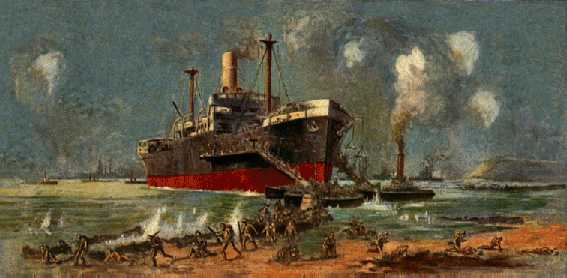
{The waters ran red with the blood of the Dublin and Munster Fusiliers and the 2nd Hampshire Regiment who were slaughtered trying to get ashore at Gallipoli on April 25, 1915.}
I wish I was traveling with President Mary McAleese at the moment.

The President is at Gallipoli in Turkey today and tomorrow where she is honoring those Irishmen who took part in the 1915 campaign there. This is the first time that this state has officially recognized those Irishmen who died there.

Coincidentally, last night I was racing through the channels during an ad break, as one does, when I stumbled onto the 1981 Australian movie "Gallipoli", starring a young Mel Gibson. "Gallipoli" is a good reflection of the Australians' view of the war which definitely fits the old adage of 'lions led by donkeys.'

More than 8,700 Australians died at Gallipoli and because of the ultimate failure and the simple of waste of life there, Gallipoli is a key moment in Australian history. Every Australian knows about Gallipoli.

Somewhere between 3,500 and 4,000 Irishmen also died there, but virtually nobody in Ireland, particularly from south of the border, knows anything about this. I cannot imagine any Irish person making a movie like the Australians' "Gallipoli". Maybe someday.

For the moment I'm just glad that to see that the President has acknowledged the sacrifice of the thousands of Irishmen at Gallipoli and the whole First World War.

Go here for more about the Irish at Gallipoli and you can watch the RTE News report of the President's visit here (fast forward to the 17:58 mark).

Wednesday, January 20, 2010

"Friends" star Kudrow's new series inspired by a night of TV watching in Ireland

Lisa Kudrow, star of "Friends", was in Ireland filming "PS I Love You" a few years back when, according to one of the Sunday papers here, she was inspired to take on a new project - to produce a new television series, which will be broadcast in America starting in March.

Now, you might think to yourself that artists being inspired by Ireland is hardly something new, but Kudrow (photo) was inspired while inside watching t.v., not out admiring the beautiful rocky, green landscape. Kudrow's inspiration was an episode of "Who Do You Think You Are," a BBC program that RTE has adapted for Ireland.

The basic concept behind WDYTYA (#WDYTYA on Twitter) is that someone the public knows will research their family tree and we the audience get to experience their discovery. It may sound dull, but it is usually far from that. You may even remember I wrote about this back in July and described WDYTYA as 'must see t.v.' (That post is now lost to the site, but I've reproduced it below)

For many of the featured celebrities it is an emotional experience as they learn about the hardships or tragedies that their grandparents, great-grandparents and further back had to overcome. Some of them get visibly moved and, although they're generally showbiz people and capable of putting it on, anyone who's researched their own family history can relate to the emotions on display - you feel closely connected to people you've never met simply because you know their blood runs in your veins.

Something you have to realize is that not knowing who the celebrity is doesn't matter. Some of the best episodes I've seen have been ones where I had no idea who the celebrity was. In fact, the episode I wrote about in July was about a British radio DJ who I'd never heard of before.

From the first time I saw WDYTYA I thought it would suit America to a tee, in fact better than any other country for the simple reason that Americans all have the immigrant stories that are generally the best ones to watch. And even if the celebrity is a bit stuck on themselves, that usually fades as they learn little truths about their family's past. (And, it's amazing how often bigamy comes up!)

The American series of WDYTYA premiers on NBC on March 5. I just hope the American series is as entertaining as the British and Irish versions. If it is, it will be well worth watching.

====================
Originally Posted July 22, 2009

Genealogy as Must See tv

There are times when I love the BBC. Tonight was one of them.

I just finished watching Who Do You Think You Are? and, honestly, it was riveting. This is a series that has been on for years, and it's often been riveting in the past. Tonight was one of the best.

The idea of the series is that basically we watch some semi-well known person research their roots. Tonight it was Chris Moyles, a DJ on BBC radio. I knew nothing of him before tonight, but that didn't hinder my enjoyment of the show.

Anyone with Irish roots would enjoy this program. All of Moyles' family was from Ireland and they all came from extreme poverty. There are a couple of twists in his family story that would probably differ from that of most Irish-Americans - like the grandmother from the slums of Dublin, always more likely to head to Britain than America - but I still think people of Irish descent anywhere would find the story moving.

My only regret is that the BBC doesn't allow people outside the UK to watch their shows online. If they did, I'd highly recommend it. If they show this series on BBC America, look out for the Chris Moyles episode. It's worth it.

Friday, January 15, 2010

Three American soldiers buried in British WWI cemetery

As you know if you've been coming here regularly I love visiting the WWI sites around Ieper (Ypres), Belgium and northern France. I was back there last week, visiting cemeteries and experiencing the region in winter. It was pretty cold and the thought of living in a trench in such weather is way below unappealing.

One of the planned stops on the tour was Lijssenthoek Cemetery, which is near Poperinge, Belgium. It's a British Commonwealth cemetery, but as soon as I walked through the gate my eyes were drawn to a sight I hadn't expected: three graves with American and Belgian flags.

Three Americans buried in a Commonwealth cemetery with 10,000 graves. Why? Who were they?

Although most of my interest in WWI has centered on the Irish involvement, the American in me couldn't ignore what I was seeing. I noted the names of the three men and went looking for their stories over last weekend.

One of the graves was Sergeant David Stanley Beattie, who was killed on August 31, 1918. He was from Troy, NY, which is not far from where I grew up. His regiment - the 105th Infantry - was one of the first American units in Belgium. He was killed on August 31, 1918 and buried in Lijssenthoek, but at his family's request he was left in Lijssenthoek and not moved to an American cemetery.

Lieutenant James Pigue from Tennessee is also buried there. He was killed on July 18, 1918, presumably leading his men out of the trench. In 1921 Pigue's father traveled to Belgium to visit the grave and after being assured by the British authorities that they would "care for the grave in perpetuity" he asked that his son's body not be disturbed.

The third grave was Pfc Harry King and his story was the most intriguing, but also the saddest because inscribed on the gravestone was, "Best of Sons and Brothers, Also Reggie Buried Close By." I couldn't see any other American graves and didn't know what to make of that bit about his brother Reggie.

However, it turns out Harry was originally from England and emigrated to America. His brother also left England, but for Canada and they both ended up in the war and both died. (Harry of pneumonia, Reggie killed in action). Their mother asked that Harry's body be moved from the American Meuse Argonne Cemetery to Lijssenthoek so that the two brothers could be together again.

Monday, January 11, 2010

Yes! The Time is now for Fr. Doyle Square

Following the publication of the Murphy Report into clerical child sexual abuse Dublin City Council wants to change the name of Archbishop Ryan Park. Okay, changing the name away from Archbishop Ryan is appropriate, but changing the name to honor "one of the city's famous writers," as suggested by one councillor, is wrong. The park remains a gift to the city from the Catholic people of Dublin and, therefore, an Irish Catholic should be honored.

The park should be named after someone who lived a positive Catholic life. Matt Talbot would be more than fitting, even Daniel O'Connell would be fine. Naming the park Fr. Mathew Park would be even better. Fr. Theobald Mathew's crusade against drunkenness in the 19th century is a bit of inspiration that our modern Ireland could use.

However, my first choice to replace Archbishop Ryan in the park's official name is Fr. Willie Doyle. It's only 4 months since I called for a Fr. Willie Doyle Square in Dublin and now that exact opportunity has presented itself. Fr. Doyle - a great Catholic and hero of the Western Front - is the perfect choice for this park. This is a man whom all of Ireland can celebrate. Catholic, Protestant, Unionist and Republican, as commenter chicagoaoh pointed out back in September.
My Mayo grandfather (who was of age in WWI but joined the IRA instead) had a 1920 copy of Alfred O'Rahilly's book "Father William Doyle, S.J." throughout his life. My grandfather said it was one of his favorite books... Doyle's was a unique story of courage and faith.
Fr. Willie Doyle was an heroic figure admired by thousands, perhaps millions, of Irish men and women, but who is now only remembered on a cold wall in Tynecot cemetery in Flanders, Belgium. The time is now to right that wrong.

Tuesday, September 29, 2009

It's time for a Fr. Doyle Square in Dublin

Posted by TheYank at 9/29/2009 10:35 AM EDT

You know who Fr. Duffy is, right? (If you don't, well, we need to remedy that. You can get a snippet here.) Anyway, the Royal Dublin Fusiliers had their own Fr. Duffy during World War I. He was Fr. Willie Doyle, a Jesuit priest originally from Dalkey, Co. Dublin, who was a hero to the men of the 16th (Irish) Division in the British Army just as Fr. Duffy was a hero among the men of the Fighting 69th later in the war.

Fr. Doyle's first taste of combat was at Loos in France in the spring of 1916 at the same battle where, I believe, my wife's was killed. From the first day his unit went into battle Fr. Doyle ministered to the troops with no regard for his own welfare. He heard their confessions, said Mass for them and, frequently, dashed out into danger to give a dying man last rites. He also risked his life to help retrieve wounded soldiers.

In this more comfortable and cynical age it's difficult to appreciate how important Fr. Doyle was to the men of the 16th Division. They were predominantly Catholic and much more committed to their faith than today's average Catholic. And that was before they were stripped of all worldly comforts and forced to live in trenches and face bullets, shells and poison gas.

General Hickie, commander of the 16th Division, wrote of Fr. Doyle:
Many a dying soldier on that bloody field has flashed a last look of loving recognition as our brave padre rushed to his aid, braving the fearful barrage and whistling machine-gun bullets, to give his boy a last few words of hope.

Two monuments along a road near the Messine Ridge in Flanders. The one on the left is for the "Loyalist" Ulster 36th Division and the one on the right is for the "Nationalist" 16th Division. The two divisions fought side-by-side in June 1916 in one of the war's rare clear-cut successes. Fr. Doyle was with the 16th Division then, but frequently found himself among the 36th.
Hickie also said that Fr. Doyle was "one of the bravest men who have fought or served out here." Fr. Doyle was awarded the Military Cross for his bravery during the 16th Divsion's assault on Ginchy during September 1916 during which thousands of Irishmen were killed.


Fr. Doyle was killed on August 16, 1917 during the infamous Battle of Passchendaele. Like thousands of others who died in that muddy hell-hole, Fr. Doyle's body was never identified.

Perhaps the greatest testimony to Fr. Doyle's commitment to the Irishmen who fought and died in WWI comes from this anonymous Ulster Protestant who wrote to the Glasgow Weekly News after Fr. Doyle's death.
Fr. Doyle was a good deal among us. We couldn't possibly agree with his religious opinion, but we simply worshipped him for other things. He didn't know the meaning of fear, and he didn't know what bigotry was. He was as ready to risk his life to take a drop of water to a wounded Ulsterman as to assist men of his own faith and regiment. If he risked his life in looking after Ulster Protestant soldiers once, he did it a hundred times in the last few days. . . . The Ulstermen felt his loss more keenly than anybody, and none were readier to show their marks of respect to the dead hero priest than were our Ulster Presbyterians. Fr. Doyle was a true Christian in every sense of the word, and a credit to any religious faith. He never tried to get things easy. He was always sharing the risks of the men, and had to be kept in restraint by the staff for his own protection. Many a time have I seen him walk beside a stretcher trying to console a wounded man with bullets flying around him and shells bursting every few yards.

Father Doyle's body was never identified. He's listed along with 35,000 others on the wall at Tyne Cot Cemetery near the town of Passendale in Flanders. Coincidentally, his name is beside that of the Reverend John Eyre-Powell, a Protestant Chaplain also from Fr. Doyle's hometown of Dalkey, Co. Dublin.

Father Doyle was recommended for a Victoria Cross, the highest honor for a soldier in the British Army, but it was denied because, according to his biographer, the "triple disqualification of being an Irishman, a Catholic and a Jesuit, proved insuperable."

It's well past time that this is put right. He should get that Victoria Cross now (if that's possible, I have no idea). More importantly, he should be honored in Dublin. New York has Fr. Duffy Square, but there is no Fr. Doyle Square or even Fr. Doyle Street in Dublin. There should be.
---------------
Comments:

jacersisityourself wrote:
Thanks to Yank for this article. Nice little bit o' history that I wasn't taught about. I never heard of Fr. Duffy. If a heroic man needs to be recognised, then let him be recognised. There are many others who are recognised by monuments etc who weren't actually heroes or heroines, just famous people. Let's give recognition to the rightfully entitled ones. Given your story, Yank, I agree... But even if Fr. Duffy isn't recognised in memorium, or in a statue, at least we can be comforted that God will recognise his work on His behalf. *High fives*
9/29/2009 6:49 PM EDT

Ajreaper wrote:
Yank I very much appreciate and enjoy your "history lessons" thanks for a very interesting piece of history.

Both Father Duffy and Doyle would scoff at being honored as they would view what they did as not heroric but simply doing thier jobs- we should honor men such as these anyway.
9/29/2009 9:56 PM EDT

TheYank wrote:
Ajreaper

Yes, Ajreaper, you're probably right, but I wonder if Fr. Doyle wouldn't concede to allow such a monument to him if it helped revive the memory of the men he served with. It is almost impossible to convey just how much the Irishmen who served in WWI have been blanked from history here.

I know that to an American you might think, well, what about Vietnam? And it is sort of analogous, but not quite.

It took a few years for Americans to come to terms with the war in Vietnam and to honor those who died and give the vets their due, but the Irishmen who served in WWI fought for an army that was then later discredited in the eyes of a great many people here and in the official history of this state. The veterans never spoke of their service; the maimed suffered silently; the dead were never honored.

This is despite the fact that hundreds of thousands of them joined up at the behest of Irish nationalist leaders who told them that fighting for Ireland's honor and for Belgium against a ruthless German foe would secure home rule for Ireland - a 100+ year old dream.

So, I guess I'd like to see Fr. Doyle honored because it will indirectly honor all those thousands of others who didn't deserve what they got, even if it was understandable in the context of the War of Independence and the need for a new country to develop its own myths and heroes.
9/30/2009 9:52 AM EDT

Ajreaper wrote:
Yank- I never thought about it in that light before. Thank you for the explanation and the example of Vietnam very much paints the appropriate picture for me about how WW1 service for an Irishman was viewed- I would hope they were, at least, not looked down upon for their service by many as American vetrans of Vietnam were. I completely agree Fr. Doyle would concede if it brought attention to the sacrifices of the men he served. The service and sacrifice of men and women in uniform should be honored and respected regardless of one's politics or opinion of any conflict they serve in.
9/30/2009 1:30 PM EDT

jacersisityourself wrote:
On a tourist trip to beautiful Austria, I visited a church to say me prayers. Afterwards, I went into the adjoining graveyard. I was privileged to see families' honouring their sons and daughters who died youngly in battles that they didn't know what they were fighting for. Vietnam comes around again. Young people being sent to war on behalf of Old Men? Again, pls explain the American sacrifice in pursuit of the harmony that doesn't exist in the US of A.
9/30/2009 8:28 PM EDT

kickstar wrote:
I don't agree with anything being named after any clergy, Brothers, priests,nuns bishops,Cardinals,Popes ministers, or vicars I am sure you get the point.It gives the false impression that they are somewhat better that regular folk and we now know that is far from the truth.Being that so many of these folk have been found guilty of sexual and physical abuse against children and it still goes on......http://ca.news.yahoo.com/s/reuters/090930/canada/canada_us_bishop
9/30/2009 9:56 PM EDT

kickstar wrote:
yank you are so full of it, The British were only too glad to award the VC to an Irish man and did so very many times and certainly during a grinding standoff like the first world war as it helped with recruitment as for priests were not issued with arms and were not as such under orders so it was quite unlikely that any would be in a position to win a VC, Can you imagine the Citation "He fearlessly sprinkled holy water (as he called it)all over the trench as the shells rained down".. Here are some Irish VC winners..... http://en.wikipedia.org/wiki/Irish_Winners_of_the_Victoria_Cross
9/30/2009 10:14 PM EDT

Ajreaper wrote:
LOL, so Kickstar because some- and I would presume a small minority of clergy were involved in such terrible crimes we should paint them all with the same brush? How pathetic and small minded is that?

The vast majority of Priests are decent men who would no more harm a child then the average person would- no one should be held accountable for the sins of others.
9/30/2009 10:29 PM EDT

Padraig wrote:
Kickstar. You truly are a jaded one. Yank writes and correctly describes a good man with no prejudices, religious or otherwise. You seem very quick to point out negatives. Yes allot priest have done terrible things but so many have done so much good. People should be honored, no matter of their background. You, my jaded tart, are racist. Not in the traditional sense, but you have the combined intelligence of a goat and are as closed minded as moth to a flame. You are not able to get out of the way because of a one tract mind. You say this would give a false impression to honor a man's greatness. We as human beings need human heroes, something that we can aspire to. Humans are capable of the worst atrocities and if judged by history, we are the most terrible animal on the planet, capable of genocide. Honestly you think the Germans were the first? What about the British trading small pox filled blankets to American Indians? That killed 3/4 of the whole population. They didn't have the immune system to combat. Genocide can go farther back than that, but the point is we need heroes. There needs to be some light in the darkness, no matter where they come from. If a man grabbed your family members hand on the edge of a cliff, would you tell him to let go because he was a Catholic Priest? Or would you say pull them up? If you said pull them up, “Does that give the wrong impression.”
10/2/2009 2:13 AM EDT

TheYank wrote:
kickstar,

First of all, thank you for that link to the web page of Irish VC winners. I'll have to have a good look at that. My first impression is that very few of the WWI winners were from the Irish Divisions - 10th and 16th. Will have to look again.

Second, I never said that the British didn't award any VC's to Irishmen, I quoted Fr. Doyle's biographer who said that Fr. Doyle had three disqualifying marks: Irish, Catholic & a Jesuit.

As for your belittling of Fr. Doyle's bravery, that barely requires a response. General Hickie described Fr. Doyle "as one of the bravest men" who served under him. That's among thousands. You may think the sprinkling of holy water a matter of amusement, but your view is not relevant. What mattered is how the men felt about Fr. Doyle's work among them.

Also, Fr. Doyle often left the relative safety of the trench in order to retrieve a wounded soldier or - as that anonymous Protestant attests - to bring water to soldiers. Bravery has nothing to do with having a bun in your hand.
10/3/2009 1:12 PM EDT

TheYank wrote:
Padraig

I'm wary of contradicting you because I'm not 100% sure myself, but the only incident I know of where the small pox blankets were used was actually as a weapon of war during what we call the French & Indian War (the Seven Years War on this side). I think it was in an attempt to lift a siege near what is Pittsburgh today. Again, I'm not that sure of my memory on that score.
10/3/2009 1:15 PM EDT

TheYank wrote:
Bravery has nothing to do with having a bun in your hand.

Too funny. There's a lot of bravery required when eating a hot dog in a bun from some of those street traders in NYC.

Obviously, I meant "gun in your hand."
10/3/2009 1:17 PM EDT

chicagoaoh wrote:
Dear Yank,

I very much appreciated your piece on Father Doyle. It has personal significance for me. My Mayo grandfather (who was of age in WWI but joined the IRA instead) had a 1920 copy of Alfred O'Rahilly's book "Father William Doyle, S.J." throughout his life. My grandfather said it was one of his favorite books, and was please I was interested in it when I visited my grandparents. After he died in 1976, my grandmother gave the book to me. It remains one of my treasured possessions. Doyle's was a unique story of courage and faith, and I am pleased you wrote about it.
10/4/2009 1:06 PM EDT

Padraig wrote:
I'll be bit more clarified in the future. Your correct 7 years war Lord Amherst. and mmm. by the way. I liked this piece.
10/5/2009 1:24 AM EDT


TheYank wrote:
chicagoaoh

I wish I had a copy of O'Rahilly's book. You're fortunate to have one. It's hard to find. You can find a copy of the text online here http://bit.ly/CsuI3 - which is where I got a couple of the quotes above - but I'd like to own a copy of the book.

I'm very interested in your personal story. I've often wondered how IRA men of the time felt about Fr. Doyle. Your grandfather obviously thought highly of him.
10/5/2009 4:44 AM EDT

edmundburke wrote:
Dear Yank,
I have a two screen names here, because I forgot my first, so I am both chicagoaoh and edmundburke.

Since you were curious about my grandfather in the IRA and his subsequent veneration of Fr. Doyle, I thought I would give you some information about him.

His name was James Curry and he was born in Mayo in 1891. His nationalism was ingrained in him growing up through the general nationalist sentiments of his east Mayo Catholic community and his involvement in the GAA, in which he played excellent football.

His GAA athletic career allowed him to score a lower level position with the railroad. Since he had such a job, he did not have to enlist in the army and escaped service in WWI. (As you know, conscription never went into effect.) Like many others, he was radicalized by the English response to the Easter Rebellion and joined the IRA by 1920. (Whether he was a member of the IRB before that I do not know.) Even though he was 29 then, he was one of the younger members of his east Mayo unit (interestingly). Due to his age, lack of seniority, and his job with the railroad, he was specifically not assigned to armed duty but was assigned to report on the movement of personnel by railroad. In so doing, he was able to report on troop movements and informer movements, the latter leading to reprisals. He volunteered for one military action but did not make the cut. During the last week of the war, the auxiliaries came to his town of Swinford to round him and his comrades up, but he was able to escape to the surrounding fields with the help of townsmen. While he was in hiding, the Truce was declared, and he returned to civilian life. He did not take part in the civil war. He was decorated for his IRA service in the War of Independence, and my grandmother gave me his medal after his death in 1976. The identical medal is on display (or was) in the Kilmainham Jail museum.

My grandfather became a Fianna Fail supporter. Other than that he did nothing political for the rest of his life. He was a devout Catholic and socially conservative. He told me in the 1970s that he did not favor IRA physical force in the North. As I mentioned, he admired Fr. Doyle. His sympathy to the IRA extended to his old comrades and ended in the 1920s. I hope this answers your questions.
10/6/2009 9:46 PM EDT

TheYank wrote:
Dear edmundburke,

First of all, have you looked for your grandfather's family in the 1911 Census? http://bit.ly/3ac6fr Be sure to check the House & Building Return. It's can be interesting when you're looking at your ancestors' hand-writing.

Thank you for the your grandfather's story.

10/7/2009 11:56 AM EDT
jacersisityourself wrote:
Lovely bit o' story by edmundburke/chicagoaoh. I hope the GAA back here in Ireland see it and record it in their future annals.
10/13/2009 7:41 PM EDT

Tuesday, September 1, 2009

John Condon of Waterford, "youngest battle casualty"

Posted by TheYank at 9/1/2009 7:02 AM EDT

As I mentioned last week I returned to Flanders because I didn't feel like I'd seen all I needed to see there. Following my last visit I became fascinated by World War I and the Irish role in it. I wanted to return to see some of the places and the graves of those I'd been reading about.

On my list was the grave of John Condon from Waterford. I came across his name in a book about the Irish in the Great War. Condon is listed by the Commonwealth War Graves Commission as the "[y]oungest known battle casualty of the war." His headstone says he was 14 when he was killed on May 24, 1915. Condon's grave is thought to be the most visited among the hundreds of thousands of soldiers' graves from the Great War.

Having read that about Condon, I thought I should pay a visit myself. When I arrived at the right cemetery - there are hundreds around Ypres - I realized I didn't have the grave reference. Uh oh, I thought. I didn't have to worry, however, because while walking through the cemetery Condon's grave almost shouted out to me what with the Irish flag and the little wooden crosses left by those who had visited recently.


As I was standing in front of this one grave among the thousand or so graves I couldn't help wondering how any 14-year-old managed to convince some (too willing?) recruiter that he was 18.


Since I've come home I've learned that Condon may have done no such thing. First, I went looking for the Condons' census form from the 1911 census. That's when doubt first entered my head. I couldn't find any family with a John of the right age to be Private Condon. So a short Google search turned up this, from the local Waterford newspaper in 2007.
According to Michael O’Connor, Director of Waterford Heritage Services, John Condon was actually born in 1896 and was 19 when he died, not 14. He hadn't fooled anyone, but was actually the same age as so many of those who died in Flanders between 1914 and 1918. And Michael O'Connor says that the Condons' census form from 1911 lists John as a 15-year-old "General Labourer."

A little additional digging and it turns out that John Condon may not be buried in that grave at all. This site claims that the remains of a different missing soldier, 35-year-old Patrick Fitzsimmons from Belfast, were misidentified as Condon's back in 1923.

Uggh. It was all so much simpler when I was just going to visit the grave of the youngest soldier killed in the war.

{Maybe not as interesting as being the youngest battle casualty, but the Condons' 1911 census form shows that John's mother, Catherine, is listed as 40 years old and married 26 years. They were certainly different times.}

Wednesday, July 22, 2009

Genealogy as Must See tv

Posted by TheYank at 7/22/2009 5:13 PM EDT

There are times when I love the BBC. Tonight was one of them.

I just finished watching Who Do You Think You Are? and, honestly, it was riveting. This is a series that has been on for years, and it's often been riveting in the past. Tonight was one of the best.

The idea of the series is that basically we watch some semi-well known person research their roots. Tonight it was Chris Moyles, a DJ on BBC radio. I knew nothing of him before tonight, but that didn't hinder my enjoyment of the show.

Anyone with Irish roots would enjoy this program. All of Moyles' family was from Ireland and they all came from extreme poverty. There are a couple of twists in his family story that would probably differ from that of most Irish-Americans - like the grandmother from the slums of Dublin, always more likely to head to Britain than America - but I still think people of Irish descent anywhere would find the story moving.

My only regret is that the BBC doesn't allow people outside the UK to watch their shows online. If they did, I'd highly recommend it. If they show this series on BBC America, look out for the Chris Moyles episode. It's worth it.

Wednesday, July 8, 2009

Byrnes at War

I was just reading James Ryan's article on the name Byrne. I didn't do a study of the names on the monuments at the Menen Gate and Thiepval, but it seemed to me that Byrne was the most common name amongst the Irish regiments, definitely the most common in the Dublin Fusiliers.


There are four Byrnes listed here on the Thiepval Memorial. Each of these four Byrnes died at the Battle of the Somme, served in the Royal Dublin Fusiliers, and was a Lance Corporal. Imagine there were four Byrnes who were Lance Corporals who died in that battle and whose bodies were never found/identified. The number of Byrnes who were privates listed on this wall was far, far greater, but they were at too great a height for me to get a picture of the names.

I wonder if any of them was related to Gabriel Byrne (featured in the picture with James Ryan's article). I'm pretty sure that the former host of Ireland's most popular television show, Gay Byrne, lost two uncles in the war.

Here's another picture (below). It's of one wall from the Menen Gate. That print you can't really make out is a portion - not even half - of all the names from the Irish regiments who were killed at Ypres, but whose bodies were never identified. It is amazing how many names are listed on these walls. And you have to bear in mind that those whose bodies were identified are not listed, but are in named graves in any of the dozens of cemeteries in the area.

Monday, July 6, 2009

Island of Ireland Peace Park

One place I was keen to see during our two-day sojourn was the Island of Ireland Peace Park. The Peace Park is near Mesen (Messines) just south of Ieper (Ypres).

I wasn't as happy with the Peace Park as I thought I was going to be. Why? Well, mostly because I had read that the Park was dedicated to those who "served with the Armies of Australia, Britain, Canada, New Zealand, South Africa and the United States." {Although, reading it again I realize I misread what was said.} So, when I saw that those who served with the American (or Canadian or Australian or etc.) forces were not included I couldn't help wondering why not. They all fought on the same side, no?

Then there was the Peace Pledge stone. I know the Peace Park was partly a response to the Good Friday Agreement, but still something about the pledge made me cringe. I'll leave it to you to make up your own minds.

Just inside the gate there are eight stones with short verses written by Irishmen who served in the war. Ledwidge and Kettle were the only names I recognized. I'm not sure if I was supposed to recognize the others; I'm not sure it matters.


There are also three small pillars representing the three Irish divisions:
  • 10th (Irish) Div. - 9,363 casualties
  • 16th (Irish) Div. - 28,398 casualties
  • 36th (Ulster) Div. - 32,186 casualties
Another disappointment were the books. Inside the round tower was a set of books listing every Irish member of the British Army who died during the war. Tremendous resource with all the names listed alphabetically. Unfortunately, a few of the books were missing. I hope they have only been removed temporarily, but it would have been on bother to take one with me if I'd been so inclined. I can't imagine anyone doing that, but the books were missing. Maybe they should have been on chains tied to the wall? That would have prevented the books going missing, but also would have prevented me from bringing one outside the Tower to look for Patrick Conway's listing.


The Round Tower is a nice feature - Irish, yet it fits in with the country-side. When it's a bit older it will be even better.

Overall, I think the Park is not bad, but it lacks some of the poignancy you get from the older monuments erected when the memory of the war and the carnage was fresh. I'd still recommend a visit, though.

Friday, July 3, 2009

Who was Patrick Conway?

=== This was originally posted at IrishCentral.com ===

One of the great things about studying family history is that you find that members of your family did things that make you wonder 'What they were thinking?', 'What drove them?'. Often they did things that don't fit the general historic themes you learn about in school and through books.

For my wife and I this process started with regards to Patrick Conway back at the end of May when we first found her great grandparents' census form on the 1911 Census web site. Patrick was "head of family", a "bricklayer's labourer". had been married for nine years and had four children. The oldest child, my wife's grandmother, was nearly 7.

It wasn't even that anything we found was all that surprising, but my wife had never really thought about Patrick Conway other than as the man who was her father's grandfather and that he died in the First World War. The census somehow brought him to life.

We have few hard facts, but we believe Patrick served with the British Army in the Boer War in South Africa around 1900. We also believe he was a member of the Citizen's Army - a worker's militia born out of the Lockout of 1913.

Now that's interesting because in Irish history the Citizen's Army and the British Army ended up on opposite sides during the 1916 Rising, but that was all in the future when Patrick Conway enlisted in January 1915.

So, he was in the British Army, left, married, had a family, worked as a bricklayer, joined the Citizen's Army and joined the British Army again. As my wife thought about all these things and the fact that he was around 38 years old when he (re)enlisted in the Army, the main question was: why? Why did Patrick Conway, a 38-year-old husband and father of four. decide to go to war?

And really there was only one answer. He must have been out of work. As a friend of mine said to me recently when I told him this story, "What employer would hire a 38-year-old militant trade unionist bricklayer's laborer?" So simple and straight-forward that it has to be true.

They were harsh times and he probably realized that the army at least offered a wage and, even in death, a pension. Something for his family to live on.

That man was the father of my wife's grandmother, somebody she knew well, but who had never talked about these things. This is why my wife had to go to Bethune, France to visit his grave. We were going to be too near to let the chance slip by.

Bethune is only about an hour over the border from Ypres so we changed our plans to include a visit there. Unlike all the other British military cemeteries that I saw, Bethune is a local cemetery, with a war graves section. It is mostly local French people who are buried there. The war graves aren't exclusively British either. Most of them are British, but there are French and German soldiers buried there as well.

We found Patrick Conway's grave and found that he was buried near four other members of the Royal Dublin Fusiliers, who all died within a day or two of each other. We guessed that they were all injured in the same engagement, but we have no way of knowing. More research.
---------------
Comments:

jacersisityourself wrote:
The two Patrick Conway articles were indeed a delight to read. It is even personal in a way because years ago I got into Family History and Genealogy before the last of our elderly aunts and uncles died. I only got so far in my research but a younger cousin took up the cudgel and found information on generations further back, some with the help of the 1911 census publications. We even have ancient photographs, which is nice ‘cos you can see the persons in your family tree.

The reference to visiting the grave of Patrick Conway was also touching. It shows even after we’re gone, someone somewhere later in our families’ tree cares enough to bother to make that effort to do so. Members of my father’s family emigrated from Ireland to Canada and my cousins and their sons and daughters now have families of their own, born in Canada but with Irish roots. The youngsters were drawn into school projects along the lines of “Who do you think you are?” a popular TV show which helps the famous and not-so-famous find their family histories.

It was queries from my Canadian cousins that sprang me into family genealogy research for their sakes. It was rewarding and highly interesting. There is a photograph of me with my great grand-aunt when I was very young. She is buried in Canada. My cousin sent me a photo of her grave’s headstone. I treasure that photo and have put it aside for my own future generations.
I certainly understand the Patrick Conway articles' import. Well done & thaanks to The Yank and his wife.
7/3/2009 7:43 PM EDT

jacersisityourself wrote:
Pity there has not been any further comments yet to The Yank’s articles about one Patrick Conway. I am sure there are many Irish descendants around the world with thoughts and memories that could have contributed to these lovely articles.

Recently I marked one my so-called ‘milestone’ birthdays. As the first-born, I had my three immediate younger family members and their other halves together for the occasion. It was nice.

The mother of us four conceived ten times but lost six babies either before or after birth. We four are the lucky survivors. I was old enough by the time my mother’s last baby died to remember my father’s grief at her, and my last born sister’s, loss, two days into her wee life.

D’ye know what? Sitting looking at my three family members alive and well across the birthday dinner table, made me think of the brothers and sisters we could have had around the table too.

And thinking just the other day about the Yank and his wife’s the visit to France to Patrick Conway’s grave made me realise I have no idea where my lost brothers and sisters are buried, if they were at all. I would like to visit a marked grave, or even unmarked grave, of at least the ones who survived delivery into our world.
What do hospitals and their staffs do with born babies that die within hours or just a couple of days? Could I ever hope to visit at least a hospital-known mass burial plot to remember my brothers and sisters, like the Yank and his wife remembered Patrick Conway?
7/4/2009 10:03 PM EDT

TheYank wrote:
jacersisityourself,

Am I right in assuming you're in Ireland? I think more people here will (& should) get interested in family history. The 1911 census is a great spur. I've seen it in action, but questions from America/Canada/wherever can also help. Obviously, I'm from America, but even I have taken for granted the access I have to the family history until I get a question from an American relative which spurs me into learning more.

Old photographs are great too, although they can be frustrating if you can't find someone who can identify the people in the picture. My grandmother was a great believer in writing names on the back of photographs and I think she's right. How we'll deal with all these digital pictures is another issue, however.
7/5/2009 5:09 PM EDT

TheYank wrote:
jacersisityourself, your story is a tough one. I wish I knew the answers to your questions about what hospitals do (did?), but I would imagine that every baby born alive would have been buried and that someone, somewhere would have a record of that. I hope so, anyway.
7/5/2009 5:12 PM EDT

jacersisityourself wrote:
I was abroad on holidays recently, so I dd not seeTheYank's postings above 'til now. Yes, I am Irish, born and raised in Dublin but living "in the sticks" now, as we say here.

Yes, old family photographs are indeed a treasure and yes, it can be frustrating trying to find out who's who in them! I have one of my great grandfather as a young man with a large group of other young men in an obviously official photo. The problem is that despite our efforts, we cannot yet find the circumstance of the photo!

I was big into photography years ago and have a black bag full of photos that I took as my family grew up. In time, those photos will be a delight to them and any descendants they might have. I appear in very few, as I was the one mostly behind the camera.

Yes, I can see the problem for future generations with digital photos, unless printed for posterity. As storage media are changing rapidly these days, even memory cards will be obsolete in time.

Thanks for kind comments on my non-surviving siblings. Your suggestions are well worth following up but a lot will depend on the extent that hospitals bother to search their records for any information that I might ask for.

I was born in the Rotunda Hospital in Dublin's city centre. As you will know from living in Dublin, there is a statue of Charles Stewart Parnell at the top of O'Connell Street. The statue shows Parnell pointing his finger towards the Rotunda Hospital. Beneath the statue, one of Parnell's speeches is written in gold. It begins "No man shall put stop to the march of a nation..." A folly, if ever there was one... the finger pointing to the door where thousands and thousands of Dublin's babies like me first smelled Dublin's air!
8/7/2009 3:25 PM EDT

Visiting Patrick Conway

As I mentioned in my Twitter posts, we visited my wife's great-grandfather's grave in Bethune, France. Corporal Patrick Conway was from Kingstown (now Dun Laoghaire), Co. Dublin and served in the Dublin Fusiliers. He "died of wounds" in April 1916.

Although Patrick Conway died more than 90 years ago, my wife and our children were (as far as we know) the first members of his family to ever visit his grave. For my wife it was a moving experience. I can understand what she was feeling as I felt the same things when I was walking the area around the River Marne where my own grandfather fought with the American Army in 1918. My grandfather lived through the war, but my wife's great-grandfather did not. Both were Irishmen fighting on the same side in different uniforms.

Here's what my wife experienced standing at the grave.
My first thoughts were for my father who had never gotten the chance to see where his Grandfather was buried. Standing in front of the grave generations of Conways and Farrells seemed to be present.

We were all there to pay our respects to a man who had died in 1916. I kept picturing my Dad standing there. He would have loved to have visited Bethune. In his time it was just too expensive to do that. He was a working man with a family to support and going to France was not a possibility.

For me, going to my great-grandfather's grave was a necessity. I wanted him to know that his family is proud of him. I wanted him to know that his descendants were thinking of him. Standing there looking at that faded gravestone, I wanted him to know that he was not "a stranger without even a name, enshrined forever behind a glass frame. "He was a living and breathing human being who is remembered and honoured by his family.

Tuesday, June 30, 2009

WWI tour & Twitter

You may (or may not) remember when I wrote two months ago that I was going to Belgium on a World War I tour. Well, that day is here. I'm off in the morning on my two day trip. You might think that means a break from me and my ramblings, but no such luck. In fact, if all goes well, I'm going to be posting more! My WWI tour will have a distinctly Irish flavor and I'll do my best to share that with you. Oh, and it's now one day in Belgium and one day in France (just over the border).

That's where that new sea-blue Twitter box comes in. See it there on the right? I hope to be able to do some brief posting inside that box throughout the days and longer posts - with pictures - here when I can find an internet connection.

You might also notice that I've changed my Twitter name from unquiet_man to AmericanIreland. Makes a bit more sense, right?

Monday, June 1, 2009

American servicemen in unmarked grave in Cork

This evening I was watching a docu-drama on the "Spanish Flu" pandemic of 1918-1919 in Ireland when near the very end there was a mention of three American sailors who died of the flu and were buried in an unmarked grave in a small graveyard in Queenstown, now Cobh, Co. Cork. I want to know more. Why were they buried in an unmarked grave? Why not shipped home for burial as all other fatalities in Queenstown were? (I think the family had to pay for repatriation at that time.) Why weren't headstones sent over by the Navy to mark these sailors' graves?

I'm not sure if there's any difference for those who served in the Navy and those who were in the Army, but I know veterans of the American army who later lived here and died here can have their graves marked with a standard military issue headstone. Who pays for that, I don't know.

Anyway, I was surprised to learn that men who served in the Navy, who died while serving, lie in an unmarked grave. That should be remedied.

Saturday, May 16, 2009

To Ypres

Bought tickets to fly to Belgium in July. The whole family is going. I'm really looking forward to seeing the Island of Ireland Peace Park near Ypres in Flanders. Not sure if there will be much more than Ypres in this tour, but I'm sure we'll find other things of interest, etc.

Comments:

dublin37 wrote:
ooooh, you must hit Bruges if at all possible. So beautiful and quaint, with lovely lace at good prices.
5/20/2009 10:57 AM EDT

TheYank wrote:
Dublin37

I'd love to, but that will be another trip. We can only fit so much in during our 36 hour visit. Brugges is on my list.
5/20/2009 11:33 AM EDT