Until April 26 I had never flown east from the US to Ireland on a daytime flight, but since then I've flown on D8 1843 to Dublin twice. It's something of an odd experience after 30+ years of flying through the night, but it suits me.
Until April 26 I had probably made a few hundred flights from the east coast of America to Ireland (or Britain on occasion with a connection to Dublin). Each of those flights followed a familiar pattern: get to the airport in the afternoon/evening, check in, board, take off and 6 or so hours and one dinner later I was in Dublin (or London or Glasgow or Manchester or Bristol, etc.). And it was morning.
Daylight and exhaustion greeted me each time. Not with D8 1843, however. I got to Dublin somewhat tired – and bored (no TV on Norwegian) – but by 1:00am I was in my bed. Sleep didn't come easily after the trip but it did come and when I woke the next morning the exhaustion I usually experience on my first day in Ireland wasn't there. There's a lot to be said for that.
However, if you don't have your own bed waiting for you it may not be the ideal way to travel. If you need a hotel you'll end up paying for a night's sleep before you see anything of Ireland. So, Norwegian's daytime flight may not suit tourists coming to Ireland but for those who live in Ireland I think it's great.
Monday, June 11, 2018
Tuesday, March 15, 2016
Rockaway garbage man has the low down on Rockaway man in the Easter Rising
Ed Shevlin's story is great, if you don't know it already: NYC garbage man who got his GED in his 30s, went to college in his 40s and learned Irish. Now he's in his 50s and is doing a Masters in Irish Studies at NYU.
His research paper on John Kilgallon from Far Rockaway, who took part in the Easter Rising, is summarized in the NY Times.
John was sent away to St. Enda’s School in Dublin, a boarding school run by Patrick Pearse, who went on to help lead the Easter Rising.
Mr. Pearse recruited Mr. Kilgallon and other St. Enda’s students for a unit that stormed the General Post Office, where the rebels set up their headquarters.And then there's this: "Mr. Shevlin will speak about this research in April at an annual meeting on Irish studies at the University of Notre Dame."
Over the course of several days of fierce fighting, Mr. Kilgallon broke into a nearby wax museum and stole a costume of Queen Elizabeth I and returned to the fight wearing it.
Great stuff.
Friday, March 4, 2016
Walmart—inoffensive, but not actually Irish St Patrick's Day tee-shirts
Walmart has gotten some heat in prior years for their St Patrick's Day tee shirts, etc. Too many (dated?) stereotypes featured in their selection in 2013, 2014, 2015, but not this year. This year, from my own observation, the shirts are not straining to be funny.
However, the shirts on display in Walmart that I saw were not entirely au fait with Ireland's national symbol - the shamrock, the three-leaf shamrock. A four-leaf clover might make for a nice shirt - I guess - but it is not a symbol of Ireland or the Irish. So Walmart and Fruit of the Loom have it wrong here.
No idea what's going on with that skull and swords image, but the little clovers all have four leaves. Tut-tut.
There was one shirt that had it right. Just one and it wasn't a Fruit of the Loom shirt. It's nothing special, but at least the shamrock has the maximum three leaves.

However, the shirts on display in Walmart that I saw were not entirely au fait with Ireland's national symbol - the shamrock, the three-leaf shamrock. A four-leaf clover might make for a nice shirt - I guess - but it is not a symbol of Ireland or the Irish. So Walmart and Fruit of the Loom have it wrong here.
 |  |

No idea what's going on with that skull and swords image, but the little clovers all have four leaves. Tut-tut.
There was one shirt that had it right. Just one and it wasn't a Fruit of the Loom shirt. It's nothing special, but at least the shamrock has the maximum three leaves.

Thursday, October 15, 2015
America - are you out of your gourd?
 |
| You can't eat these things, right? |
Decorative gourds? When did that become a thing?
I've lived outside America for a long time and I have spent very few October days in the US of A over the last ... 24 years. When I left I'm pretty sure decorative gourds were not a thing.
After I hearing those two women – and after I'd stopped chuckling – I started noticing that there are gourds everywhere. Even in the church I went to on Sunday there are gourds. Are some of these actual former living things? I have no idea, and I don't care. I don't think you can eat them, whether they were once alive or not.
So what's going on here? Where did all these gourds come from? When did they become a vital part of my fall?
Now I know that most of my memories of October and Halloween are from my childhood, but I was 27 when I left America. If gourds had been a thing before I left in 1991 I'd have known about it. And if I didn't, my wife surely would and she'd have asked me about this strange American custom of decorating your house or church or office or ... anything with gourds.
I'm sure there are people out there who take their gourds seriously, but I can't take them seriously.
{Next - why would anyone want pumpkin flavored anything?}
Saturday, August 1, 2015
Proclamation? Declaration of Independence? Where are the signers buried? Don't ask @IrishExaminer
The editorial in today's Irish Examiner says "All the signatories of the Declaration of Independence lie there [Glasnevin] and their ghosts will assuredly be present today."
What? Surely the Examiner is aware of the fact that most of the executed leaders of the Rising, including all the signatories of the Proclamation, are buried in Arbour Hill cemetery, right? Okay, that's the Proclamation, not the "Declaration of Independence."
Yes, Ireland did declare its independence, but that was a declaration approved at the first meeting of the First Dáil. Was it actually signed? Maybe. I don't really know. If yes, who signed it and are they all buried in Glasnevin?
Is this really what the Examiner was referring to in their editorial about today's event at Glasnevin to mark the funeral of Jeremiah O'Donovan Rossa? Again, I don't really know, but if the declaration was signed, is there a copy of that document somewhere that we can view?
Overall, the point of the Examiner's editorial was lost thanks to this confusion.
* Corrected - Thomas Kent & Roger Casement are not buried in Arbour Hill
What? Surely the Examiner is aware of the fact that most of the executed leaders of the Rising, including all the signatories of the Proclamation, are buried in Arbour Hill cemetery, right? Okay, that's the Proclamation, not the "Declaration of Independence."
Yes, Ireland did declare its independence, but that was a declaration approved at the first meeting of the First Dáil. Was it actually signed? Maybe. I don't really know. If yes, who signed it and are they all buried in Glasnevin?
Is this really what the Examiner was referring to in their editorial about today's event at Glasnevin to mark the funeral of Jeremiah O'Donovan Rossa? Again, I don't really know, but if the declaration was signed, is there a copy of that document somewhere that we can view?
Overall, the point of the Examiner's editorial was lost thanks to this confusion.
* Corrected - Thomas Kent & Roger Casement are not buried in Arbour Hill
Monday, July 20, 2015
Moving to Ireland? Where to take your driving test!
Are the people in the west of Ireland naturally better drivers than those in the east? Or do they have better instructors there? I only ask because I was looking at the driving test pass rates for each test center and it definitely looks like a new driver would have a much better chance of passing the test if they found a test center west of the Shannon.
If I had to take the driving test in the near future and I had a choice as to where, (based on the last three years' pass rates) I'd try to book my test in one of these (in order):
If I had to take the driving test in the near future and I had a choice as to where, (based on the last three years' pass rates) I'd try to book my test in one of these (in order):
- Sligo
- Ennis
- Tuam
- Clifden
- Carrick-on-Shannon
- Rathgar
- Naas
- Tallaght
- Raheny
- Carlow
However, an overall theme is basically - head west, but avoid the Shannon center, which has had a pass rate of less than 50%.* If you're in that area, head to Ennis, where the pass rate is nearer 70%.
I really wish I could plot these rates on a map, but I don't have those skills.
I really wish I could plot these rates on a map, but I don't have those skills.
* Kilrush had a bad 2013 in terms of the pass rate, but seems to have righted the ship in 2014.
Monday, March 30, 2015
Leicester Cathedral should flood eBay with Richard III booklets
Let me say up front that I have no problem with Leicester Cathedral cashing in on the whole Richard III shebang. Churches need money too and if reburying a 500+ year old king puts coins in the coffers fair enough.
However, I think it's a bit rich for the man in charge of that whole affair to give a big "tsk tsk" to anyone else who might earn a penny or two out of the reburial.
The Dean of Leicester said:
However, I think it's a bit rich for the man in charge of that whole affair to give a big "tsk tsk" to anyone else who might earn a penny or two out of the reburial.
The Dean of Leicester said:
"We've noticed that service booklets from the cathedral's services are being sold for extortionate prices on eBay, presumably by those who attended the services," he said.Rather than moan about people selling the booklets at "extortionate prices" on eBay the Dean should flood eBay with his own booklets at whatever price he considers fair. That will put an end to anyone charging "extortionate prices" and will also earn the cathedral a few extra pounds. eBay is the opportunity, not a threat.
"This is very sad - many would have welcomed being there and keeping this as a souvenir.
"We have had extra copies printed and we are selling a set of all three for £12.50 to cover costs from Christian Resources in St Martin's House, next door to the cathedral."

Thursday, March 26, 2015
Five centuries late – the funeral of the century belongs to Richard III
So today's the day. The day of the celebrity funeral of the year, the century! Right? And not a damp eye about the place – the perfect funeral, not even a twinge of sadness among any in the church or anywhere at all really.
Richard III's funeral today is kind of like Will & Kate's wedding, only without the beautiful bride (or bridesmaid). What about the Royal Family? I don't know if they'll be in attendance for the big event in Leicester, but let's face it Richard wasn't (and isn't) really much of endorsement for the concept of monarchy.
In fact, his reputation was so poor that despite my real interest in the discovery of his body in the parking lot in Leicester, I didn't think many in Britain would really care. I am surprised at how big this thing is. I'm also also a little ... perplexed by today's ceremony.
Does Richard actually require a second funeral? Is there no statute of limitations on these things? Are people really going to pray for the repose of his soul?
I guess I'll have to wait and see how the ceremony is conducted, but there's no denying that interest is huge. I'm sure people all over Britain have been hanging Union Jack bunting, making plans to gather with friends and family for the funeral and preparing afternoon teas according to instructions in Funeral Magazine (Yes, there is one) so that they can enjoy 15th century royal treats after Richard III is buried once and for all - again.
I hope everyone enjoys the day. It's on Channel 4 in Britain. I have no idea if there's any coverage in the US of A. I sure hope so.
Here's a song appropriate for today's occasion/festivities.
Richard III's funeral today is kind of like Will & Kate's wedding, only without the beautiful bride (or bridesmaid). What about the Royal Family? I don't know if they'll be in attendance for the big event in Leicester, but let's face it Richard wasn't (and isn't) really much of endorsement for the concept of monarchy.
In fact, his reputation was so poor that despite my real interest in the discovery of his body in the parking lot in Leicester, I didn't think many in Britain would really care. I am surprised at how big this thing is. I'm also also a little ... perplexed by today's ceremony.
Does Richard actually require a second funeral? Is there no statute of limitations on these things? Are people really going to pray for the repose of his soul?
I guess I'll have to wait and see how the ceremony is conducted, but there's no denying that interest is huge. I'm sure people all over Britain have been hanging Union Jack bunting, making plans to gather with friends and family for the funeral and preparing afternoon teas according to instructions in Funeral Magazine (Yes, there is one) so that they can enjoy 15th century royal treats after Richard III is buried once and for all - again.
I hope everyone enjoys the day. It's on Channel 4 in Britain. I have no idea if there's any coverage in the US of A. I sure hope so.
Here's a song appropriate for today's occasion/festivities.
Thursday, October 9, 2014
Empires of the Dead
 |
| Highland Cemetery, Le Cateau, France |
I'm sure I wouldn't have enjoyed the book half as much if I hadn't been to so many WWI cemeteries. In fact, I'd love to read a book that deals with the American cemeteries and the decisions that led to the look and character we take for granted today.
Today we assume that the cemeteries look the way they do because it was always going to be this way. Crane's book makes plain that this isn't true, that the cemeteries are primarily the result of one man's vision, which was shaped by his views on the British Empire and equality (all headstones are uniform - for unknown privates up to well known generals).
At the time many families wanted their loved ones returned to Britain (or Ireland or any of the other nations in the Empire), but that was at odds with Fabian Ware's vision. He had support too, from Kipling who spoke for all those whose sons' bodies were never identified, who had nothing to return home for burial.
If you've traveled to Ypres or to the Somme you'll know what those cemeteries look like: every grave uniformly shaped and sized, and only some sparse personal details and a regimental insignia to make each stone different. Each cemetery has a large "stone of sacrifice" that looks like an altar and a 'cross of sacrifice.'
I always assumed the cross was an automatic, but it was actually the source of some upset at the time or, rather, its absence was a source of upset. The original plans didn't allow for a cross and this bothered many of the families of the dead and so the 'cross of sacrifice' was added. Originally the cemeteries were only going to have the secular stone of sacrifice, but that didn't set well with many in Britain, especially the families of the dead. Lutyen's stone was insufficient for most and his rival's cross was added, much to his horror.
 |
| The cross in the cemetery at Etreux |
The story of what the 2nd Battalion of the RMF did there is tremendous, but I'm now very curious about the cemetery at Etreux. I want to know why this cemetery is so different, so out of sync with Ware's vision. There are a number of private memorials and the cross is not the standard 'cross of sacrifice,' but a Celtic cross design.
I've been in many CWGC cemeteries and the one at Etreux is one that definitely stands out.
Thursday, September 11, 2014
Too old for many things, but not too old to run for a bottle of wine

I just wish I could say that I hurt it diving to field a ground ball or even that I fell off my bike trying to make that sharp bend in the trail in the woods at too high a speed in a desperate effort to win that all-important 6,215th race against my brothers. But no, unfortunately, those days are way in the past.
No, I hurt my knee when I banged it off a door that was caught on a loose rug. It was caught and wouldn't budge, but I didn't know that when I galloped down the stairs at top speed in order to retrieve that much needed ... bottle of wine.
I didn't have time for doors, especially doors that were partly open but not open enough to squeeze through. I descended 7 stairs in two steps and flicked the door with my outstretched left hand and presumed it would be wide open by the time the rest of me arrived. Alas, it was not.
My left knee took the brunt of the blow as I walloped it off the side of the door. I was hurt. And stunned. It took me a few seconds to realize that I'd have to hop the rest of the way to the wine, which is what I did as guttural, Yosemite Sam-like noises poured forth from deep within me. It was only when I got to the wine that I fully grasped the truth of my situation – that I had a bottle of wine, but the opener was back upstairs AND I was in a lot of pain.
For a few brief seconds I wondered if I was too old 'for this.' You see, I just had one of those 'milestone' birthdays (I'm not saying which, but I was born the same year as Shea Stadium opened), which possibly sowed that seed of doubt. Happily, that moment passed.
Yes I am too old to play baseball. Yes I'm too old to race my brothers on my bicycle. (Although I daresay that if someone put the four of us on bikes and said, “Who can get to the far end of the trail first?” we would still all kill ourselves AND each other in a bid to be first.)
But I am not too old to give my all in pursuit of a bottle of wine. I figure that when that day does come my time on this Earth will be nearing an end. I hope I am never too old to chase wine.
There was no real damage to my leg other than the bruise, which is now just about gone. Within a few minutes of that initial bang I was able to hobble upstairs with my wine. The first glass was strictly medicinal, I told myself, as I poured out the second. The pain was definitely easing by then.
By the next day it was just a little sore and now, six days later, it's but a yellowish spot on my knee and a fading memory.
It did leave one lasting mark, however. I learned a very valuable lesson – always have a bottle opener on you. You never know what calamity might befall you and prevent you from getting to the opener when you most desperately need it.
Tuesday, July 1, 2014
The #ABMC should provide free WiFi at America's #WWI cemeteries
Here's what might sound like a wacky idea, but the American Battle Monuments Commission should provide free WiFi at the American WWI cemeteries. Why does anyone need WiFi you ask?
Well, as you wander among the graves some will catch your eye. Maybe it's the name – same as a family member or a friend – or maybe it's the state he's from or maybe it's the fact he was awarded the Medal of Honor, the Distinguished Service Cross or the Croix de Guerre (as many Americans were) and you want to do a quick Google search.
Why shouldn't visitors to the cemetery be able to do that? I think they should be encouraged to do so because otherwise the sea of white crosses is just that – a sea of white crosses. And believe me, when you're at the Meuse-Argonne Cemetery the 14,000 white crosses and occasional Star of David are overwhelming. Each cross represents an individual, a person with their own story and those individual stories are what people connect with, not really the broad sweep of a battle.
Providing WiFi will afford American visitors (& others) the opportunity to learn a little more about one (or more) of those who is (are) buried there. That will help personalize the cemeteries, lessen the "sea of white crosses" effect. And, just in case someone thinks adding WiFi to the cemeteries would be disrespectful I ask you to remember:
Well, as you wander among the graves some will catch your eye. Maybe it's the name – same as a family member or a friend – or maybe it's the state he's from or maybe it's the fact he was awarded the Medal of Honor, the Distinguished Service Cross or the Croix de Guerre (as many Americans were) and you want to do a quick Google search.
Why shouldn't visitors to the cemetery be able to do that? I think they should be encouraged to do so because otherwise the sea of white crosses is just that – a sea of white crosses. And believe me, when you're at the Meuse-Argonne Cemetery the 14,000 white crosses and occasional Star of David are overwhelming. Each cross represents an individual, a person with their own story and those individual stories are what people connect with, not really the broad sweep of a battle.
Providing WiFi will afford American visitors (& others) the opportunity to learn a little more about one (or more) of those who is (are) buried there. That will help personalize the cemeteries, lessen the "sea of white crosses" effect. And, just in case someone thinks adding WiFi to the cemeteries would be disrespectful I ask you to remember:
- Providing free WiFi should be near enough to cost-free and unobtrusive. The infrastructure should be all but invisible.
- The dead won't mind. In fact, if it helps people to learn about them as people I think that if they could speak they'd be pleased.
- Anyone with access to a 4G connection can access Google at the cemeteries already, but that probably includes no Americans or if it does it includes only those for whom cost of downloading data while overseas is no issue.
So, it may be an odd suggestion, but free WiFi will enable Americans (and others) to learn more and, thus, to honor more fully those who are buried in America's war cemeteries.
Wednesday, June 25, 2014
Who was Eleanor Bradley-Peters?
Last week I was touring around the area known as the Saint Mihiel Salient during WWI and I came to the town of Thiaucaourt, France. For reasons I can't recall now I walked into the local cemetery in which was buried one, lone British soldier - T J Kite of the Grenadier Guards who died after the Armistice on December 8, 1918.
 As I turned to leave the little graveyard I saw a cross that was shaped just like the crosses that mark the graves of fallen American servicemen in Europe. The cross read simply "Eleanor Bradley-Peters / July 6, 1865 - November 1, 1941." When I got home I Googled her name, expecting to find she was an English or American poet who had opted to live in France.
First I found a reference to an Eleanor Bradley-Peters born July 1, 1855 and died November 1, 1941. Again, I didn't know anything about her, but I thought to myself, "Good for you - moving to France and lopping 10 years off your age. Sure you died under Nazi occupation, but you were 86 (or 76) by then. I hope you gave em hell."
Unfortunately, I dug a little more and the story turned. Her only son - Edward McClure Peters Jr - was killed in action at Seicheprey on March 11, 1918 and is buried in the St Mihiel American Cemetery, which is only half a mile down the road from where Eleanor is buried.
So, how did Eleanor come to be buried there? I have no idea, although it seems clear that she felt a great need to be near her son's grave. I'd love to know more. Did she move to France shortly after WWI finished? Or did she provide for her burial there in a will?
There is probably no way to know for sure, but I will probably keep looking for a while. If I find more, I'll provide an update.
First I found a reference to an Eleanor Bradley-Peters born July 1, 1855 and died November 1, 1941. Again, I didn't know anything about her, but I thought to myself, "Good for you - moving to France and lopping 10 years off your age. Sure you died under Nazi occupation, but you were 86 (or 76) by then. I hope you gave em hell."
Unfortunately, I dug a little more and the story turned. Her only son - Edward McClure Peters Jr - was killed in action at Seicheprey on March 11, 1918 and is buried in the St Mihiel American Cemetery, which is only half a mile down the road from where Eleanor is buried.
So, how did Eleanor come to be buried there? I have no idea, although it seems clear that she felt a great need to be near her son's grave. I'd love to know more. Did she move to France shortly after WWI finished? Or did she provide for her burial there in a will?
There is probably no way to know for sure, but I will probably keep looking for a while. If I find more, I'll provide an update.
Friday, January 17, 2014
If you're looking for my older blog posts...
This account used to be part of Irish Central, but it isn't any more. I will still be blogging at Irish Central, but I just thought I'd make all the posts I've done for that site visible here. I don't know how many of my older posts are visible at Irish Central.com now.
Thursday, January 9, 2014
No crossing the Irish border say some car rental companies
 |
| Dun Luce Castle in Co Antrim - off limits to tourists as far as Argus Car Hire is concerned. |
I had an eye-opener last week. I had reserved a rental car for New Year's Day to take the family to Belfast for a function, but when I had a close look at the terms and conditions I saw, buried on page 4, "All cross-border travel disallowed."
Stunning. Jaw-dropping. Argus Car Hire left me flabbergasted.
I thought those days were way in the past. I mean, both parts of Ireland have been part of the 'Single Market' within the EU since 1987. It's over 15 years since the agreement signed on Good Friday 1998 heralded a new peace up north and new relationships between the north and south.
Among those new relationships is Tourism Ireland, established in 2002, to market "the island of Ireland overseas as a holiday destination." That's the whole island, one entity, north AND south together. 2002 - 12 years ago now.
Like I said, I was stunned. Still, I had options. I had only booked the car because my own car needed some repairs and my mechanic had said he couldn't get the parts before the New Year. However, my mechanic called on the 30th to say he had received the parts and that he was ready to go to work on my car. So my own car was ready by New Year's Day, but it was too late to cancel the rental car. I figured I would use the rental anyway.
Too late? Yes, too late. That I had to give 48 hours notice to cancel my booking was not buried in the terms and conditions. I knew I couldn't cancel the booking without being charged for the rental. That's why I set off to get the car even though I didn't need it and only canceled the booking when I realized I couldn't use the car anyway.
Then I started thinking ... what about all those tourists who book a car for their vacation, the one they decided to take after they were sold on the "island of Ireland" as a dream destination? What happens to those people if they booked through Argus Car Hire? (And they are almost certainly not the only ones who bar cross-border travel.)
My guess is that most of them never realize they aren't allowed to take the car over the border. Why would it occur to them? They're going to Ireland. That's how it was sold to them, right? It would only become an issue if something happened, if they were involved in a car accident or the car was stolen. That's when they'd learn that they had unwittingly violated the terms of their contract. Then they'd have issues. Big issues.
And, just in case you're unsure what it's like to cross the border, it's like going from Bergen County, NJ to Rockland County, NY. In other words, if you're on a highway you'll probably realize that you've changed jurisdictions, but if you're on a smaller road you could easily be unaware that you'd wandered over the border. It is in no way like passing into Canada from America.
That's the point. That's why Tourism Ireland exists. As far as tourism is concerned it's "the island of Ireland" and car rental companies - I'm looking at you Argus Car Hire - are obviously part of the tourism industry. It's more than time that they acknowledge the realities of tourism in Ireland in 2014.
Wednesday, November 27, 2013
Wake Up America! You're ruining Thanksgiving.
 |
| Black Friday crowds {Photo: thanks to Forbes.com} |
Hey America you're wrecking Thanksgiving. Do you care?
Thanksgiving just ain't what it used to be. Back when I first moved to Ireland Thanksgiving was one thing that I really missed. I missed the simplicity of a day with no commercial implications. No presents to buy or cards to send or any of it.
A few years ago I wrote that Ireland should adopt Thanksgiving. I wondered why so many less-likable bits of American culture made it to Ireland, but not one of the best things America has to offer: Thanksgiving.
Unfortunately I'm less positive about Thanksgiving than I used to be. The Thanksgiving I was writing about, the one I wanted Ireland to adopt, is in the process of being tossed away by America.
I don't know why, but for some reason Thanksgiving has morphed into a sort of frenzied and frantic (and fake) Opening Day of the Christmas shopping season. It's a shame because one of the greatest things about Thanksgiving was that the stores were closed.
I know that back in the day the little candy store or gas station would be open – for newspapers and gas – but there was basically no shopping to be done on Thanksgiving. What bliss!
That is no longer the case. These days the stores are all falling over one another to shout out how they're open Thanksgiving Day! As if this is a good thing.
This is a disaster. Oh sure, the stores don't open til late in the day (5pm is late in the day? & Kmart is opening at 6am!), but that doesn't matter. They're open. Why?
How many family dinners will have to be rushed, dessert postponed because Mom or Dad has to be at work by 5? A holiday is a day, not a few hours in the morning. Only not any more. Now Thanksgiving is just another shopping day, albeit with the twist that the stores open in the evening and stay open for 30 hours or whatever. Some holiday.
I guess the retail stores feel they must do this to compete with Amazon, which – of course – takes no days off. Yet most of the stores that are opening Thanksgiving Day have web sites where you can buy stuff so why do they have to force employees out to work?
And really, what is it that makes people so desperate to shop that they can't resist going to the stores on Thanksgiving Day? Is shopping really all that important?
Maybe there is some great sociological explanation for all this, but I don't really care. Nobody needs to buy a sofa or a skirt or a Playstation on Thanksgiving Day. They may want to, but they don't need to.
Yes, I know, Black Friday and all that hoopla. Another ridiculous contrivance. Were the stores empty on Wednesday? Was there nothing to buy anywhere last weekend? No, of course not. The idea that nobody buys a Christmas present until the now shortened Thanksgiving Day is over is patently false. That's why Black Friday is noting other than a pernicious falsehood.
So come on America! Before it's too late, cut out this nonsense and return Thanksgiving Day to what it was: a day for food and parades and food and football and food and family. Especially food and family.
Best Buy will wait. Let's have Thanksgiving Day – a full day – as a day without stores, without sales, without shopping. Just a day to give thanks. And to eat.
Saturday, November 23, 2013
Notre Dame Stadium in late November – a new experience for my daughter
 |
| Notre Dame plays BYU in what promises to be a cold Notre Dame Stadium on Saturday. {Photo: thanks to the Deseret Morning News} |
I'm an unsympathetic father. I have to admit I chuckled when my daughter told me of her fears, of what Saturday might be like for her. No, I didn't chuckle. I laughed.
I mentioned my daughter before: she's in her freshman year at Notre Dame. She's learning a lot about life in America.
She has visited America many times, but most of those visits were in the summer. Still she has been in upstate NY around Christmas time. She's seen snow. She's felt that cold – for a few minutes before retreating into the central heating.
Today is going to be something entirely different.
As I'm sure you know part of life at Notre Dame is football. If you're a student you go to the games and you cheer. You get there early and you wait til the end, which is after the team comes to sing with the students following the game.
She had to learn. She didn't know much about football before this year. Oh and sure, the football games were great fun in the warm sun of September, but the game against BYU scheduled for November 23 in South Bend, IN was always going to be a different kettle of fish. It's going to be cold. I mean COLD.
According to WNDU the forecast for the area is, "Windy and cold! Lake-effect snow showers in many areas, although southwestern areas will be sunny much of the day. High: 29, Wind: NW 15-25." Get that? High 29 (that's -2C for those who prefer their temperatures in the Celsius). Also, see that wind? 15-25 – pleasant if you're walking along the beach on a hot day, but tomorrow in South Bend? It will be something she's never experienced.
I chuckled again just putting that in there.
Ireland has a different cold. The kind of cold, damp weather that makes you feel miserable. It never makes you feel like parts of you are just about to snap off. That's what my daughter is in for as the sun sets over the stadium this evening.
Oh, and as she's learned already, football is not like rugby. She was once at the Aviva Stadium for a big Leinster rugby match on an unusually cold day a few years ago. The big difference though is time: rugby, including halftime, lasts about two hours.
By the time she's spent two hours in Notre Dame Stadium this afternoon/evening she won't even be half way to being able to return to her warm dorm room. Nope.
It will be a minimum of four hours outside. In the cold. And the wind. And the blowing flurries.
Maybe when the wind is particularly brisk, really kicking up, she might hear my laughter cutting through the distance to reach her miserably cold ears.
Thursday, November 21, 2013
Train journey between Albany and New York is special (PHOTOS)
 |
| The winter sun breaking through the clouds over the Hudson River. |
PHOTOS - The view from an Amtrak, Albany to NYC
I had the opportunity to take the train from Albany to New York last week. I don't get that chance often, but when I do I always enjoy it.
No, I'm not talking about Amtrak, which annoyed me by promising me WiFi and then not providing it, but the actual route the train takes. It has to be one of the prettiest train routes anywhere.
Now I know there are some special tourist routes that exist simply to take you on a scenic tour of mountainous regions or coastal areas, but I'm not talking about that kind of train route. I'm talking about the regular train line connecting two cities.
The train between New York and Albany runs along the Hudson River and that is the source of much of the spectacular scenery along the way. Starting with the Palisades in New Jersey the opposite bank of the Hudson is picturesque. You get a good, up-close view of West Point, a number of bridges, islands in the river and just the general rustic beauty of 140 miles or so of a mostly unspoiled riverbank and hinterlands. Trees, mountains the occasional breath-taking home are all part of the package.
Yet when the weather turns from autumn to winter you get a different view if you look inland rather than towards the Hudson. For most of the year all you see is dense vegetation, but when the leaves fall from the trees and bushes wither up you get a view that's denied to travelers the rest of the year.
Many fantastic homes, some that appear to date back to the 19th century or earlier, many little streams and ponds – all seemingly featuring duck-blinds – and parkland are all there waiting to be discovered in the fall. You can even catch sight of some rock faces and cliffs that are hidden the rest of the year.
It seems odd to me now that I used to take that train regularly when I was in college, but I don't remember ever noticing the natural beauty along the way. Now I can't get enough of it.
It distracts me from my work or the frustration of not being able to do my work because the WiFi is broken. It entices me to try to capture a shot or two on my phone, none of which ever looks as good as what my eye sees on the way past. It causes me to just sit and wonder: are there are journeys along the Rhine or Danube or Seine or Vistula or whatever as beautiful as the one I took for granted for so many years? I kind of doubt it.
PHOTOS - The view from an Amtrak, Albany to NYC
Photo gallery here.
Tuesday, November 19, 2013
Part Messier, part Mattingly and part LT, Roy Keane returns to Ireland's soccer team
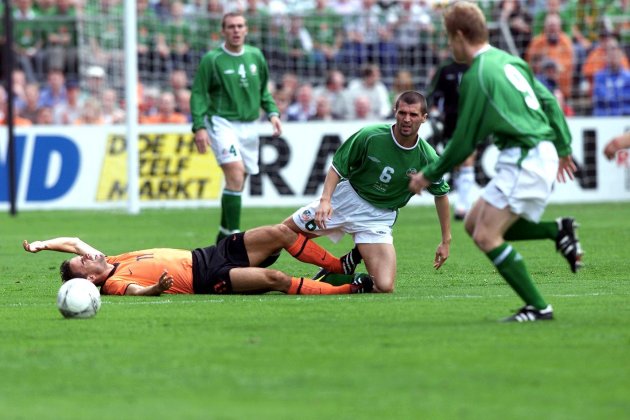 |
| Memorable Keane moment: in the must win 2001 match against Holland Keane 'took care' of Dutch star Marc Overmars in the first minute, setting the tone for an Irish win. {Photo: TheJournal.ie} |
If you follow soccer you probably know Roy Keane is back with the Irish national soccer team, this time as a coach, not a player. Tonight Ireland has its second match under its recently appointed regime with Martin O'Neill as head coach assisted by Keane. It's really Keane, however, who has Irish fans excited – not for what the team will do, but for what he will do.
If you don't know who Roy Keane is, if you never saw him play, well he was something else. Keane was a unique combination of will and anger, skill and thuggishness – a great player who made his teammates better players, but often let them down with his own indiscretions. He was never theatrical, but always dramatic.
He was like Don Mattingly, but without the even temper. He was like Lawrence Taylor, but without the cocaine and convictions. He was like Mark Messier, but without the smile (or tears).
Like Mattingly, Keane always seemed prepared, a professional. Like Taylor, Keane combined talent, will and aggression to become the most feared player in the league. And like Messier, Keane was a captain, a leader and a winner. Just as Messier willed the Rangers to victory in 1994 that was what Keane was like for Manchester United in 1999 when they won the Champions League.
With Ireland Keane played mostly with players who were not the caliber of his Manchester United teammates. Regardless, he played hard and lifted his teammates to higher levels. His greatest achievement with the Irish team was when they qualified for the 2002 World Cup.
Then came Saipan. To most of the world Saipan is a small island in the Pacific, site of a bloody WWII battle. To the Irish Saipan is one of life's great 'If onlys'.
The Irish team arrived in Saipan before the 2002 World Cup full of joy at having qualified, but without the equipment they needed to prepare for the tournament. A “Sure, it'll be grand” attitude ruled. Except with Keane.
Keane arrived without joy, but with a fire in his belly for the tournament ahead. He wanted to win – to win the World Cup. To Keane everyone else was 'just happy to be here.' He couldn't take it and what followed was a slow motion eruption that ended with Keane sent home by the manager, Mick McCarthy.
The people of Ireland were riven between those who backed Keane and those who backed McCarthy. It was a civil war with brother against brother. It was the main story on the nightly news for weeks. Would Keane return to the team or remain 'offside'? People beseeched the government: 'Fix this!'
In the end, Keane stayed home. The team played admirably, but they were eliminated in the second round when they failed to recognize that Spain was playing one man short during extra time – a definite failing of leadership.
Would they have done better with Keane? Undoubtedly. Would they have won the World Cup? Probably not, as the eventual winners, Brazil, looked far superior to every other team. However, given how things played out the Irish team may well have been Brazil's opponent in the final if Keane had been there. 'If only ...'
But it was not meant to be. What we learned then is that the Ireland of 2002 wasn't much different than the Ireland of 1902. Roy Keane, like other difficult geniuses Ireland has produced, could not cope with Ireland nor Ireland with Keane.
Yet, now he's back and the nation is agog. The media is following his every move, dissecting every twitch, seeking meaning in every word. 'How long will it last?' is what everyone wants to know.
For now all is peaceful, but more than any other people the Irish know that this is not how things stay. The plot thickens, the drama intensifies and builds to the climax which, inevitably, ends in tragedy. Then it will be 'Exit Keano – stage left.'
Saturday, November 9, 2013
HSBC survey says Ireland's a terrible place to live if you're an expat
 |
| The International Financial Services Centre in Dublin. One place in Ireland where expats can be found in sizable numbers. |
This marks the first time Ireland has featured in the “Expat Explorer Survey,” now in its seventh year. The views of those expatriates living in Ireland who took part in the HSBC survey must be sending a nervous shudder up the spines of those whose job it is to entice overseas investment to Ireland.
Let's face it: Ireland has done remarkably well attracting FDI (foreign direct investment). Most of that investment comes from America, of course, but HSBC surveyed expatriates from all over the world, living all over the world.
This highlights the greatest issue with this report: HSBC doesn't tell us how they selected the respondents to their survey. How did they find them? How was the survey administered? Are those who took part representative of the expat community that lives in Ireland? How do the views of those who took part in the survey match those of the American business executives whose views would be pretty important to Ireland?
We simply don't know, which makes the survey less useful, but still it cannot be ignored. The Washington Post featured it on the World Views section of their web site. It will probably be picked up elsewhere. And the HSBC imprimatur may not mean much to you, but it may well mean a lot to those executives who are weighing up where to locate their European base.
So what did the report say about Ireland?
Well, nothing good. HSBC broke down the findings into four categories: Expat Economics, Expat Experience, Raising Children Abroad and Expat Expenses. Which ones did Ireland do well in? None.
The first category measured the expats' satisfaction with their earnings and the economy of the host country. Ireland finished 36th out of 37. Only Italy fared worse. Maybe this is to be expected given what has happened to the Irish economy lately, but if this is true then these are not the sort of expats who I would have expected to answer a HSBC survey.
I don't know why HSBC separated out expenses from earnings for the measure of Expat Economics, but Ireland finished 37th out of 37 on this list. Italy jumped up to 34th so we can say with certainty that in terms of standard of living for expats, the HSBC puts Ireland firmly in the bottom: below every other EU country surveyed, below America, Canada and Australia, below Taiwan and Brazil. Heck, Egypt, South Africa, Vietnam and Indonesia were all well above Ireland.
Obviously life for the average person in Egypt, Vietnam and Indonesia is much tougher than for the average person in Ireland. These are the expats' experiences. Still are the expats in Ireland that much different than those in Indonesia? If not, why do they rate Ireland so badly?
Those were the money categories. What about the Expat Experiences and Raising Children Abroad, the so-called “quality of life” factors?
Again, the results are abysmal. Childcare is expensive and overall, expat parents see Ireland as pretty poor for children in terms of education, health and experience. There were only 24 countries in the 'raising children' comparison. Ireland was 23rd, above Qatar, but below Saudi Arabia, Turkey and Mexico.
Then there's Expat Experience: quality of life, ease of setting up and integrating into the local culture. This was where Ireland fared best. Well, least badly. Ireland was ranked 30th of the 37 countries. However, of the seven states listed below Ireland only one could be called “western” - the Netherlands. The others are Indonesia, Vietnam, Kuwait, Oman, Egypt and Saudi Arabia.
Again, it doesn't seem a scientifically credible survey, but that may not matter. HSBC is a trusted source for many and the Washington Post for many more. With this sort of thing reality matters far less than perception and the perception is Ireland's not that great a place to live.
That's the sort of perception that absolutely cannot be allowed to take root in the boardrooms of corporate America, particularly in the IT and biotech firms that the Industrial Development Authority (IDA) has been successfully targeting for many years. It wouldn't be a bad idea for the IDA to begin working on a counter strategy.
The IDA is probably longing for last six years when Ireland was simply ignored by HSBC. Then it was a case of 'no news is good news.'
Thursday, October 24, 2013
Only the soon-to-be-extinguished bonfire left of Ireland's Halloween traditions
 |
| Irish Halloween bonfire - note the wooden pallets, always a favorite with kids at this time of year. {Photo: thanks to Independent.ie} |
It's Halloween season in America and I do mean season. The day I remember as a kid has exploded into a massive season of Halloween-themed celebration.
Where I grew up - north of Albany, NY - Houses are decorated as if it's Christmas and those decorations are up for a month. I guess the cardboard pumpkins on the windows and skeleton on the front door, taped up on the 29th of October, are insufficient to meet the modern American family's need to express its enthusiasm for Halloween.
There are also 'haunted hayrides' and, apparently, every kid has to visit a pumpkin patch these days.
Then there are the stores. They are overflowing with candy, store-bought costumes (adult as well as children sizes), decorations, greeting cards - who sends a Halloween card? - and, of course, pumpkins. Every fast food joint has a pumpkin flavored something or other. Pumpkin coffee? Eh, no thanks.
The thing is, none of this is in the least bit surprising. That people are putting up lights and inflatable vampires is a harmless, if overdone, effort to make things bright and fun for kids. I do wonder if the over-supervised kids of today have anywhere near the fun we had, but these things are hard to gauge.
Slightly more surprising is that it's nearly exactly the same in Ireland. It wasn't always like that. It wasn't even vaguely like that.
When I first arrived in Ireland Halloween was barely a blip. Young kids got dressed up - in whatever their mothers could find in the house - and went to a few doors asking "Any apples or nuts?" That's what they got too. Apples and nuts.
There was no candy. There were no store-bought costumes. There were no decorations. There were no pumpkins.
That's all gone now. In 20 years the American Halloween has become Ireland's Halloween. Kids go door-to-door in store-bought costumes, ringing doorbells on decorated houses, declaring (more than asking) "Trick or treat!" all in the expectation of romping home with bags full of candy. The kids are older too - often 12+. (Substituting candy for apples probably explains that.)
And there are pumpkins. Everywhere. You can get them in the supermarket and your coffee!
 |
| One of the better suburban Halloween scenes. |
Yup, Ireland's Halloween is just about indistinguishable from America's except for one last vestige of the old customs - the bonfire.
The bonfire on Halloween in Ireland is an ancient tradition, but the bonfire isn't so much dying out as being snuffed out. The fire authorities are doing all they can to discourage the continuation of this tradition and I don't really blame them.
Kids gather up all sorts of junk - wooden pallets are a particular favorite - for weeks in advance of Halloween. Old mattresses and even car tires are added to the giant piles. I'm sure that in the past the bonfires were much smaller simply because people threw away so much less, but these days they're huge and dangerous.
On the October 21 Dublin City Council announced that they had seized over 500 tons of pallets, tires and other junk destined for bonfires. That's ten days before Halloween and that's only what they've found. What's not found is probably far greater because kids are on to the adults. They gather and hide this stuff as if it's gold dust, waiting for Halloween night to pile it up and light it on fire.
Of course it isn't just the fire authorities who worry about these bonfires. In my neighborhood parents keep a watchful eye for any hint of a bonfire. None of us wants them, even those who grew up with the tradition. They all seem to accept that today's bonfires are just out of hand. Nobody wants to be downwind of burning tires or mattresses.
I'm with them. I want to see the bonfire disappear. It's against my nature, but I'm with the forces of modernity and keen to see this ancient practice vanish.
** Traditional Irish Halloween foods such as the Barm Brack and Colcannon haven't gone away. Fortunately.
Subscribe to:
Posts (Atom)